
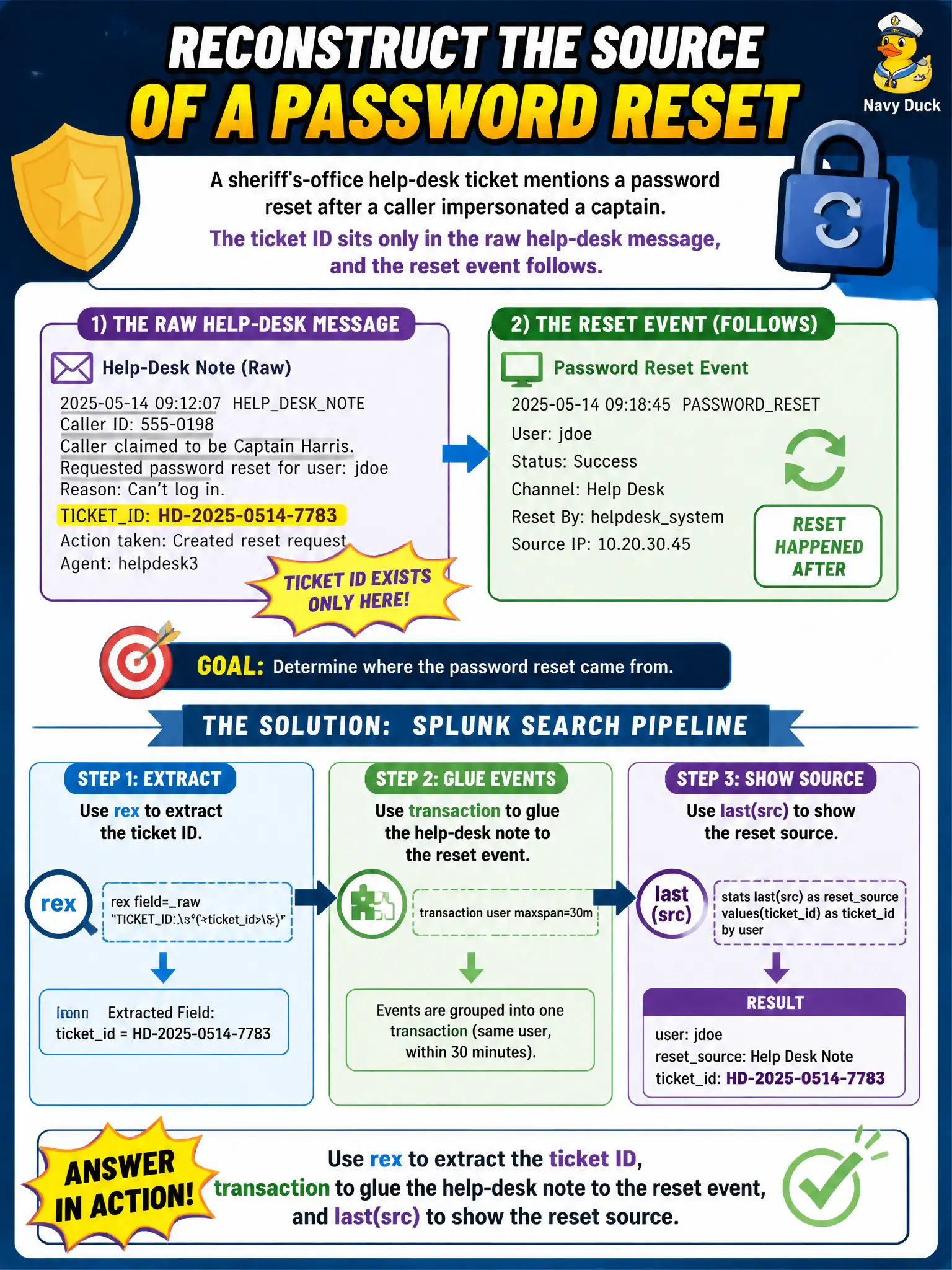
A sheriff's-office help-desk ticket mentions a password reset after a caller impersonated a captain. The ticket ID sits only in the raw help-desk message, and the reset event follows. How should the analyst reconstruct where the reset came from?
Select an answer to reveal the explanation.
Short Explanation
The ticket number is buried in the help-desk sentence — rex pulls it out. transaction then clips that note to the later password reset, and last(src) answers the civic question: where did the reset come from after the fake captain called.
Full Explanation
Reconstructing a sheriff's-office social-engineering password reset requires chaining commands to the evidence that actually exists: rex extracts the ticket ID buried only in raw help-desk text, transaction groups that ticket with the subsequent reset event, and last(src) returns the most recent reset source for the civic investigation. That pattern turns a narrative ticket plus an authentication event into a single story answering where the reset came from after the impersonated captain call. tstats alone cannot invent a help-desk ticket field the Authentication or other accelerated models do not contain. makeresults fabricates a source without reading help-desk or auth logs, so it cannot reconstruct the real path. foreach across notable fields does not join two datasets or extract buried ticket IDs from free-text messages. Exam caveat: transaction still needs a shared key and a sensible maxspan or maxpause so unrelated resets are not glued to the wrong help-desk ticket. Operational check: rex the ticket ID from a sample help-desk message, transaction to the matching reset, verify last(src) matches the suspected caller path, and save the SPL as a repeatable step for similar civic social-engineering resets.