
The elections office wants failed logons on high-priority voter-file hosts investigated first. Which SPL sequence best prioritizes that hunt?
Select an answer to reveal the explanation.
Short Explanation
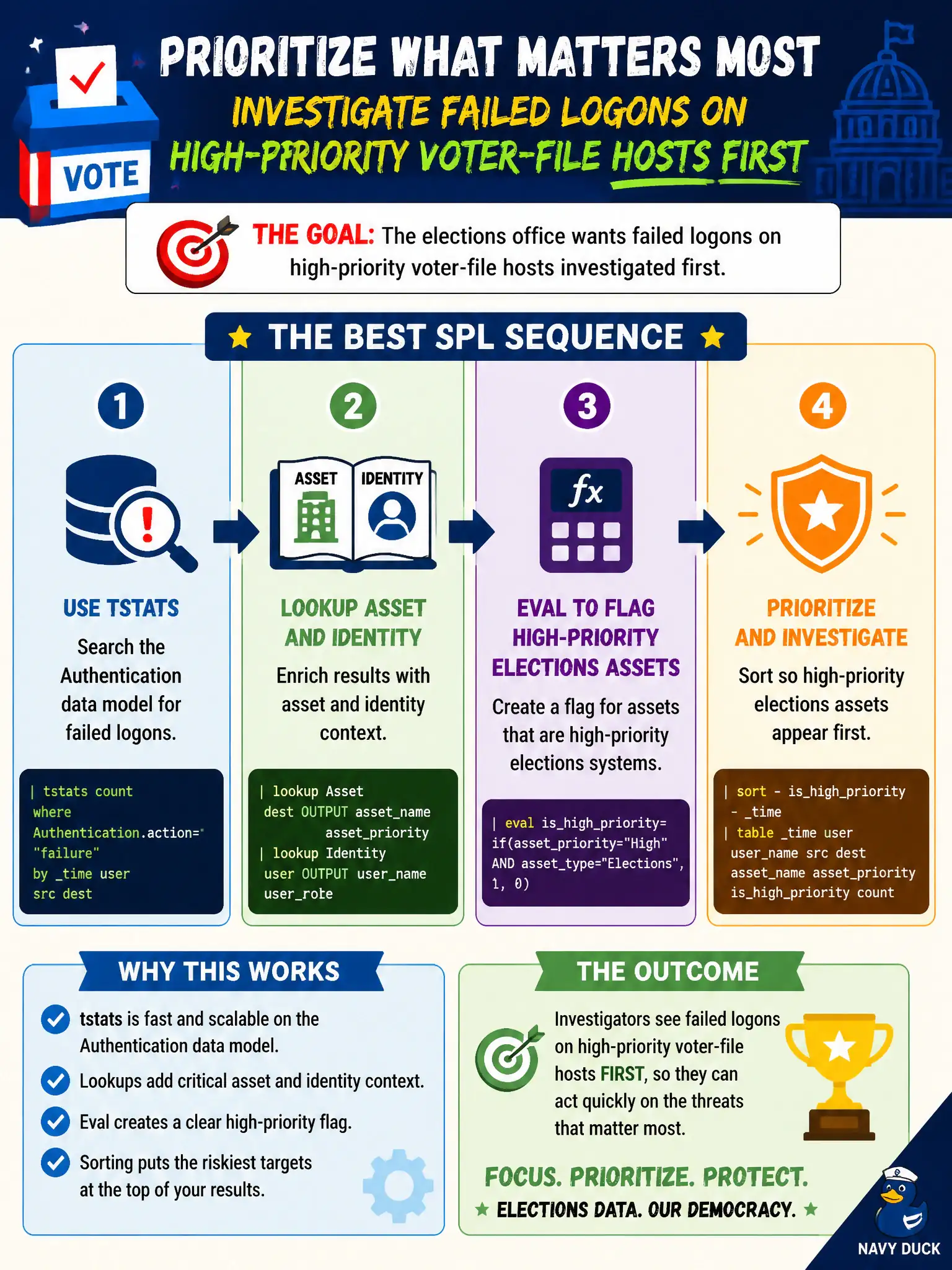
Count the failures on the fast road (tstats), stamp on who owns the box (lookup), then raise a flag for high-priority elections gear (eval). That is how voter-file hosts jump to the front of the queue instead of drowning in a week of raw city logs.
Full Explanation
Prioritizing elections failed-logon work combines named SPL jobs: tstats aggregates failures from an accelerated Authentication data model, lookup attaches Asset and Identity context such as priority and business unit, and eval flags high-priority voter-file hosts so those assets surface first. That sequence uses summaries for volume, civic inventory for criticality, and a calculated flag for queue order—exactly what an elections office needs when not every failure is equal. makeresults invents failures instead of recovering real authentication telemetry and cannot prioritize genuine voter-file risk. A week-long transaction across all city indexes is an efficiency anti-pattern and still leaves manual sorting for elections hosts. foreach on _raw is not how civic asset ranking works; repeating regex does not replace Asset and Identity priority fields. Exam caveat: tstats only helps when the Authentication model is healthy and accelerated and failures are mapped into the expected CIM fields. Operational check: run tstats for failed logons in a short window, lookup Asset and Identity, eval the high-priority elections flag, and confirm known voter-file hosts sort above low-priority failures before handing the hunt to the on-call analyst.