
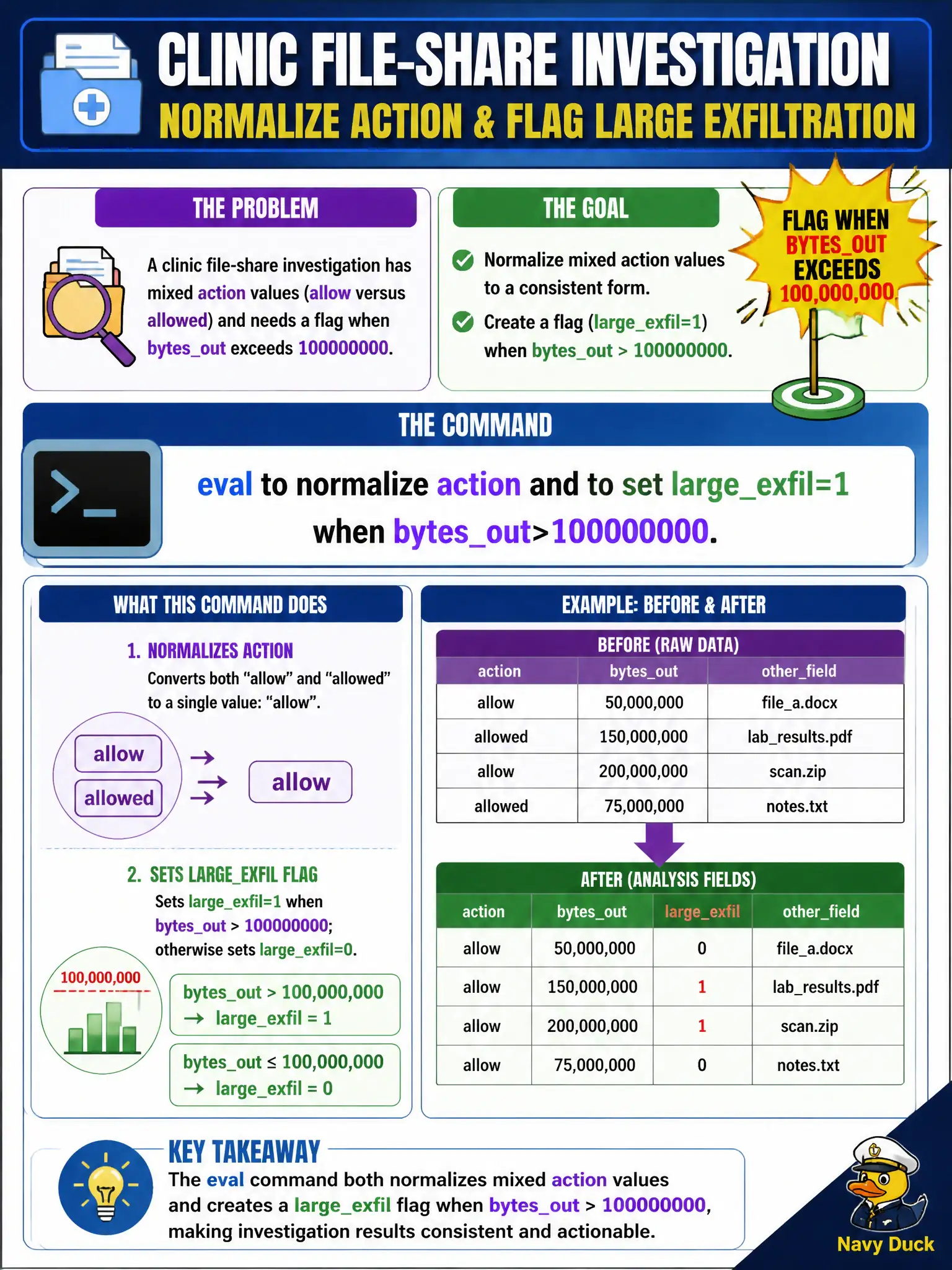
A clinic file-share investigation has mixed action values (allow versus allowed) and needs a flag when bytes_out exceeds 100000000. Which command calculates those analysis fields?
Select an answer to reveal the explanation.
Short Explanation
eval is the pocket calculator and the spelling fixer. Make allow and allowed the same word, then flip large_exfil when the clinic share ships a giant pile of bytes. That is analysis math, not a new index.
Full Explanation
In Splunk Enterprise Security for a municipal SOC, eval creates or normalizes fields during search—including unifying vendor action strings such as allow versus allowed and computing flags such as large_exfil when bytes_out exceeds 100000000. Those calculated fields then drive filters and stats in a clinic file-share investigation without rewriting indexes. Claiming tstats summariesonly rewrites vendor action strings automatically fails by concept because tstats reads summaries; it does not normalize inconsistent vendor action vocabulary. Claiming transaction maxpause=0 normalizes CIM fields as a side effect fails by concept because transaction groups events by time and keys; it does not standardize action values or compute exfil flags. Using makeresults to overwrite the clinic events with synthetic allow rows fails by concept because synthetic overwrites destroy evidence and invent outcomes. Exam caveat: SPLK-5001 names eval for security-analysis field calculation and normalization on civic event streams. Operational check: eval a normalized action field that maps allow/allowed to one value, eval large_exfil=1 when bytes_out>100000000 on the clinic share events, filter and stats on those fields for the case, and document thresholds used for the healthcare privacy briefing.