
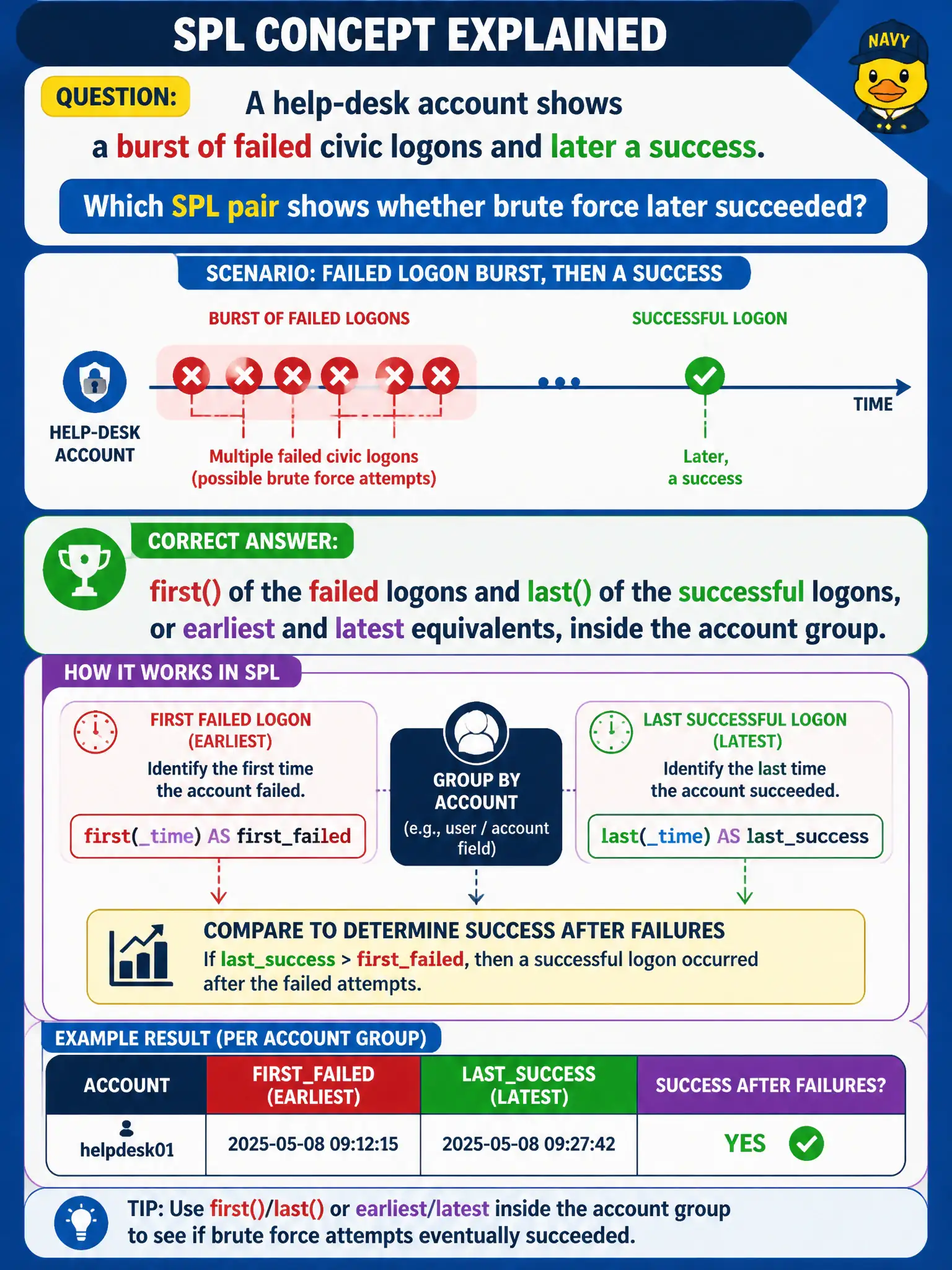
A help-desk account shows a burst of failed civic logons and later a success. Which SPL pair shows whether brute force later succeeded?
Select an answer to reveal the explanation.
Short Explanation
Line the help-desk logons up like tickets at a window. The first failure and the last success tell whether the pounding eventually opened the door. That is first() and last(), not a guess.
Full Explanation
In Splunk Enterprise Security for a municipal SOC, first() and last()—or earliest and latest equivalents—return ordered values inside a grouped set of events so analysts can compare the beginning and end of a civic brute-force path. On a help-desk account that shows a burst of failed logons and later a success, first() of the failures and last() of the successes (or earliest/latest) show whether pounding eventually opened the door. Using rex only, because field extraction proves the success without ordering events, fails by concept because extraction creates fields; it does not establish intra-group chronological order of fail then succeed. Using makeresults to create a synthetic success row if any failure exists fails by concept because inventing success invents compromise and destroys investigative integrity. Using foreach across unused CIM ports to infer success from destination count fails by concept because port iteration is unrelated to ordered authentication outcomes. Exam caveat: SPLK-5001 names first()/last() (and earliest/latest) for security analysis that depends on order inside an account group. Operational check: group Authentication events by the help-desk account, compute first/earliest failed and last/latest successful logon times, confirm success is after the failure burst before declaring compromise, and escalate credential reset and session review for that civic account if the sequence holds.