
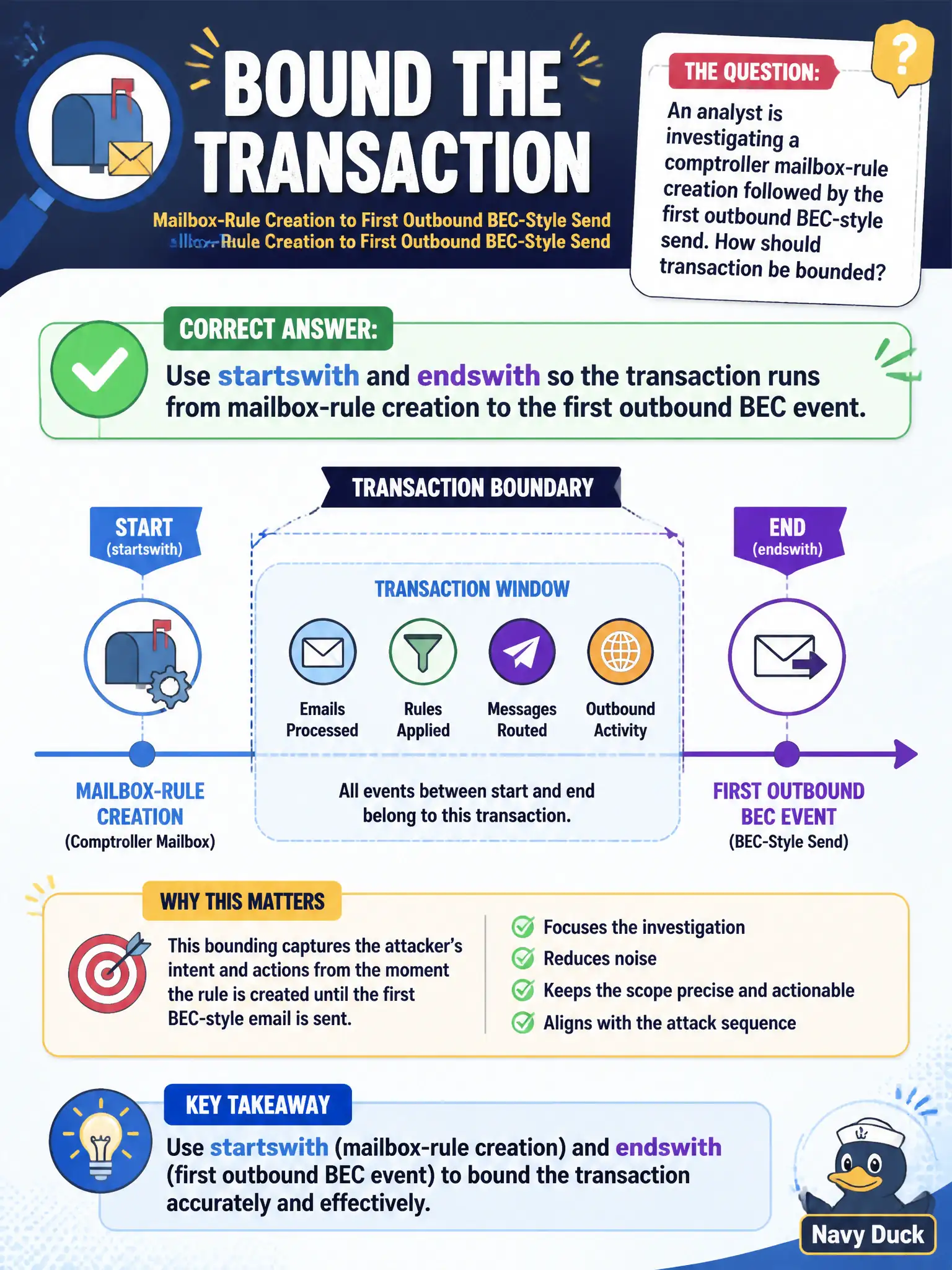
An analyst is investigating a comptroller mailbox-rule creation followed by the first outbound BEC-style send. How should transaction be bounded?
Select an answer to reveal the explanation.
Short Explanation
The story starts when the mailbox rule appears and ends at the first shady outbound. startswith and endswith put those bookends on the transaction. An unbounded 90-day blob is not an investigation.
Full Explanation
In Splunk Enterprise Security for a municipal SOC, transaction supports startswith and endswith conditions that bound the grouped session to a meaningful investigative window rather than an unbounded blob. For a comptroller mailbox-rule creation followed by the first outbound BEC-style send, startswith and endswith run the transaction from rule creation to that first outbound event so the civic BEC path is readable. Leaving transaction unbounded so every comptroller event for 90 days becomes one session fails by concept because a quarter-long mega-session buries the attack path in unrelated finance activity. Using tstats summariesonly instead, because start and end conditions only exist on data models, fails by concept because startswith/endswith are transaction features, not data-model-only controls, and tstats does not replace those bounds. Dropping user from the grouping so start and end can match any civic mailbox fails by concept because losing the grouping key mixes unrelated mailboxes into a false session. Exam caveat: SPLK-5001 expects bounded transaction with startswith/endswith for multi-stage civic investigations such as BEC, not unbounded or mis-grouped sessions. Operational check: set transaction grouped by user (or mailbox) with startswith on mailbox-rule creation and endswith on the first suspicious outbound, verify the session length matches the incident narrative, and attach the bounded session to the comptroller case before containment decisions.