
A county SOC is adding a correlation search for a weak civic signal: a treasurer VPN from a rare city. Leadership wants fewer single-signal pages to on-call. How should that search's adaptive responses be designed?
Select an answer to reveal the explanation.
Short Explanation
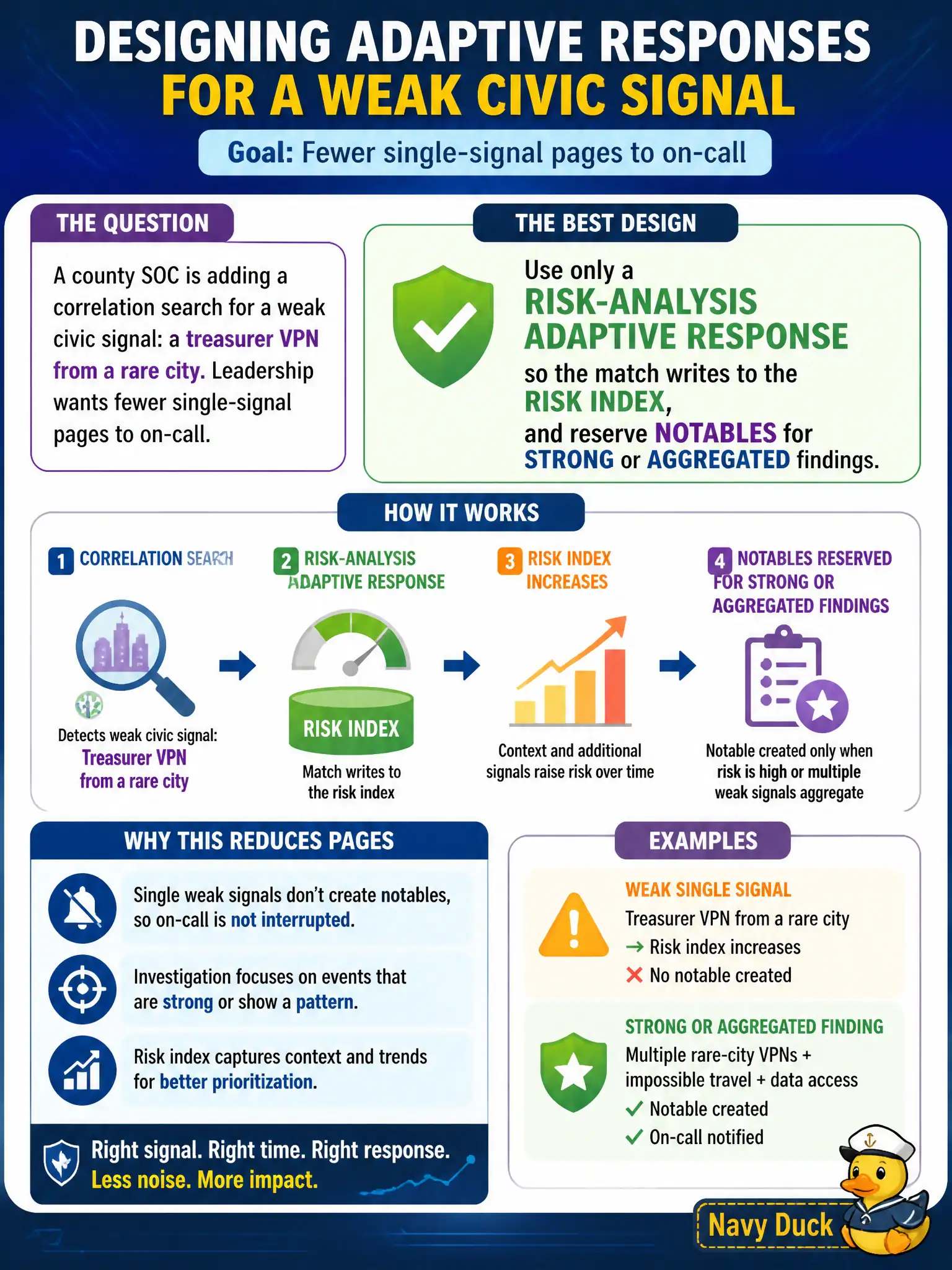
A single rare-city VPN is a faint smoke smell, not a fire alarm. Risk analysis drops a chip on the treasurer's pile; a notable is the bell that should wait until the pile is actually tall. One weak civic ping should feed the risk index, not page the night shift.
Full Explanation
In Splunk Enterprise Security for a municipal SOC, Risk-Based Alerting treats a single weak civic signal—such as a treasurer VPN from a rare city—as a contributing event rather than an immediate Incident Review ticket. Designing that correlation search with only a risk-analysis adaptive response writes the match to the risk index against the treasurer as a risk object, so on-call pages stay reserved for strong detections or aggregated risk notables after score crosses threshold. Creating a notable on every rare-city VPN match fails by concept because it recreates the one-alert-per-signal queue RBA is meant to shrink and trains leadership to ignore pages. Disabling the correlation search and asking the treasurer to self-report unusual travel fails by concept because human email is lagging, incomplete, and not continuous telemetry on indexed VPN events. Forwarding every rare-city VPN syslog line to a new custom index for hand query fails by concept because it abandons ES adaptive responses and risk aggregation for a siloed hunt pile. Exam caveat: SPLK-5001 expects defense analysts to request risk-as-action for low-fidelity civic signals and to keep notables for high-fidelity or aggregated findings, not to invent side indexes or self-report workflows. Operational check: open the correlation search’s adaptive responses, confirm Risk Analysis is the action for the rare-city VPN rule, verify risk events appear on the treasurer risk object without a new notable per match, and show leadership that Incident Review volume dropped while contributing evidence still accumulates.