
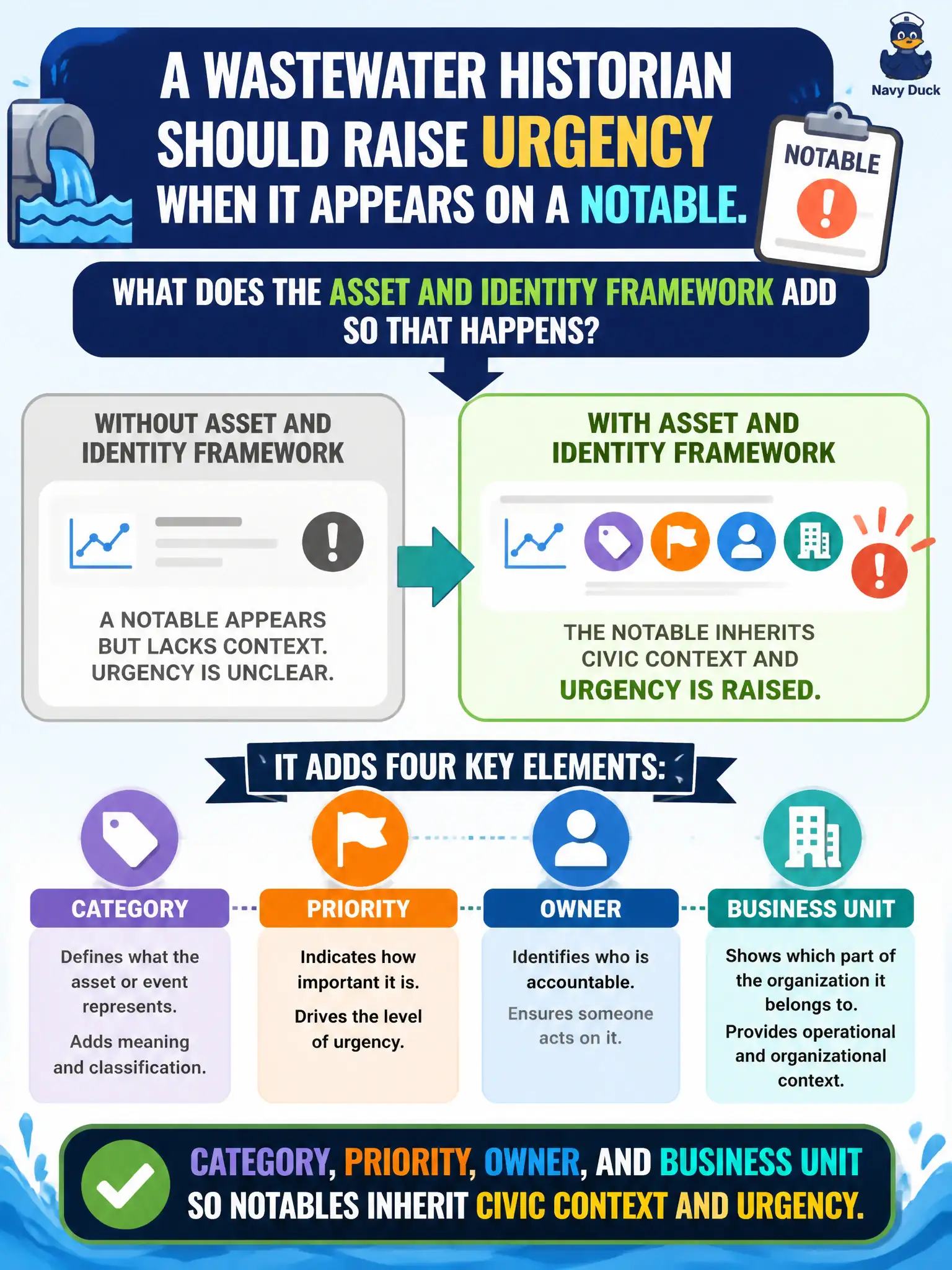
A wastewater historian should raise urgency when it appears on a notable. What does the Asset and Identity framework add so that happens?
Select an answer to reveal the explanation.
Short Explanation
Asset and Identity is the plant directory taped to the historian: category, priority, owner, business unit. When those are filled in, notables inherit how urgent the civic asset is. It is not a CIM TA and it is not a cluster plan.
Full Explanation
Asset and Identity adds civic business context—category, priority, owner, and business unit—so when a wastewater historian appears on a notable, urgency and ownership inherit from the asset record. That framework turns a bare hostname into an operationally meaningful OT asset for triage, paging, and escalation to the utilities owner. It does not replace CIM mapping on the historian sourcetype, author correlation searches through SOAR, or redesign indexer licensing pools.
Treating Asset and Identity as a replacement for CIM field mapping fails by layer—CIM normalizes event fields; Asset and Identity enriches assets and identities after those fields exist. Calling it a SOAR playbook that authors new correlation searches confuses the identity framework with orchestration and content authoring. Calling it an indexer clustering plan that stores OT in a separate license pool confuses infrastructure licensing with asset urgency metadata displayed on notables.
Exam caveat: Asset and Identity means context, urgency, and ownership on notables—not CIM substitution, not SOAR, not clustering.
Operational check: ensure the historian is in the asset lookup with high priority, an OT category, and a named owner; generate a test notable; and verify urgency and owner populate on Incident Review before declaring the framework healthy.