
Elections staff ask how Splunk incorporates MITRE ATT&CK in day-to-day SOC work rather than in a one-time slide. What is the operational answer?
Select an answer to reveal the explanation.
Short Explanation
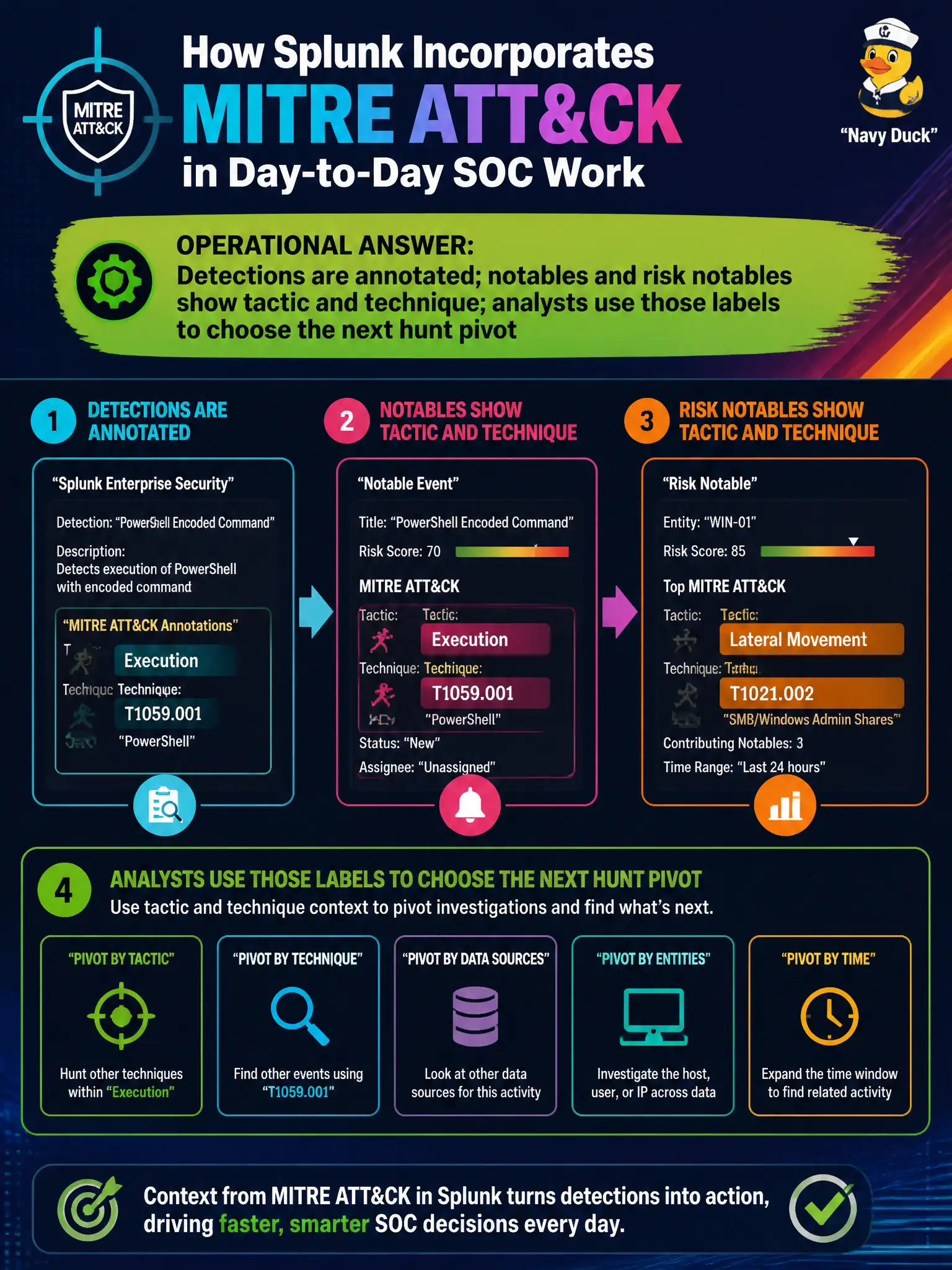
Day-to-day ATT&CK is a label on the ticket, not a slide from last year's offsite. Annotated detections stamp tactic and technique on notables and risk notables so the next pivot is obvious. It is not clustering config and it does not auto-close the queue.
Full Explanation
Elections staff asking how Splunk incorporates MITRE ATT&CK in day-to-day SOC work should hear that detections are annotated, notables and risk notables show tactic and technique, and analysts use those labels to choose the next hunt pivot. Day-to-day ATT&CK is operational metadata stamped on civic tickets, not a one-time board slide from last year's offsite. That keeps election-season hunting tied to a shared technique language Analysts can act on during the shift.
Treating ATT&CK as a one-time slide unused afterward fails by concept: the blueprint emphasizes ongoing annotated detections in live workflow. Claiming Analysts rewrite ATT&CK techniques into indexer clustering rules fails by concept: clustering is infrastructure configuration, not ATT&CK operations. Claiming ATT&CK is imported as a lookup that auto-closes every notable fails by concept: annotations inform pivots; they do not auto-close the queue.
Exam caveat: Operational ATT&CK in ES = annotate → display on notables/risk → pivot; not slides-only, not clustering config, not auto-close lookups.
Operational check: During elections readiness, sample notables for ATT&CK labels, require Analysts to record the next pivot suggested by the technique, and escalate unlabeled high-value detections back to Engineers for annotation.