
Seasonal parks staff quit or no-show during week one even though orientation attendance looks fine. How should the CHRO evaluate and redesign onboarding?
Select an answer to reveal the explanation.
Short Explanation
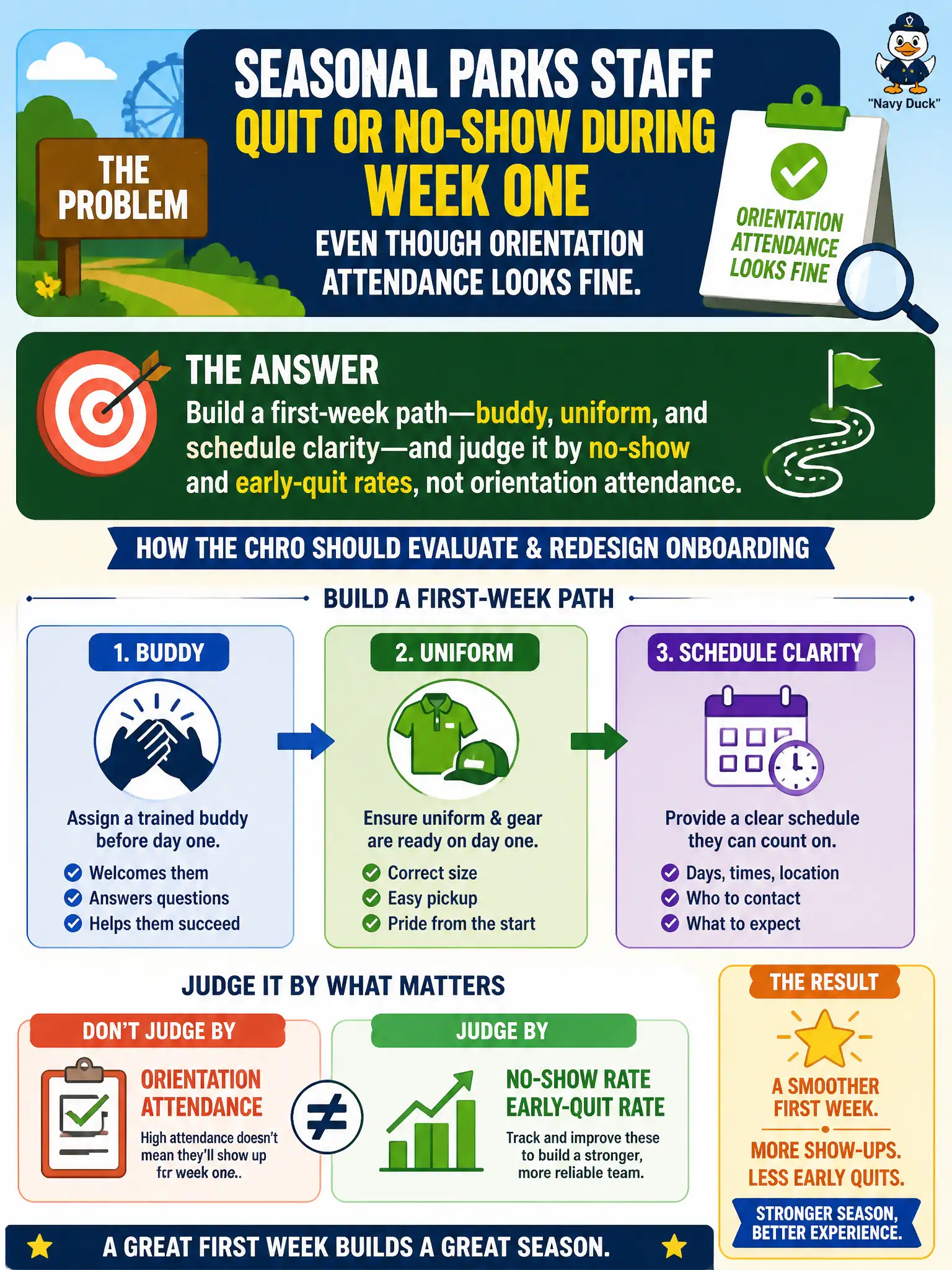
Showing up for the slideshow and then vanishing from the ballfield is a first-week design fail, not a mystery. Give them a buddy, a shirt that fits, and a real schedule—and score the program on who is still there Friday.
Full Explanation
Seasonal parks staff who quit or no-show in week one despite orientation attendance reveal a first-week design failure. The CHRO should build a first-week path—buddy, uniform, and schedule clarity—and judge onboarding by no-show and early-quit rates, not by orientation sign-in sheets. Showing up for the slideshow and vanishing from the ballfield means the program measured the wrong thing and failed to make the job real, equipped, and scheduled.
Counting orientation attendance as success and leaving week one unchanged preserves the failure mode. Eliminating first-week contact so seasonal staff 'sink or swim faster' increases early exits. Converting every seasonal job to year-round full-time so onboarding quality 'no longer matters' is an unaffordable non sequitur.
Exam caveat: first-week path design still sits inside seasonal budget and classification reality; buddies need time and training, not just a label. The concept is outcome-based onboarding evaluation for high-churn seasonal work.
Operational check: assign trained buddies with scheduled check-ins; issue fitted uniforms before first shift; publish week-one schedules at offer or orientation; track no-show and 7-day quit rates by park; and redesign any site whose early-loss rate exceeds the threshold.