
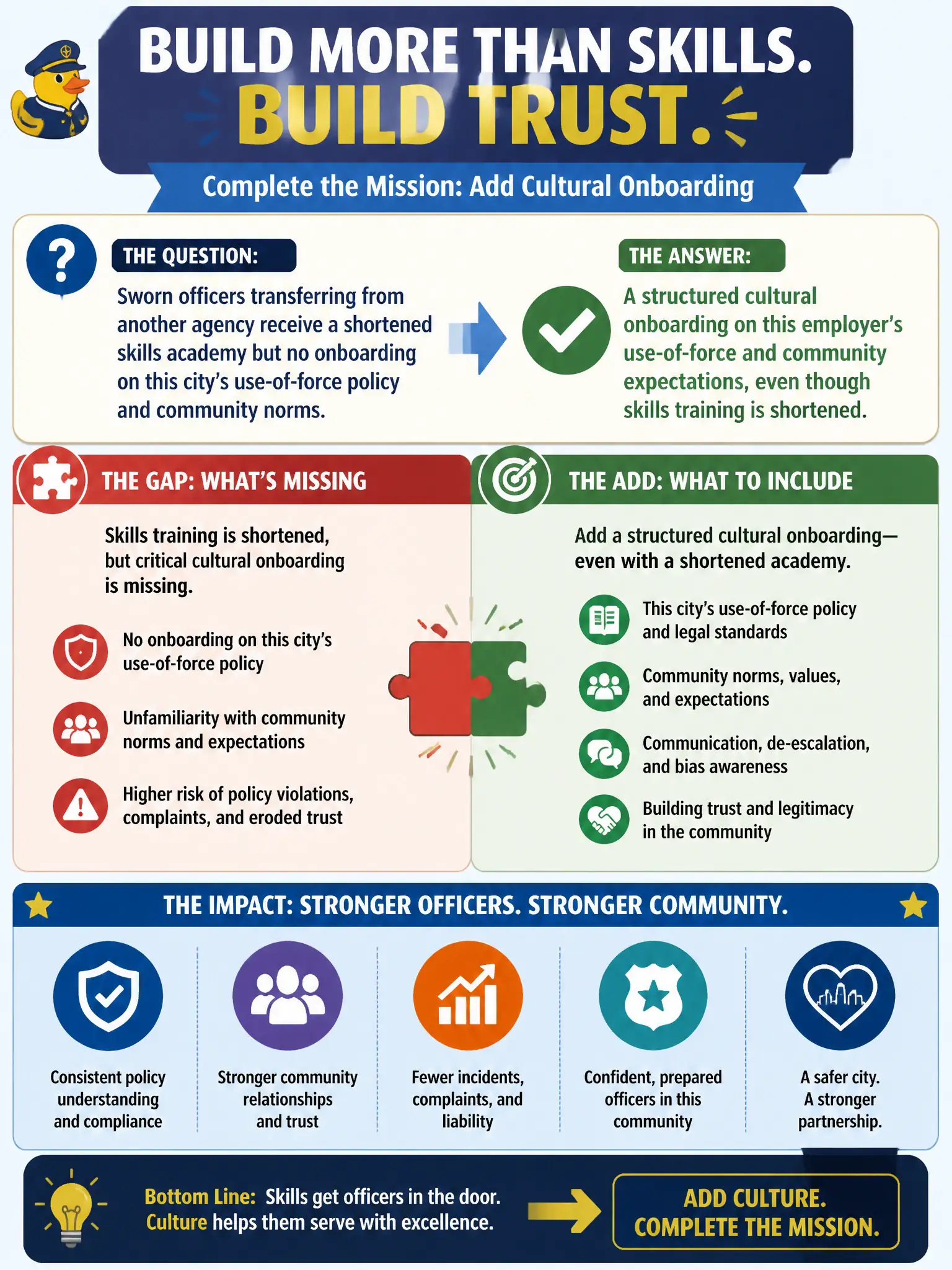
Sworn officers transferring from another agency receive a shortened skills academy but no onboarding on this city's use-of-force policy and community norms. What should the CHRO add?
Select an answer to reveal the explanation.
Short Explanation
A lateral officer is not a USB drive you plug into a new city. The badge transferred; the "how we police here" did not—teach this city's rules, not just the driving course.
Full Explanation
Lateral sworn officers who receive a shortened skills academy still need structured cultural onboarding on this city's use-of-force policy and community expectations. A badge transfer is not a USB-stick culture transfer; how this employer polices—force policy, de-escalation expectations, complaint handling, and community norms—must be taught even when driving and firearms skills are abbreviated. Skipping that onboarding treats laterals as plug-and-play and exports another agency's culture into this city's streets.
Doing nothing because laterals already have a badge assumes culture travels with the credential. Running a second full recruit academy for every lateral may be unnecessary if skills are truly equivalent, and it is not the only way to teach local policy culture. Providing only a benefits election packet leaves policy culture as 'the chief's problem' and abandons HR's onboarding design duty.
Exam caveat: cultural onboarding does not replace required POST or state certifications; it complements shortened skills paths with employer-specific standards. The concept is local policy and community-norm integration for laterals.
Operational check: build a lateral onboarding module on use-of-force, stop-and-frisk or equivalent local policy, complaint processes, and community expectations; require attested completion before solo duty; pair laterals with field training officers briefed on culture goals; and audit early complaint or force indicators for lateral cohorts.