
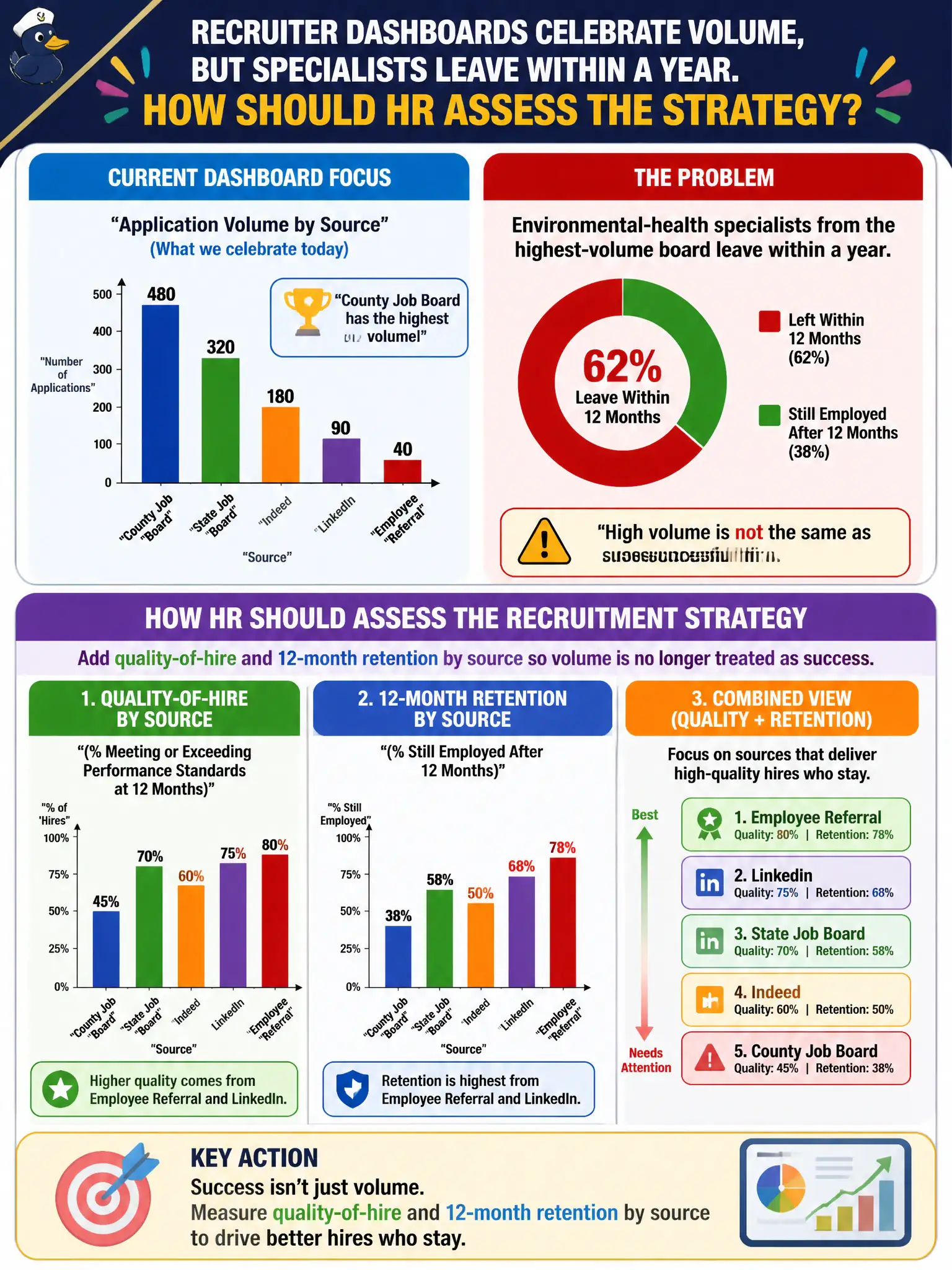
Recruiter dashboards for a county health department celebrate application volume by source, yet environmental-health specialists from the highest-volume board leave within a year. How should HR assess the recruitment strategy?
Select an answer to reveal the explanation.
Short Explanation
Counting applications is like counting shoppers who walked past the window and calling it sales. The strategy works only if the people you hire stay and perform—so score sources on quality and first-year retention, not traffic.
Full Explanation
Recruiter dashboards that celebrate application volume by source misread success when the highest-volume board produces environmental-health specialists who leave within a year. HR should add quality-of-hire and 12-month retention by source so volume is no longer treated as victory. Counting shoppers who walked past the window is not sales; a source works only if hires stay, become productive, and protect the public-health caseload the county hired them to carry.
Raising the application-volume target so the department can absorb expected first-year attrition industrializes failure and normalizes churn. Dropping every source except the highest-volume board because reach is 'all that matters' doubles down on the wrong metric. Replacing source reporting with time-to-fill only ignores whether fast hires stick and perform.
Exam caveat: quality and retention metrics must be defined consistently and should not be used to punish hiring managers for systemic onboarding or compensation failures outside recruiting's control. The concept is multi-metric source evaluation beyond traffic counts.
Operational check: add 90-day performance and 12-month retention by source to the dashboard; weight spend toward sources with durable yield; redesign or exit the high-volume/high-churn board; and review results quarterly with hiring managers, finance, and the health director.