
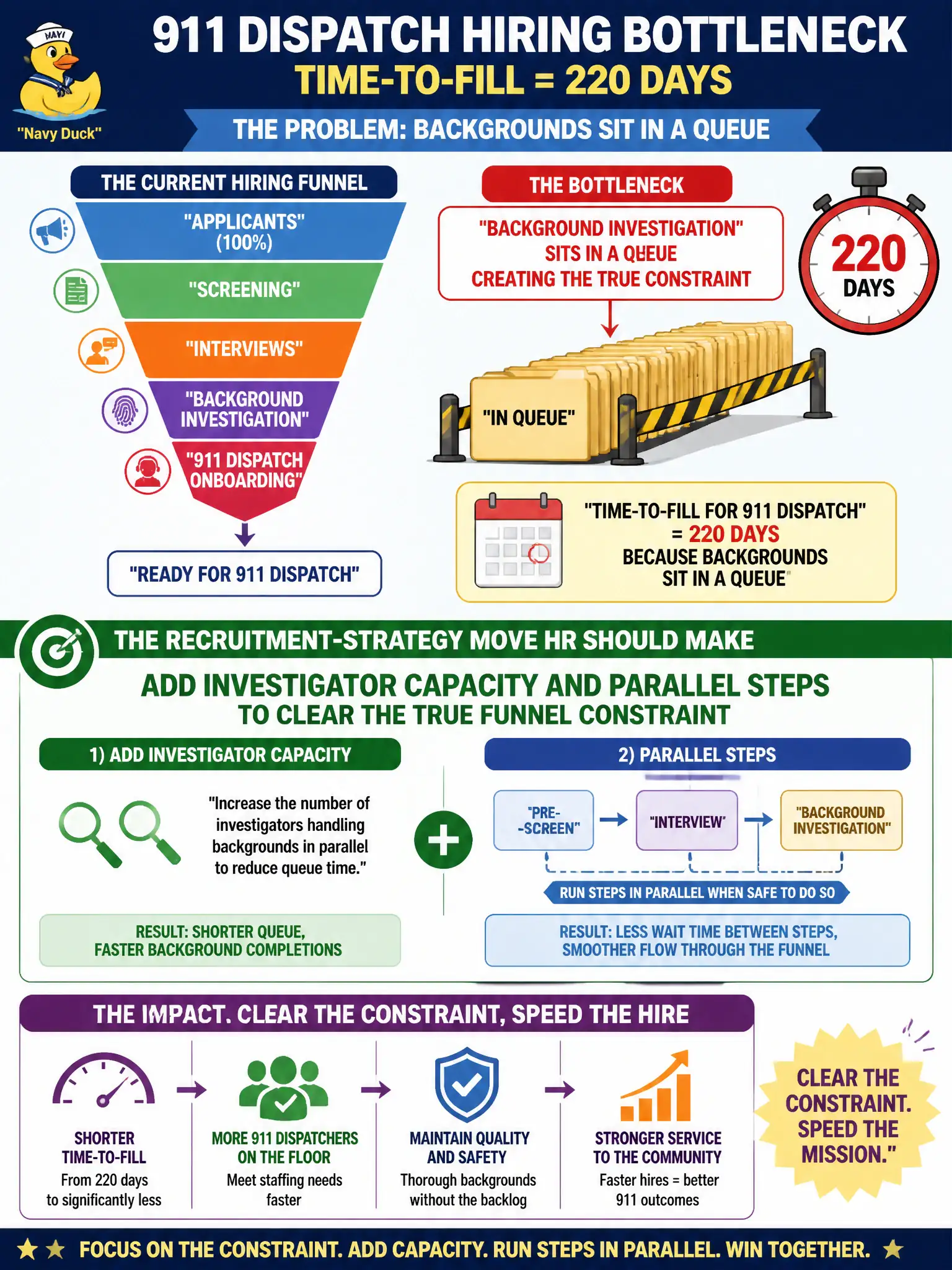
Time-to-fill for 911 dispatch is 220 days because backgrounds sit in a queue. What recruitment-strategy move should HR make?
Select an answer to reveal the explanation.
Short Explanation
If files die on an investigator's desk, more career-fair banners just grow the pile. The constraint is process capacity. Staff the background shop and run steps in parallel so 220 days is not the product.
Full Explanation
When time-to-fill for 911 dispatch hits 220 days because backgrounds sit in a queue, the recruitment-strategy move is to add investigator capacity and parallel steps that clear the true funnel constraint. Career-fair banners and social boosting grow the pile in front of a clogged background shop; they do not move files to clearance. Process capacity is the product when the binding constraint is investigative throughput, and SPHR recruiting strategy attacks constraints rather than decorating them.
Buying more banners and boosting increases volume into the bottleneck and can worsen candidate experience as people wait months. Lowering the background standard so more files close each week trades public-safety integrity and community trust for artificial speed. Closing the posting every quarter to reset the time-to-fill clock is metric gamesmanship that hides backlog rather than hiring dispatchers.
Exam caveat: adding investigator capacity and parallelizing steps must preserve lawful, thorough backgrounds—not rubber-stamp clearances to hit a dashboard number. Some steps cannot run in parallel for legal or practical reasons; counsel and the background unit should design the sequence. The concept is attacking the binding constraint in the selection funnel.
Operational check: map the dispatch funnel and measure aging in background; fund investigator FTE or vetted vendor capacity; run medical or other steps in parallel where law allows; set aging SLAs with weekly backlog reports to the CHRO and police/911 leadership; and keep reporting time-in-stage until 220 days is no longer treated as normal.