
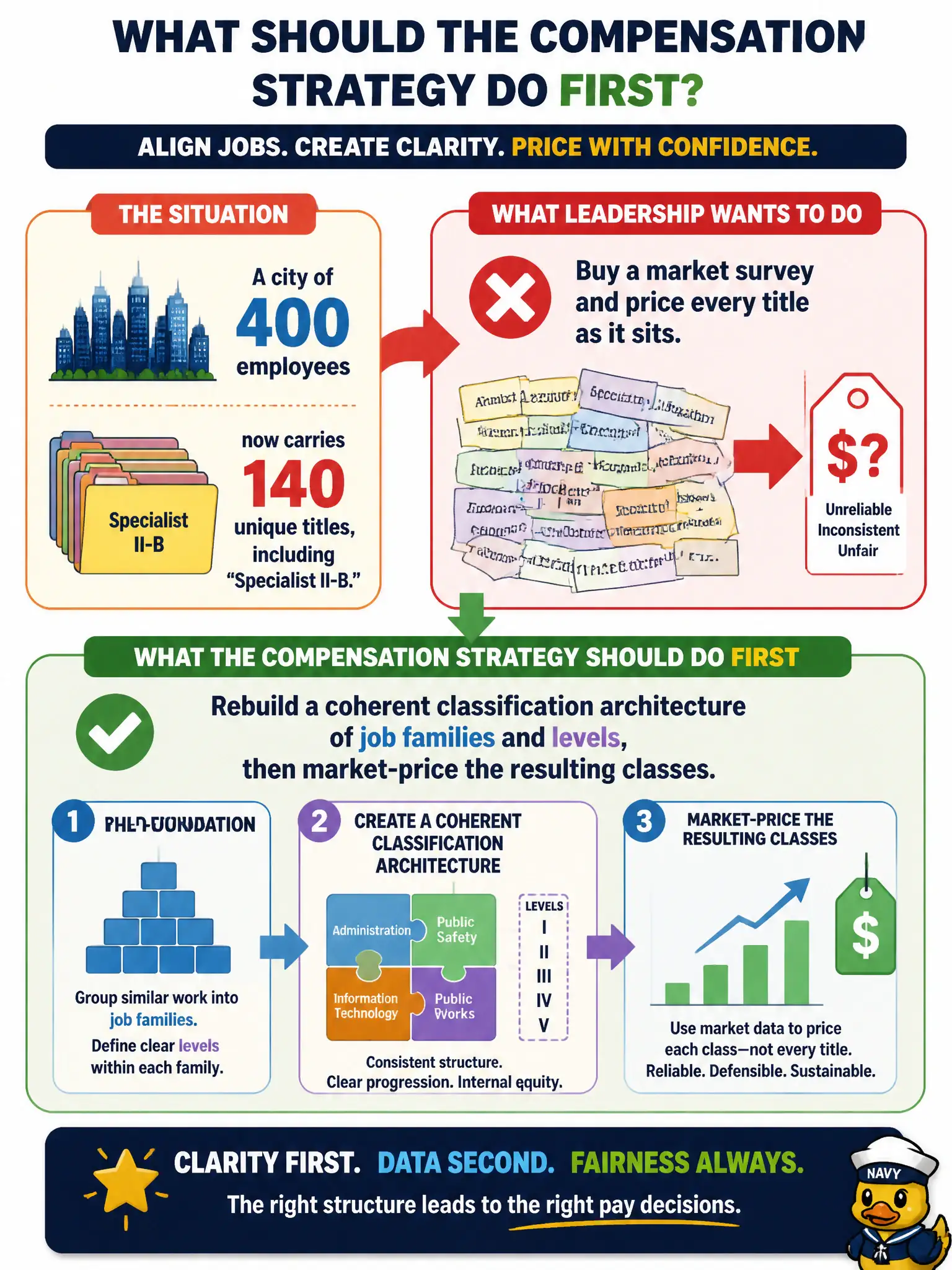
A city of 400 employees now carries 140 unique titles, including "Specialist II-B." Leadership wants to buy a market survey and price every title as it sits. What should the compensation strategy do first?
Select an answer to reveal the explanation.
Short Explanation
Pricing 140 mystery titles is like tagging every box in the attic without deciding what the rooms are. Classification is the floor plan; market data is the furniture. Build the architecture first or the survey just baptizes the mess.
Full Explanation
Compensation strategy depends on classification architecture before market pricing. With roughly 140 unique titles in a mid-size city workforce, pricing every snowflake as it sits preserves like-work inequity and produces unreliable survey matches. Rebuilding coherent job families and levels first, then market-pricing the resulting classes, is the sequence that makes survey data usable and restores internal equity language council can understand.
Pricing every unique title independently fails because it treats title inflation as structure and multiplies match noise instead of grouping comparable work. Collapsing every title into one municipal-specialist band oversimplifies and destroys legitimate level differentiation that markets and careers require. Freezing titles and granting an across-the-board percentage postpones architecture work and spends money without fixing the classification defect that made the survey hard.
Exam caveat: architecture rebuild may trigger bargaining duties over job descriptions and differentials; sequence the study with labor notice while still refusing to market-price chaos. Operational check: before buying deep survey cuts for every odd title, publish a draft family-and-level map covering a majority of incumbents and confirm HR and department heads can match at least a pilot set of jobs to survey benchmarks under the new classes.