
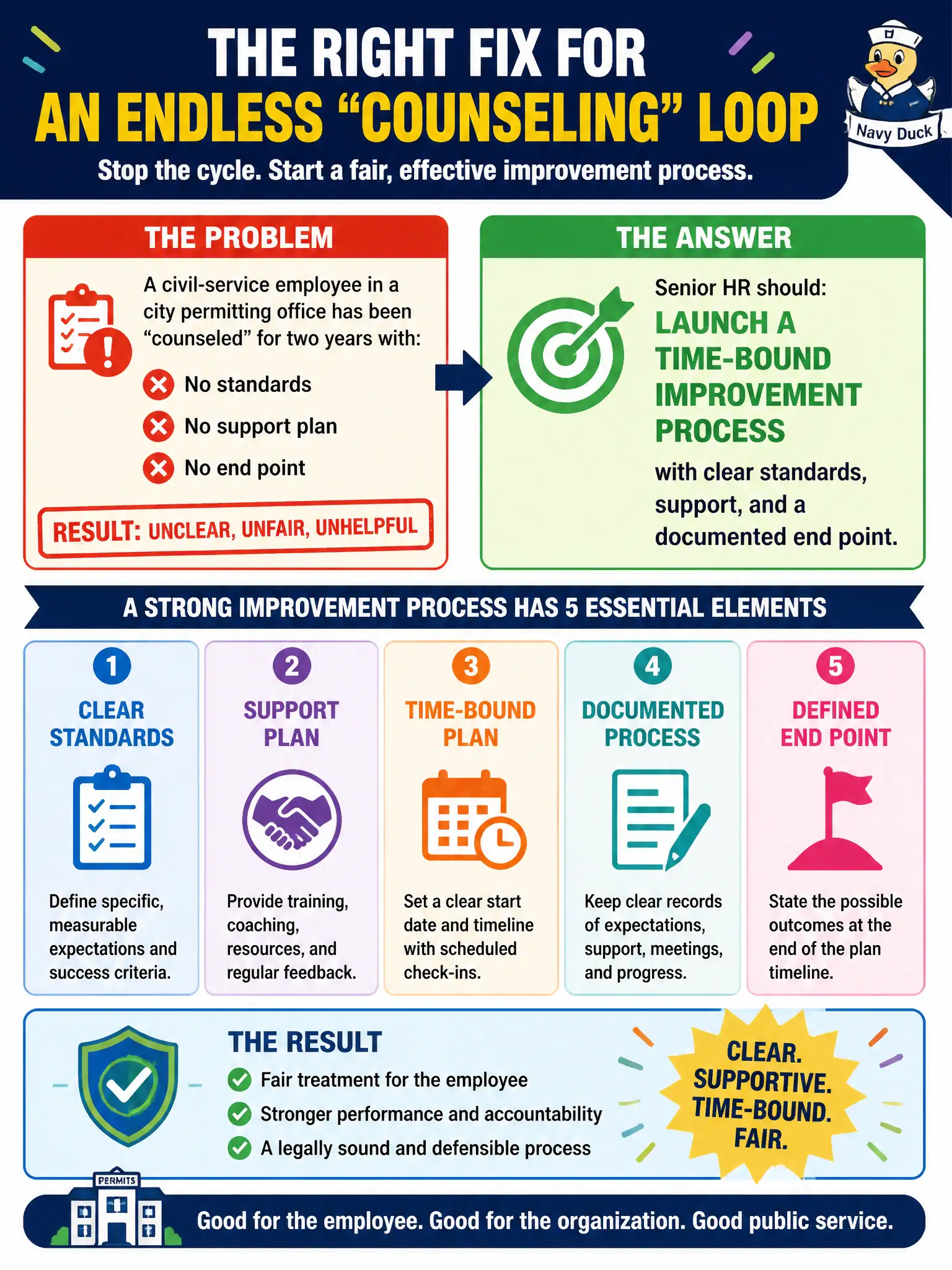
A civil-service employee in a city permitting office has been "counseled" for two years with no standards, no support plan, and no end point. What should senior HR install?
Select an answer to reveal the explanation.
Short Explanation
Endless hallway "counseling" is a hamster wheel, not a plan. Civil service still needs a real improvement process: what good looks like, what support is on the table, and when the clock stops. Without an end point, nobody is actually managing performance.
Full Explanation
A civil-service employee 'counseled' for two years with no standards, no support plan, and no end point is stuck in endless hallway talk, not performance management. Senior HR should launch a time-bound improvement process with clear standards, support, and a documented end point. Public employers still owe due process and clarity; civic fairness to coworkers and residents who depend on the role requires an actual plan, not a hamster wheel.
Continuing informal hallway talks until retirement fails by concept: indefinite counseling is avoidance. Skipping straight to termination without a documented improvement process fails by misunderstanding civil service—plans are often required, not forbidden. Transferring the employee with no performance file fails by exporting an unmanaged problem and erasing accountability.
Exam caveat: follow the jurisdiction's civil-service and CBA steps exactly; time-bound plans must include notice, support, and measurable standards. Operational check: issue written standards and support resources, set review dates, document outcomes, and decide sustain, extend, or separate when the clock ends. Public employers should record the chosen control and rejected options in the talent or labor file so future leaders understand how the decision protects continuity of resident services.