
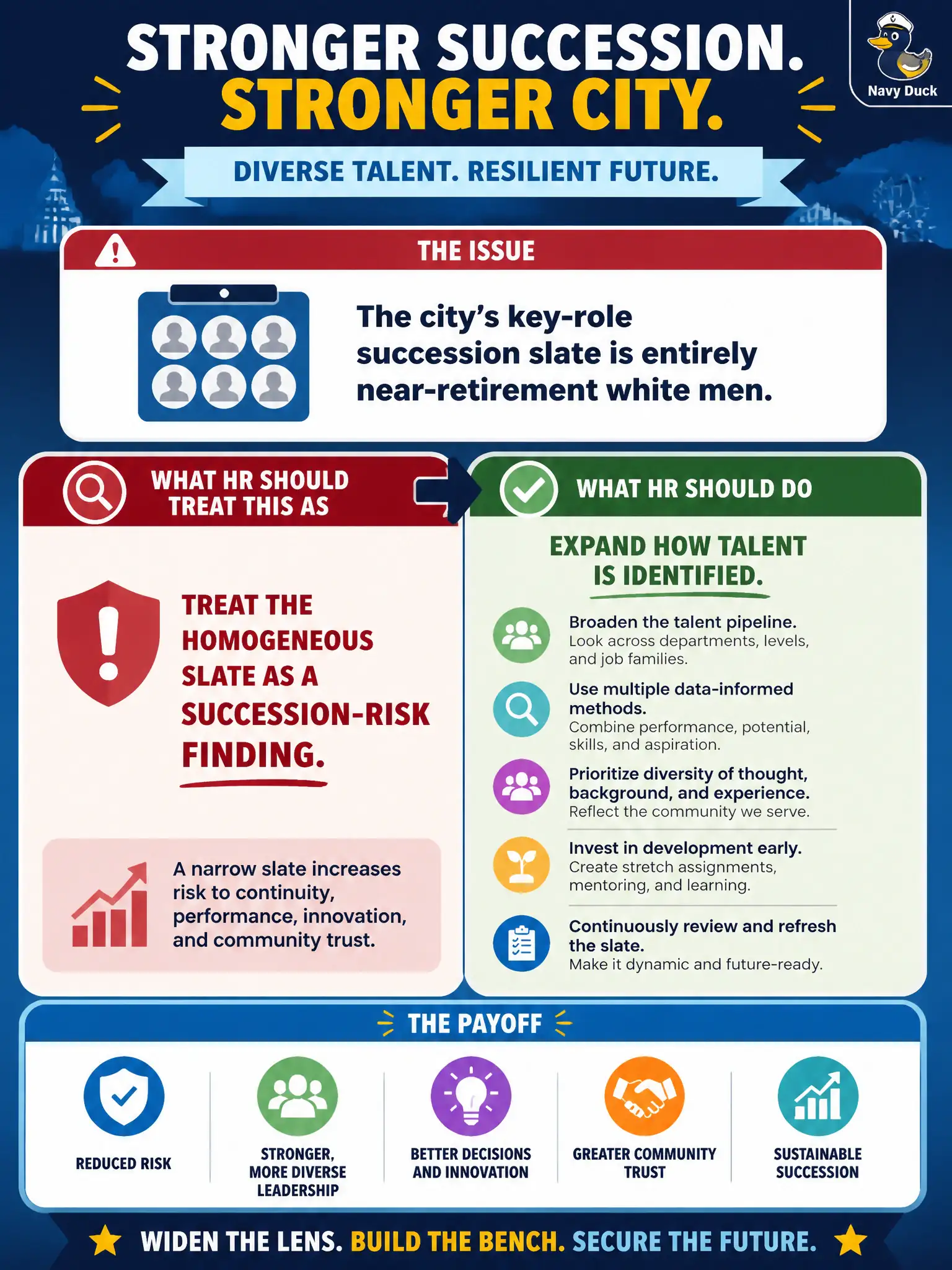
The city's key-role succession slate is entirely near-retirement white men. What should HR treat this as, and what should it do?
Select an answer to reveal the explanation.
Short Explanation
If every name on the bench is the same vintage and the same story, that is not stability—it is a cliff. Homogeneous slates are a continuity and inclusion risk. Widen how talent is found.
Full Explanation
A key-role succession slate that is entirely near-retirement white men is a succession-risk finding, not proof of organizational stability. HR should expand how talent is identified so the bench is broader and less cliff-like. Civic employers owe continuity that can survive simultaneous retirements and must confront how homogeneous networks shrink the leadership pipeline residents ultimately rely on for public services.
Treating demographic sameness as proof of stability and freezing identification methods fails by concept: sameness concentrates exit risk and blind spots at the same moment. Hiding the slate from council so continuity risk is not discussed fails transparency and governance duties for enterprise risk. Shortening the list to the three most senior names and stopping the search fails by doubling down on the cliff.
Exam caveat: expanding identification means structured, job-related outreach and assessment—not lowering standards or illegal preferences dressed up as diversity theater. Operational check: reopen talent identification with clear criteria, add cross-department candidates, and brief leadership on both continuity risk and slate composition as enterprise risk metrics.