
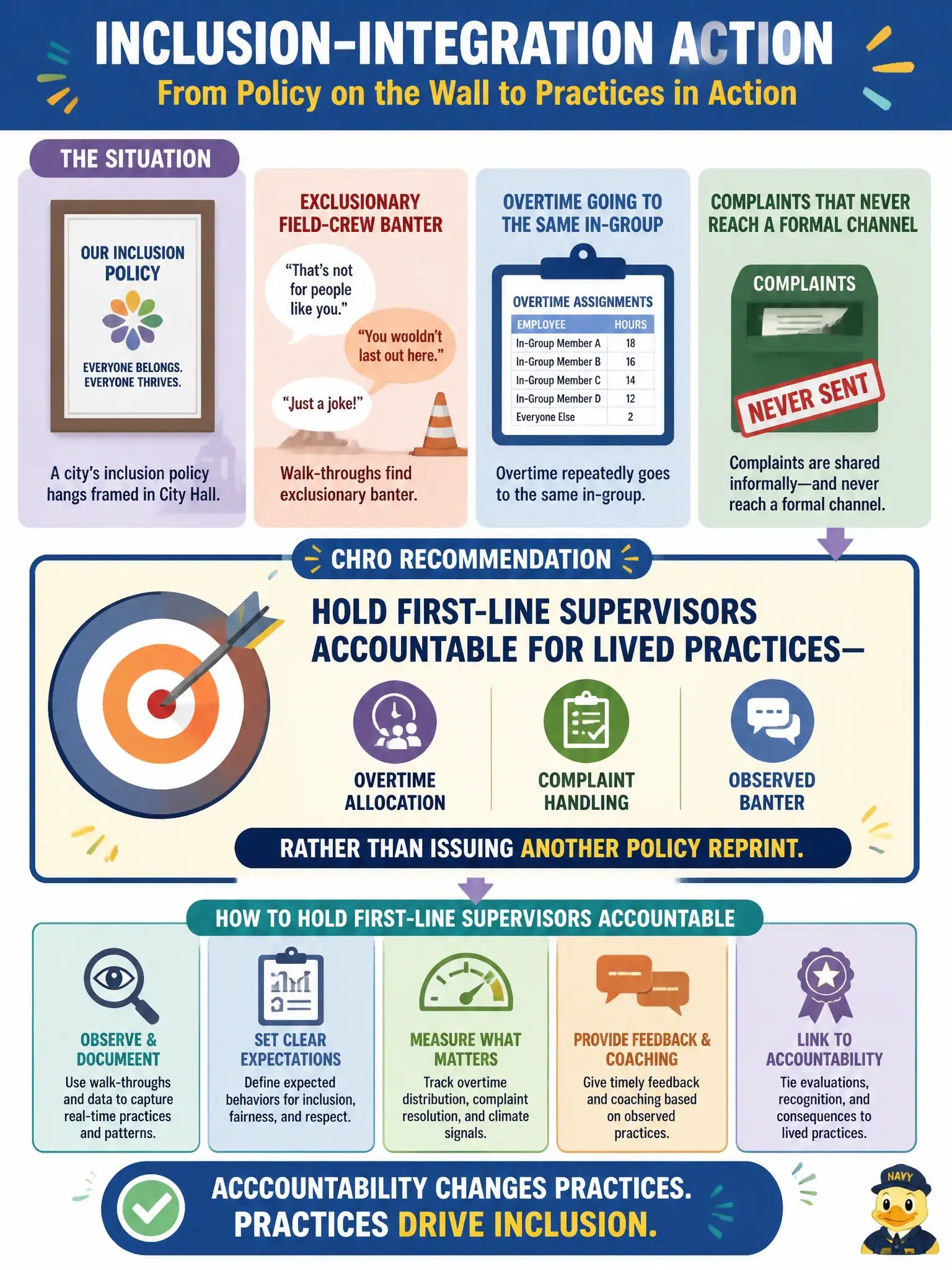
A city's inclusion policy hangs framed in City Hall, but walk-throughs find exclusionary field-crew banter, overtime going to the same in-group, and complaints that never reach a formal channel. What should the CHRO recommend as the inclusion-integration action?
Select an answer to reveal the explanation.
Short Explanation
A framed policy is like a diet poster on the fridge while the kitchen still serves junk. Inclusion is real when overtime, complaints, and crew talk change—not when the lobby gets another plaque. Put supervisors on the hook for those lived practices.
Full Explanation
Inclusion integration in a municipal workforce is judged by lived practice, not by whether a framed policy hangs in City Hall. When field-crew banter excludes coworkers, overtime stays inside an informal in-group, and complaints never reach a formal channel, residents ultimately receive service from a culture that contradicts the city's stated values. The correct SPHR action is to hold first-line supervisors accountable for overtime allocation, complaint handling, and observed banter—the operational levers that actually change belonging on the crew. Public stewardship requires that supervisors own those practices rather than treating inclusion as a lobby plaque.
Reprint-and-recertify fails by concept: laminated cards prove awareness, not integration, and leave the overtime and complaint systems untouched. Treating informal banter as off-limits because a written policy exists fails because existence of policy is not evidence of culture change; it excuses the very signals walk-throughs already found. Rolling field-crew scores into a citywide average fails by concept because averaging hides the unit-level pattern that makes integration diagnosable and actionable.
Exam caveat: supervisor accountability does not replace lawful complaint channels or anti-harassment duties—it sits alongside them as the day-to-day control. Operational check: define measurable supervisor expectations for overtime equity, complaint intake, and crew climate; review unit data and walk-through notes in the next leadership cycle; and brief the city manager on whether lived practices moved, so civic trust is not left to another reprint.