
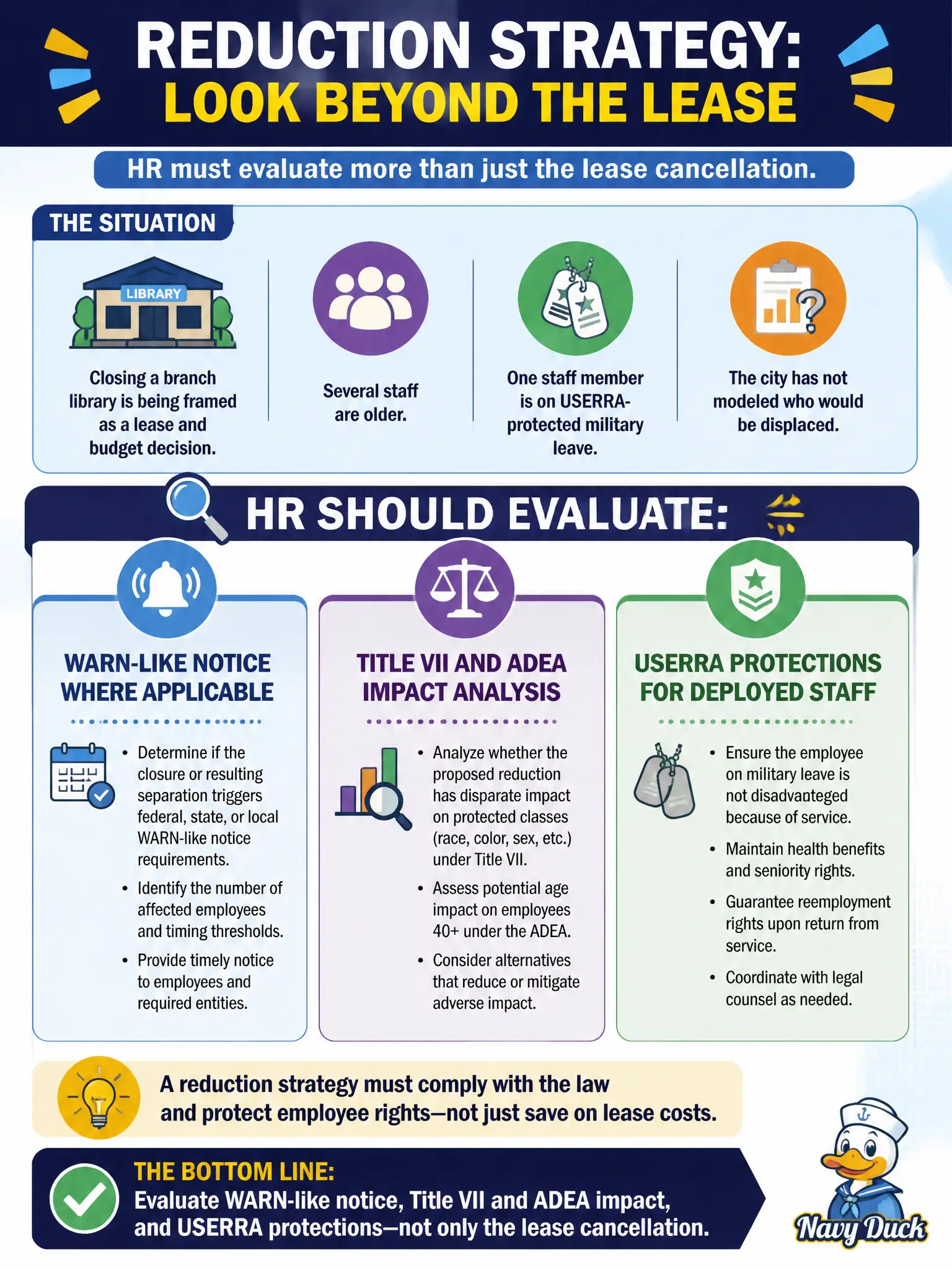
Closing a branch library is being framed as a lease and budget decision. Several staff are older, one is on USERRA-protected military leave, and the city has not modeled who would be displaced. What should HR evaluate as part of the reduction strategy?
Select an answer to reveal the explanation.
Short Explanation
A library closure is not just a lease. It is a reduction: who loses work, whether notice is due, whether the impact falls on older staff, and whether anyone on military leave is protected. Run WARN-like, Title VII/ADEA, and USERRA screens as strategy, not as a facilities afterthought.
Full Explanation
Closing a branch library framed as a lease decision is still a workforce reduction. HR must evaluate WARN-like notice where applicable, Title VII and ADEA impact analysis, and USERRA protections for deployed staff—not only the lease cancellation. Older staff concentration, military-leave status, and selection for displacement are employment-law events; facilities math without people analysis produces discriminatory or protected-status violations dressed as real estate.
Evaluating only lease-break cost treats employment law as irrelevant. Reusing the building before people analysis prioritizes property over displacement design. Placing the deployed employee into the displaced group first to save a filled seat invites USERRA violations.
Exam caveat: not every site closure triggers federal WARN, but analogous notice, civil-service, and bargaining rules may; ADEA/Title VII analysis and USERRA still matter. The concept is people-impact strategy as part of the closure, not after.
Operational check: inventory affected employees by age, protected class, and military-leave status; design selection criteria before names; run impact analyses; coordinate notice and bumping with counsel and labor; protect USERRA rights explicitly; and refuse closure timelines that skip those steps.