
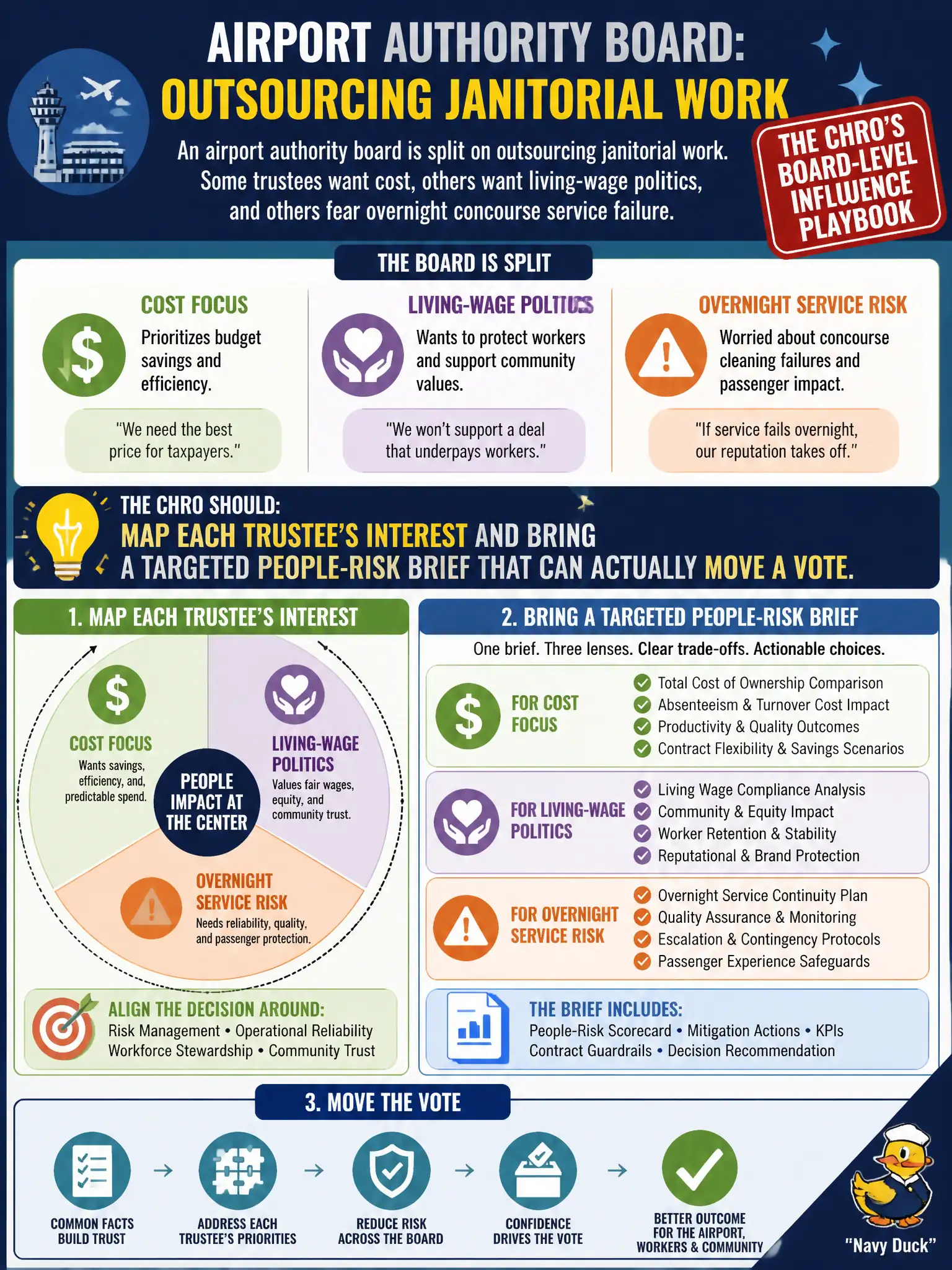
An airport authority board is split on outsourcing janitorial work. Some trustees want cost, others want living-wage politics, and others fear overnight concourse service failure. What board-level influence approach should the CHRO take?
Select an answer to reveal the explanation.
Short Explanation
A split board is not one audience—it is three or four different reasons-to-vote-yes sitting in the same room. Map each trustee's interest and bring a people-risk brief that actually lands on those interests. A generic outsourcing white paper is wallpaper.
Full Explanation
Board-level influence is targeted and interest-based, not broadcast. An airport authority board split on outsourcing janitorial work is not one audience: some trustees prioritize cost, others living-wage politics, others overnight concourse service failure. The CHRO should map each trustee's interest and bring a people-risk brief that can actually move a vote—labor displacement and bumping exposure, contract-management capacity, living-wage and reputational risk, and continuity of overnight cleaning that keeps the airport open. A brief that lands on those distinct decision criteria is influence; a generic white paper is wallpaper.
Treating the board as a single audience with one generic outsourcing paper misses the factions that determine the vote. Refusing to brief because labor displacement is 'operations, not HR' abandons SPHR board advising on workforce risk. Lobbying only the chair ignores swing trustees and can backfire when the rest of the board feels managed.
Exam caveat: interest mapping is not promising every trustee a different incompatible outcome. The concept is tailored risk communication under one recommended people strategy, not custom deals that cannot coexist.
Operational check: build a trustee interest map before the meeting; prepare a one-page people-risk matrix covering cost, service failure, displacement, and living-wage optics; identify the two or three undecided votes and brief them with the risks they care about; and document the recommended staffing/contract-admin residual if outsourcing proceeds.