
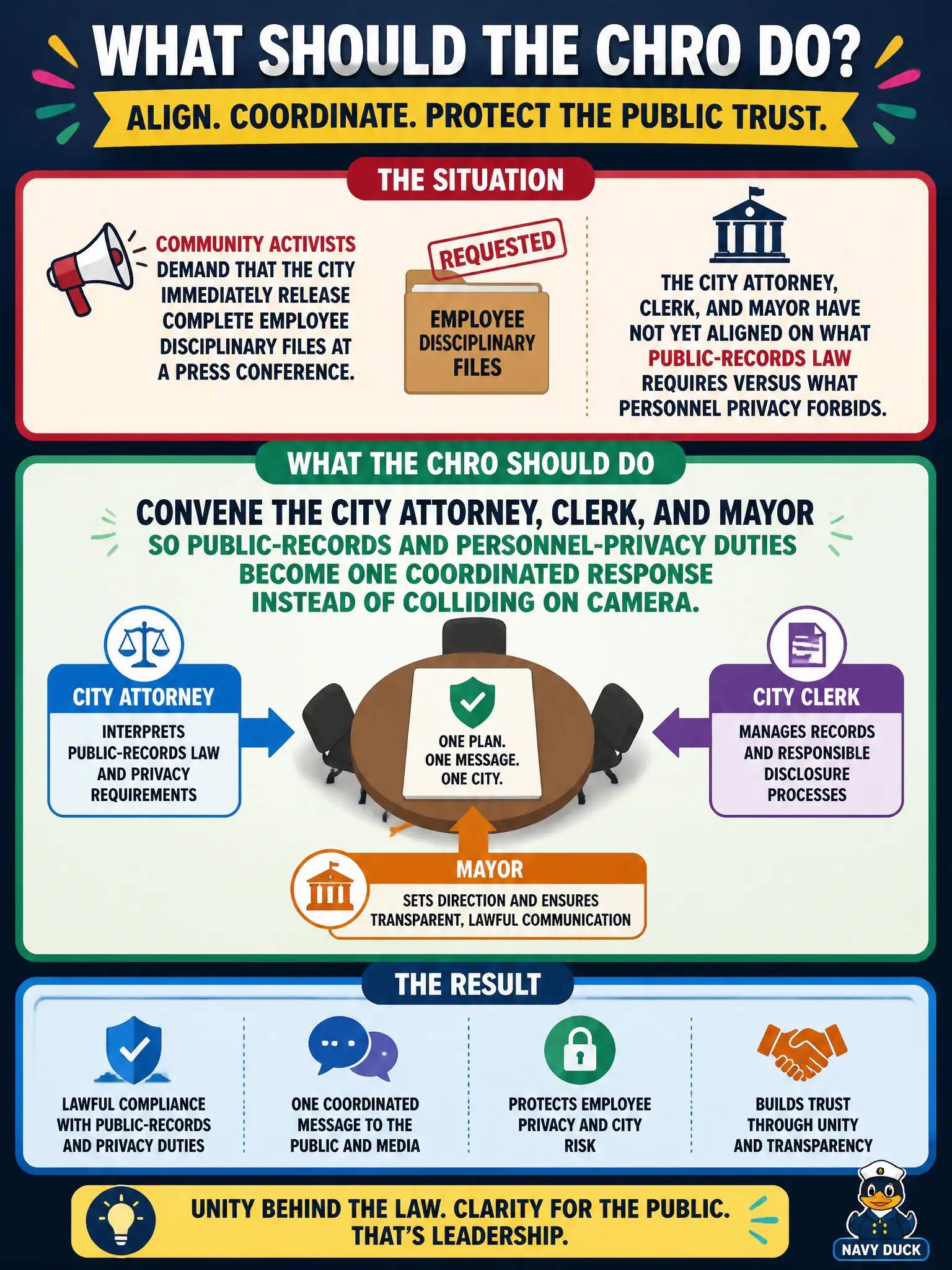
Community activists demand that the city immediately release complete employee disciplinary files at a press conference. The city attorney, clerk, and mayor have not yet aligned on what public-records law requires versus what personnel privacy forbids. What should the CHRO do?
Select an answer to reveal the explanation.
Short Explanation
Personnel files at a press conference are a two-train problem: public-records law heading one way, employee-privacy law heading the other. If the attorney, clerk, and mayor have not met, those trains collide on live camera. HR's leadership job is to get those three stakeholders in one room before anyone speaks.
Full Explanation
Public-sector CHROs sit at the collision point of sunshine or public-records duties and personnel privacy. When activists demand complete disciplinary files at a press conference and the city attorney, clerk, and mayor are not yet aligned, the correct move is to convene those stakeholders so one coordinated lawful response replaces colliding improvisation on camera. Some records may be releasable, some must be redacted, and some are barred; those lines are legal and records-administration judgments, not press-relations instincts. HR's leadership job is to force the alignment before anyone speaks, protecting employees, the city's legal posture, and credible transparency at the same time.
Releasing complete files to demonstrate transparency can violate privacy and personnel statutes and create liability the activists will not carry. Refusing all comment while each official improvises produces contradictory statements that look like cover-up even when the city is trying to comply. Handing activists HR-only redacted summaries without attorney and clerk review usurps records roles and can still over- or under-disclose.
Exam caveat: coordination is not delay-for-delay's-sake, nor a strategy to never release anything lawfully required. The concept is unified legal-records decision-making under pressure, not opacity as a default.
Operational check: convene attorney, clerk, mayor, and communications with a written matrix of what the request covers, what statute requires or forbids, and who is the single spokesperson; freeze ad-hoc releases until that matrix is signed off; prepare a public statement that explains both transparency and privacy duties; and log the decision trail for later public-records scrutiny.