
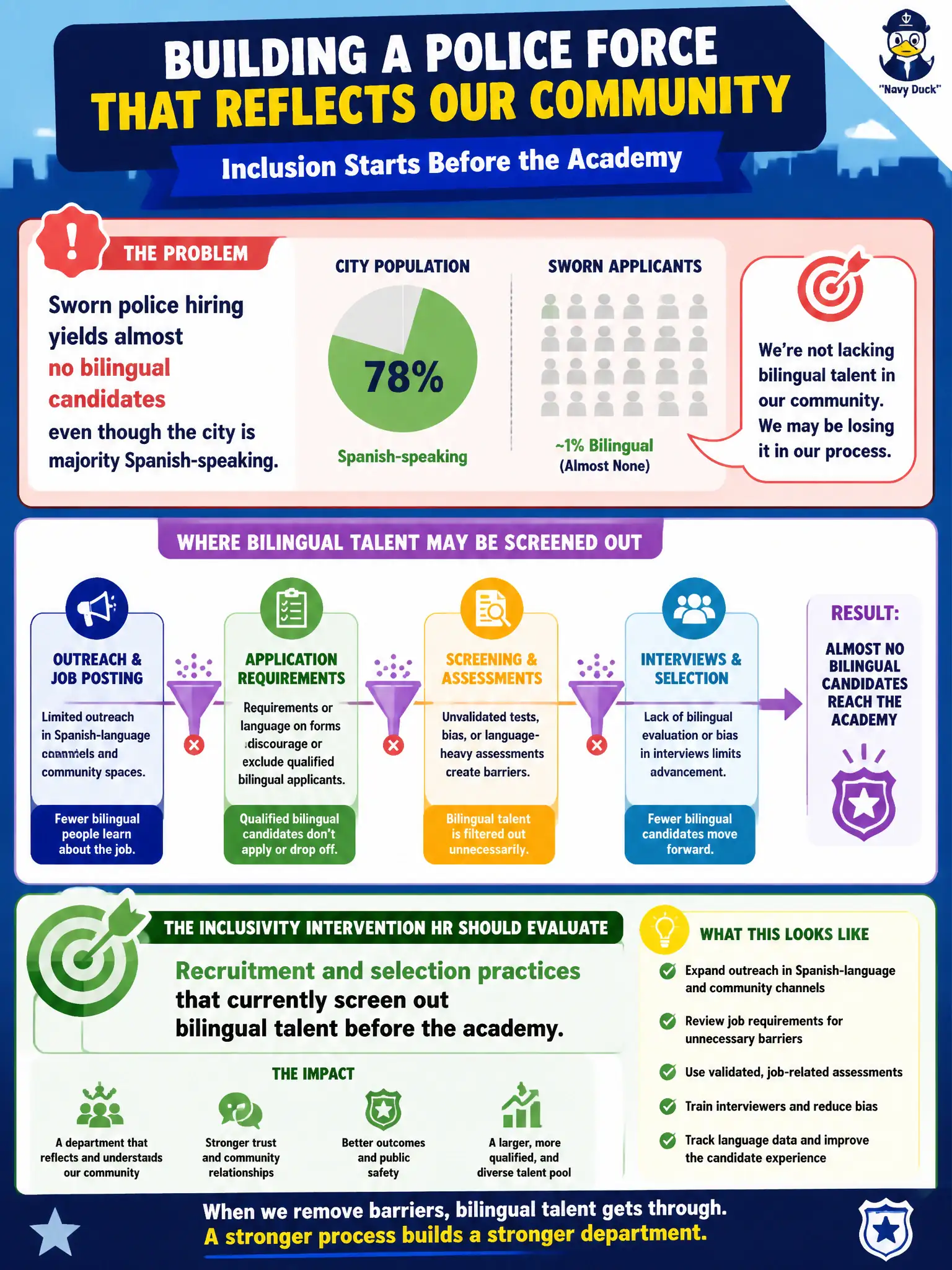
Sworn police hiring yields almost no bilingual candidates even though the city is majority Spanish-speaking. Which inclusivity intervention should HR evaluate?
Select an answer to reveal the explanation.
Short Explanation
Posters and phrase-of-the-week emails do not put bilingual officers on the street. If the city is majority Spanish-speaking and sworn hiring still yields almost none, the leak is in recruitment and selection. Inclusivity strategy has to reach those systems, not the lobby wall.
Full Explanation
Evaluating recruitment and selection practices that currently screen out bilingual talent before the academy is the correct inclusivity intervention when sworn hiring yields almost no bilingual candidates in a majority Spanish-speaking city. Yield problems are selection-system issues: where talent drops out of sourcing, testing, or standards that are not job-related. Appreciation posters, phrase-of-the-week emails for incumbents, and diversity statements on unchanged postings do not put bilingual officers on the street. Exam caveat: SPHR inclusivity includes diagnosing adverse barriers in recruitment and selection that block community-language capacity. Operational check: map the sworn funnel by language skill, validate tests and requirements, widen sourcing in Spanish-speaking communities, remove non-job-related screens, and track bilingual yield into the academy for civic policing needs. In municipal practice, record the rationale in the recommendation packet so future leaders see why rejected options would weaken service, equity, or legal durability for residents. Re-validate after the next budget or bargaining cycle that the control still holds under current staffing and legal constraints.