
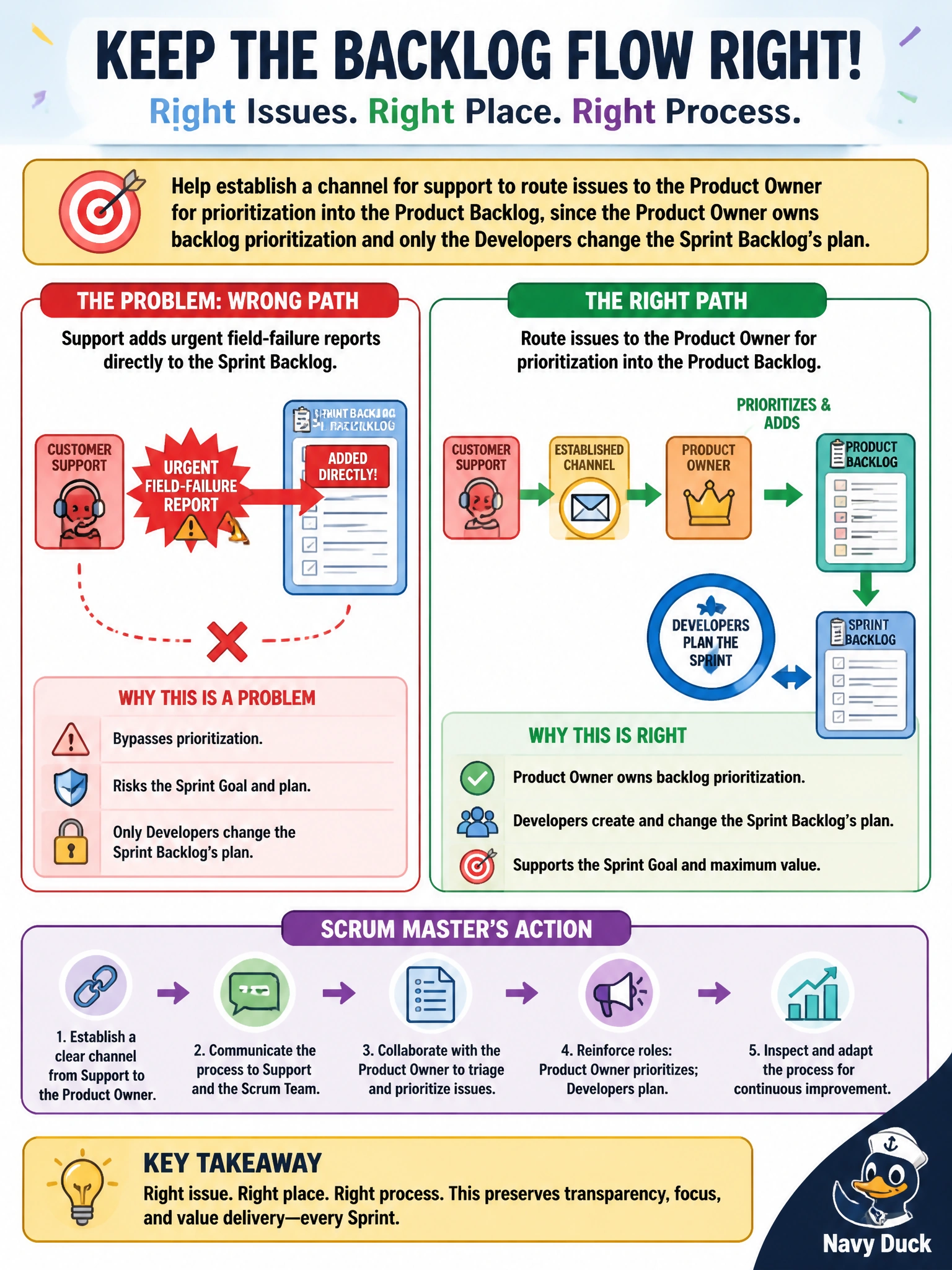
A customer-support organization that predates Scrum starts adding urgent field-failure reports directly to the firmware Scrum Team's Sprint Backlog whenever a robot malfunctions, without involving anyone else. What should the Scrum Master do to address this across the organization?
Select an answer to reveal the explanation.
Short Explanation
Support has every reason to feel urgency about a malfunctioning robot — that's not the problem. The problem is that urgency is skipping straight past the person accountable for ordering the work and landing directly in the middle of a Sprint the Developers already planned. Building a real path from support into the Product Backlog fixes the urgency and respects who owns what.
Full Explanation
The Product Backlog is the single source of work for the product, and the Product Owner is accountable for ordering it based on value and risk; the Sprint Backlog belongs to the Developers, who are the only ones who can adapt it during the Sprint. Support inserting items directly into the Sprint Backlog bypasses both of those boundaries at once — it skips the Product Owner's prioritization and it imposes scope changes on the Developers from outside. The organizational fix is a working relationship between support and the Product Owner so urgent field issues reach the backlog through the person accountable for ordering it, which the Scrum Master can help set up as part of serving the organization. Letting support keep bypassing the process treats "urgent" as an automatic override, when some reported issues will turn out less critical than others once triaged — that triage is exactly what backlog ordering does. Making support wait until Sprint Review for anything overcorrects and could leave a genuine safety issue unaddressed for weeks. The Scrum Master personally picking which issues get pulled in oversteps into Product Backlog ordering, which isn't the Scrum Master's accountability. A caveat: a true emergency may still justify an urgent Sprint Backlog change by the Developers in consultation with the Product Owner — the point is that this becomes a deliberate exception, not support's default channel. Concrete check: ask whether a field-failure report can be traced to a Product Backlog item, or whether it only ever shows up as a Slack message straight to a Developer.