
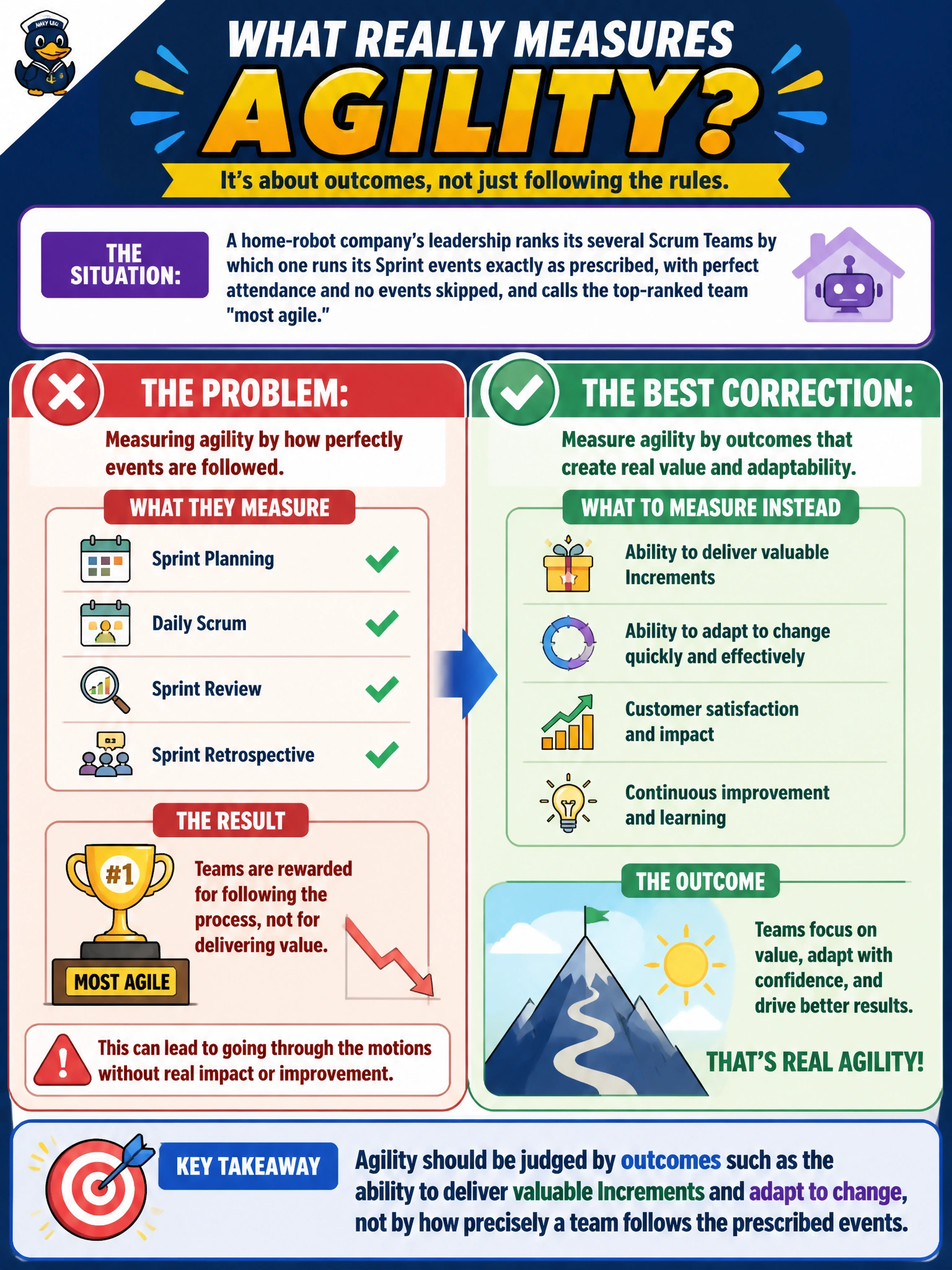
A home-robot company's leadership ranks its several Scrum Teams by which one runs its Sprint events exactly as prescribed, with perfect attendance and no events skipped, and calls the top-ranked team "most agile." What is the best correction to this way of measuring agility?
Select an answer to reveal the explanation.
Short Explanation
Never missing a Daily Scrum says a team is disciplined about a calendar invite — it doesn't say anything about whether the robot they're building is actually getting better for customers. Agility isn't a punctuality contest; it's whether a team can sense a change and respond to it, and that only shows up in what actually got delivered and adjusted, not in a perfect-attendance sheet.
Full Explanation
The purpose of Scrum's events is to enable transparency, inspection, and adaptation — the events are a mechanism, not the goal. Ranking teams by how exactly they execute the mechanism confuses the container for the contents: a team can run flawless, on-time events and still fail to inspect honestly or adapt its plan, while a team with a messier process might be genuinely responsive to change. The better lens is outcomes — does the team ship Increments that deliver real value, and does its Product Backlog visibly change in response to what's learned. Insisting the Guide requires uniform, strict event mechanics misreads it; the Guide fixes each event's purpose and timebox but leaves plenty of practice-level variation to the team, and none of that variation is itself a measure of agility. Ranking the least experienced team lowest regardless of outcomes ignores that agility is about responsiveness and value, not tenure — a newer team can outperform an established one. Counting shipped features without regard to value repeats the same mistake as compliance-ranking in a different unit: volume of output isn't the same thing as value delivered. A caveat: outcome measures are noisier and slower to collect than a compliance checklist, which is exactly why leadership tends to default to the easier number. Concrete check: for any team called "most agile," ask what customer-facing outcome improved recently and how the team knows.