
Given that hardware constraints like PCB manufacturing lead times and firmware flash cycles make it hard to iterate as quickly as pure software, what should a Scrum Team at a home-robot company do to still reliably produce a usable, Done Increment every Sprint?
Select an answer to reveal the explanation.
Short Explanation
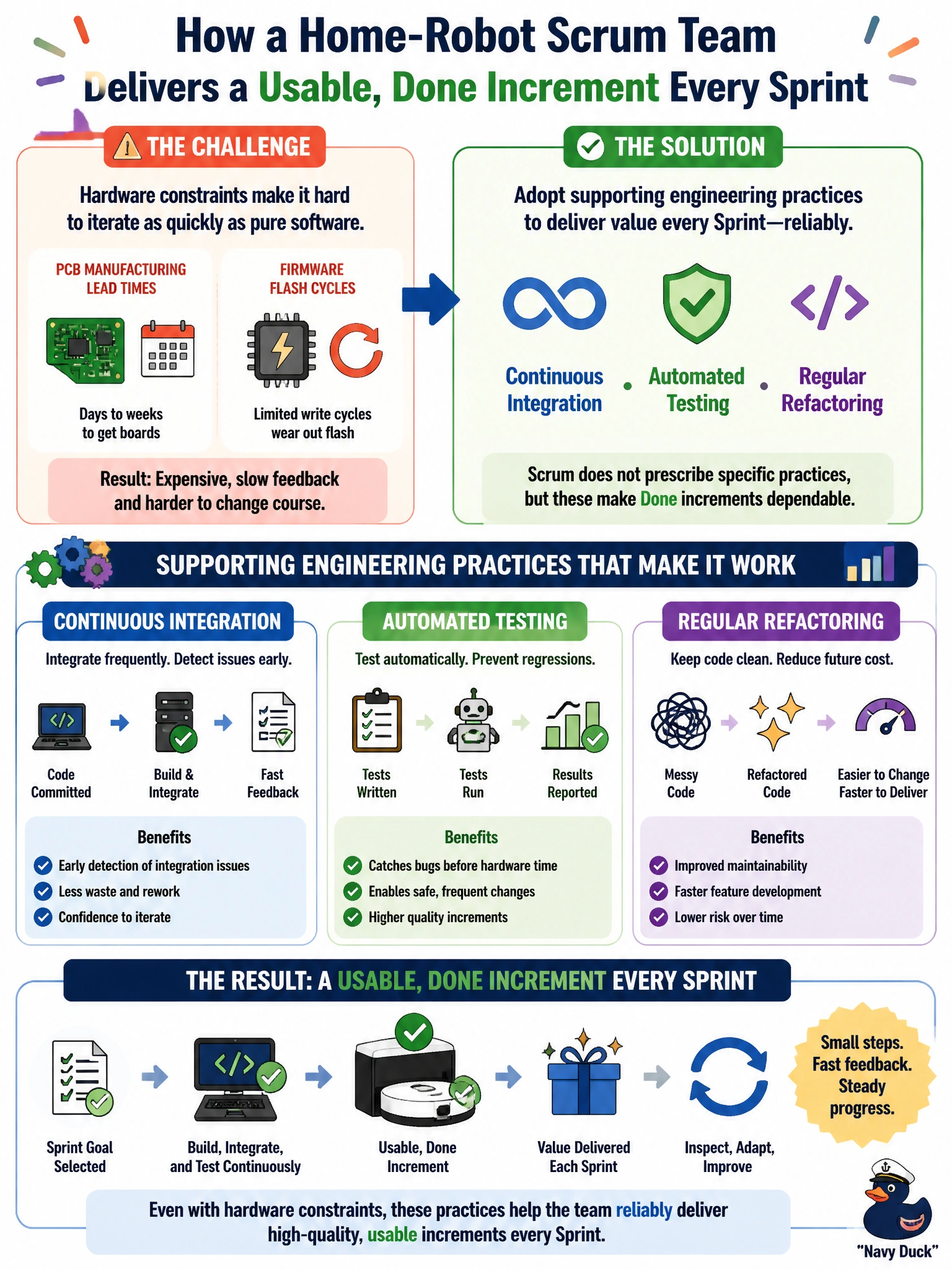
Scrum won't hand a team a specific engineering practice to use — it just expects a usable, Done Increment every Sprint, hardware constraints and all. Practices like continuous integration, automated testing, and steady refactoring are how real teams actually make that possible, even though the Scrum Guide itself never names them as requirements.
Full Explanation
The Scrum Guide deliberately does not prescribe specific engineering practices, leaving the Scrum Team free to choose whatever technical approaches work best for its context, but that flexibility does not remove the underlying challenge of consistently producing a usable, Done Increment inside a fixed timebox — a challenge made harder by hardware realities like PCB lead times and firmware flash cycles that cannot simply be sped up. In practice, teams that manage this well tend to lean on supporting engineering disciplines such as continuous integration to catch conflicts early, automated testing to give fast and repeatable quality feedback, and ongoing refactoring to keep the underlying design able to absorb new work without becoming brittle. None of these are Scrum requirements in themselves, but they directly support the outcome Scrum does require: a genuinely Done, potentially releasable Increment at the end of every Sprint. Simply extending Sprint length treats the timebox as the problem rather than addressing the actual constraint, and a longer Sprint doesn't make firmware flash cycles or manufacturing lead times any faster — it just delays feedback further. Excluding hardware-touching items from the Definition of Done entirely would gut the standard exactly where quality risk is highest, and having the Scrum Master personally verify technical quality misplaces an accountability that belongs to the Developers, not to a facilitation-focused role. A practical check for any team in this position is to look at recent Sprints and ask which specific engineering practice would have most reduced last-minute crunches — that answer usually points directly at where to invest first.