
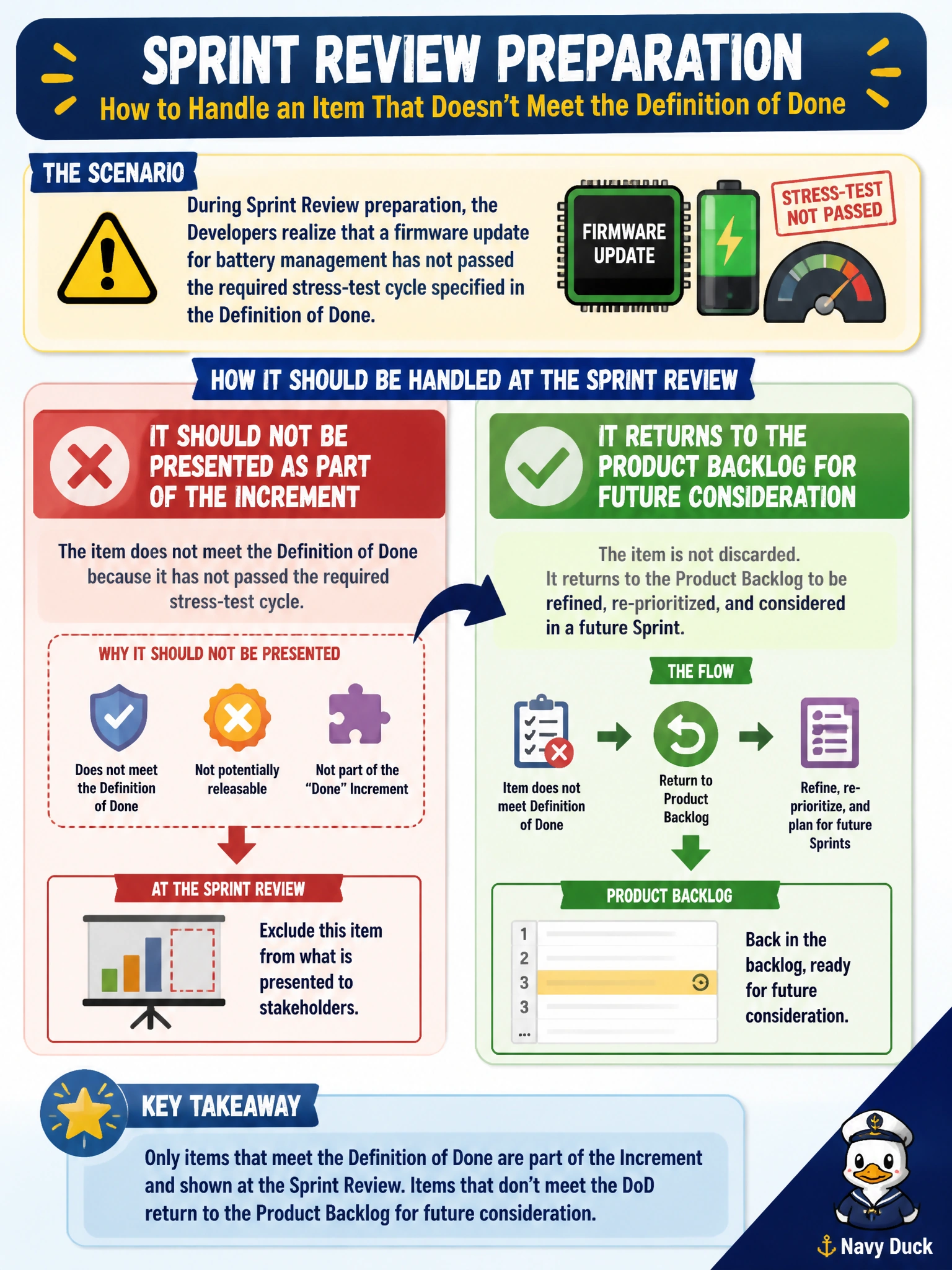
During Sprint Review preparation, the Developers realize that a firmware update for battery management has not passed the required stress-test cycle specified in the Definition of Done, so how should this item be handled at the Sprint Review itself?
Select an answer to reveal the explanation.
Short Explanation
"Almost Done" for a battery-management update isn't actually done — it's a battery that hasn't been proven safe under stress yet. If the Definition of Done isn't met, the item simply isn't part of the Increment, and it goes back to the Product Backlog rather than being softened into a verbal asterisk at Sprint Review.
Full Explanation
Sprint Review exists to inspect the actual Increment and adapt the Product Backlog based on what genuinely got done, and presenting work that has not met the Definition of Done — even with a caveat like "almost Done" — undermines that inspection by blurring what is real progress and what is not. Because the battery-management update has not passed its required stress-test cycle, it does not meet the agreed quality standard and is therefore not part of the Increment; it returns to the Product Backlog, where the Product Owner can decide how to prioritize finishing it. Letting the remaining stress test happen after release is particularly risky for a physical product like a battery system, where an unverified safety-relevant test could translate directly into real-world harm if something is wrong. The Definition of Done is also not something to be renegotiated item by item at the Scrum Master's discretion; it is a standard the whole Scrum Team holds consistently, precisely so that decisions like this one don't come down to an individual's judgment call under time pressure. Handling the gap transparently — reporting honestly that the item isn't Done rather than softening the language — keeps the Sprint Review a trustworthy basis for whatever comes next. An operational check is to require every item on the Sprint Review agenda to be checked item-by-item against the Definition of Done beforehand, so a gap like this surfaces before the meeting rather than being discovered as an awkward surprise during it.