
The companion-app team covers its user interface exclusively with manual testing, and several UI regressions have reached customers in recent releases because manual testers could not realistically re-check every screen every Sprint, so which change would most reduce this recurring problem?
Select an answer to reveal the explanation.
Short Explanation
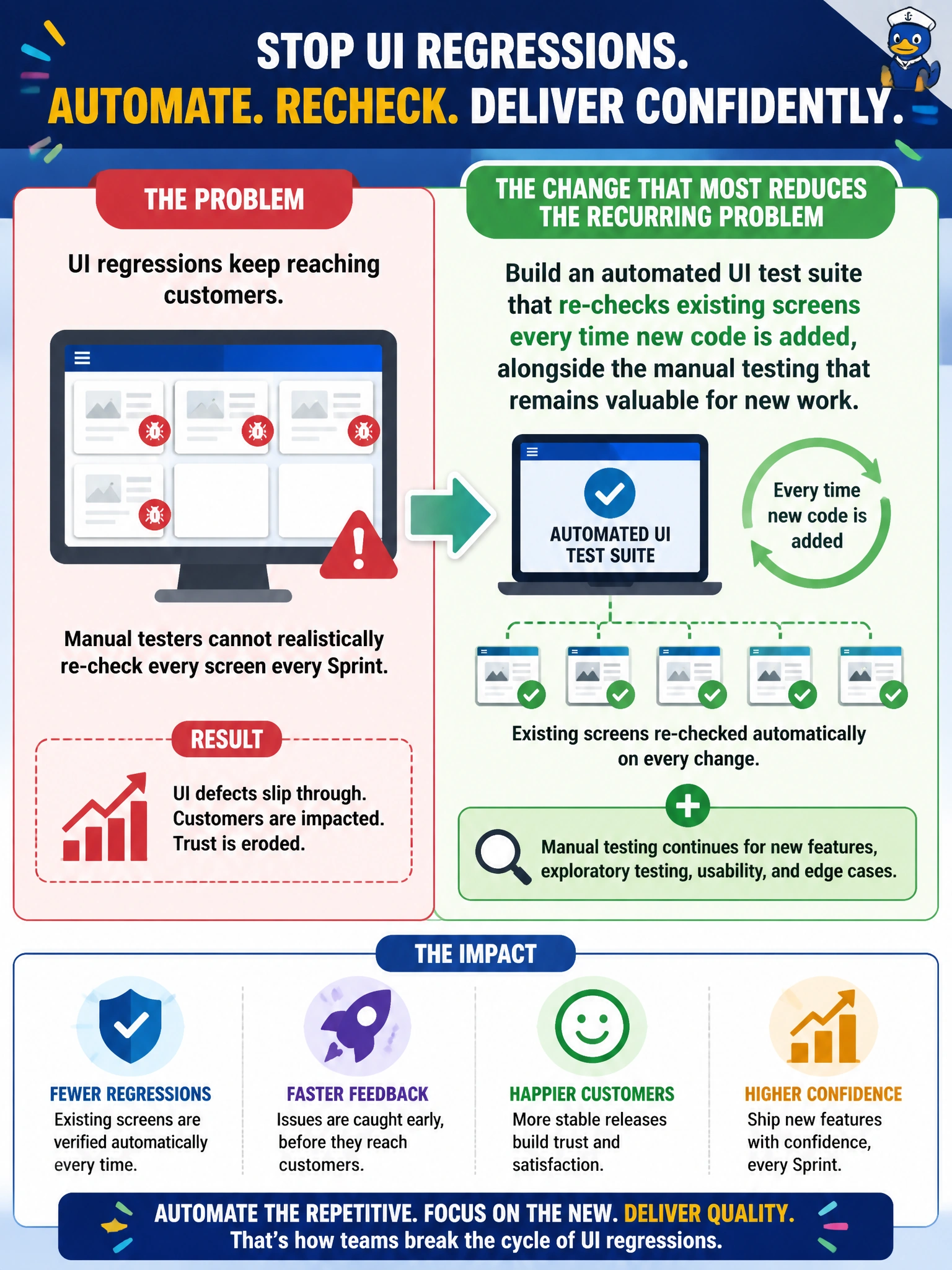
Expecting people to manually re-check every screen, every Sprint, forever, is asking for something that just doesn't scale — eventually something slips through, and it did. Automated tests can re-run that same full check constantly and tirelessly, freeing manual testers to focus on the judgment calls only a person can make, like whether something new actually feels right.
Full Explanation
Manual testing is valuable for exploratory checks and subjective judgment, but it does not scale well as the surface area of an application grows, because re-verifying every existing screen by hand every Sprint eventually exceeds what a team can realistically cover in the time available. That gap is exactly where regressions slip through: not because testers are careless, but because the volume of manual re-checking needed keeps growing while the time to do it stays fixed. An automated UI test suite closes that gap by continuously re-verifying existing behavior every time new code changes anything, catching regressions immediately rather than waiting for a person to happen to notice, while manual testing remains useful for genuinely new features where human judgment adds the most value. Narrowing manual testing to only the newest screens actually makes the problem worse, since it explicitly stops re-checking the older screens where these regressions are occurring. A longer Sprint doesn't scale either, since the same underlying growth in surface area will eventually outpace any fixed amount of additional time. Deprioritizing new UI work sidesteps the real issue rather than solving it, since the regressions are happening in existing screens, not new ones. A good operational check is to track how many recent production regressions were in previously "working" screens versus brand-new ones — a high share in old screens points squarely at a lack of automated regression coverage.