
A newly hired firmware Developer asks why the team bothers maintaining a written Definition of Done instead of just letting each Developer decide individually when their own work feels finished, so what is the best explanation?
Select an answer to reveal the explanation.
Short Explanation
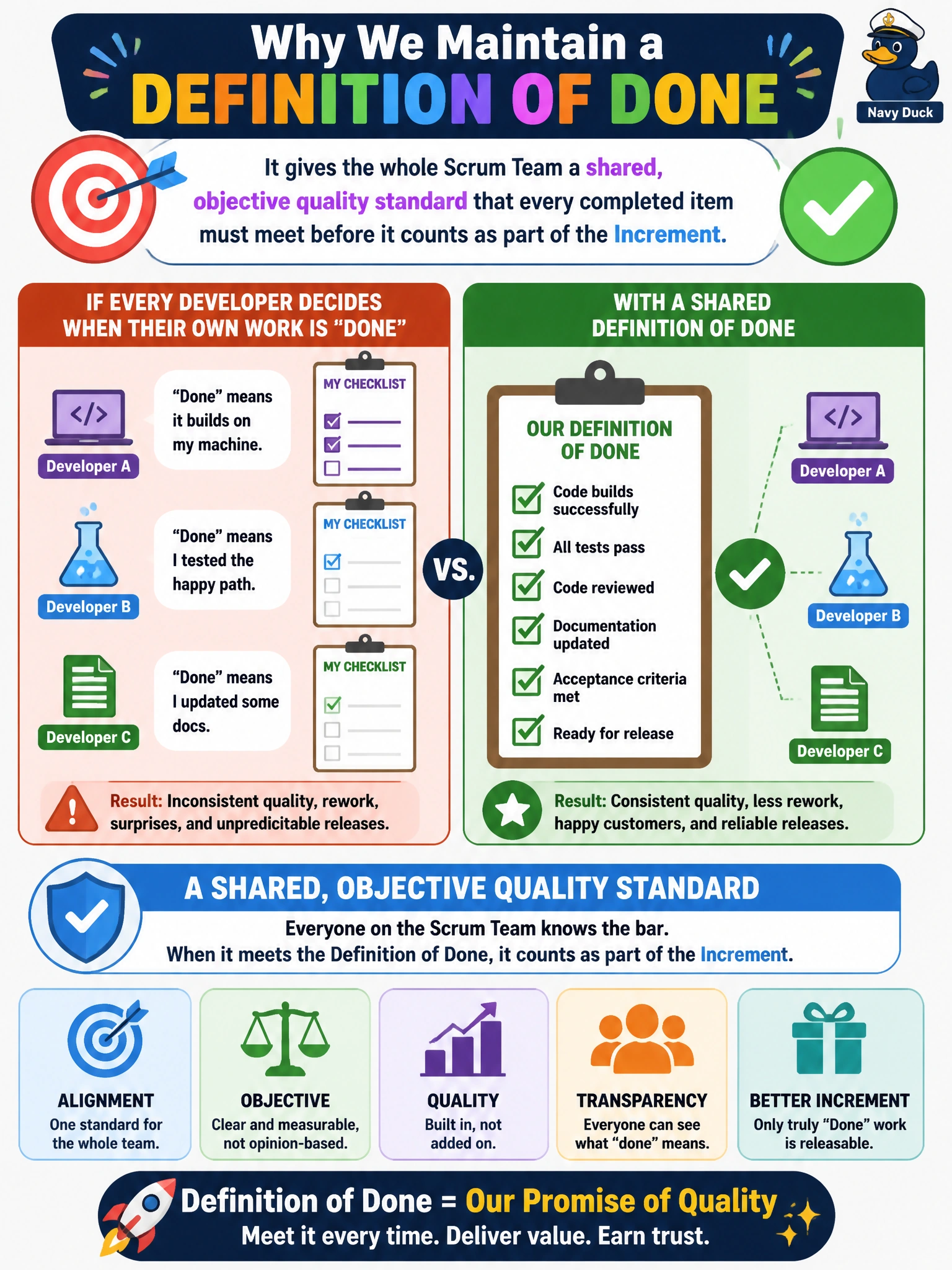
Without a shared Definition of Done, "finished" becomes whatever each Developer happens to feel that day — one person's Done might skip testing another person's wouldn't. A written Definition of Done gives everyone the same, objective quality bar, so "Done" means the same thing no matter who touched the work.
Full Explanation
The Definition of Done is a formal description of the quality standard that any Product Backlog item must meet to be considered part of an Increment, and its value comes precisely from being shared and consistent rather than left to individual judgment. If each Developer decided independently when work felt finished, the meaning of "Done" would vary by person and by day, which would undermine the trust that Sprint Reviews, forecasting, and release decisions all depend on. A consistent Definition of Done also protects against quality drifting downward under pressure, since it applies the same way regardless of who is doing the work or how close a deadline feels. It is not primarily a checklist for the Scrum Master to enforce from the outside — the whole Scrum Team owns and applies it, and the Developers are expected to hold each other to it as part of self-management. It is also not something the Product Owner can adjust item by item to fit shifting priorities, since a standard that moves depending on what's convenient stops functioning as a standard at all. A good operational check for any team is to hand the written Definition of Done to a Developer who did not work on a given item and ask them to verify it independently — if they can confirm Done using only the written criteria, the standard is doing its job.