
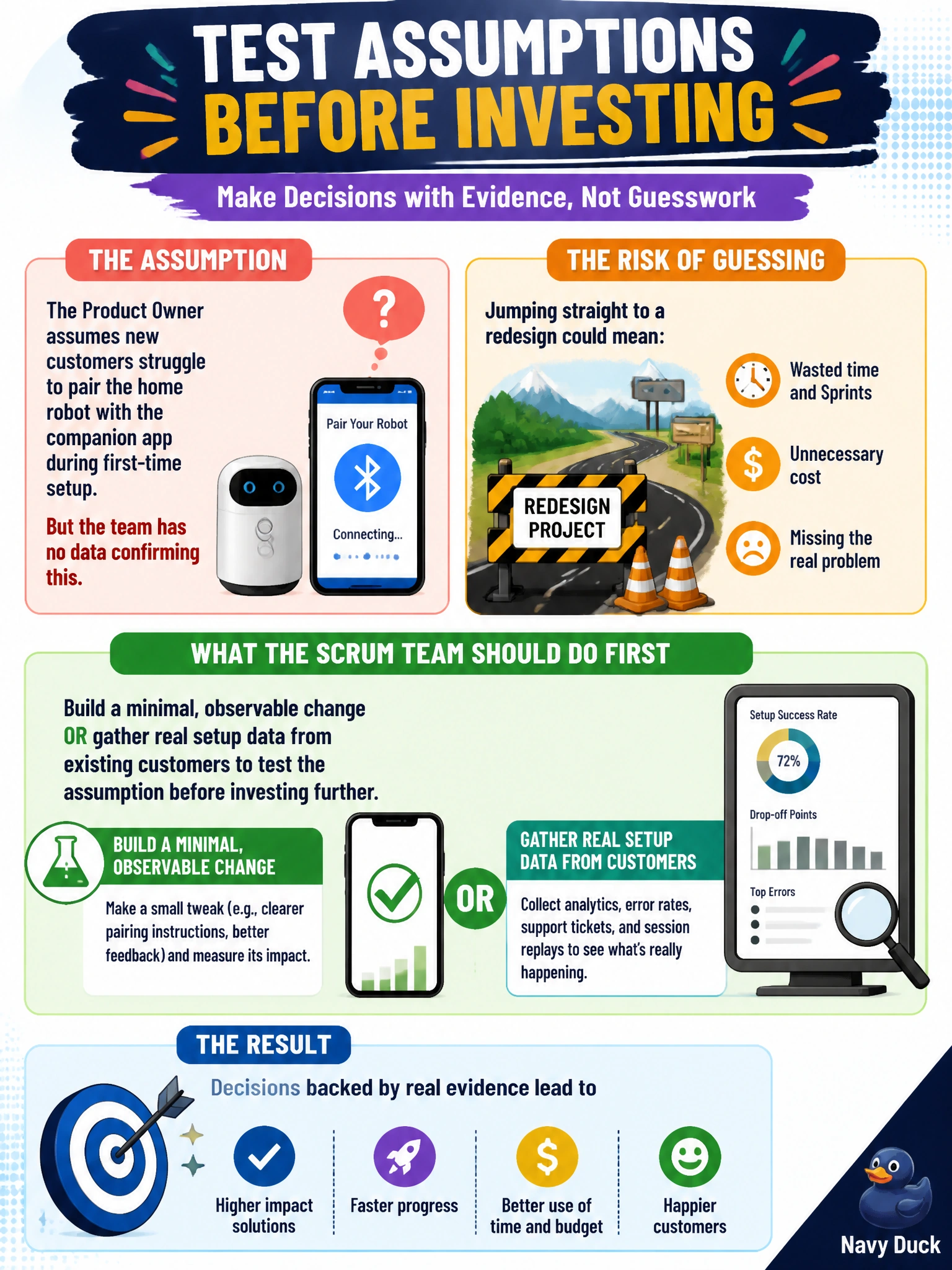
The Product Owner assumes new customers struggle to pair the home robot with the companion app during first-time setup, but the team has no data confirming this. Before committing several Sprints to redesigning the pairing flow, what should the Scrum Team do first?
Select an answer to reveal the explanation.
Short Explanation
Believing something is a problem and knowing it is a problem are two different things. Before spending Sprints on a redesign, get a small, real look at what actually happens when customers try to pair the robot, and let the evidence decide, not the hunch.
Full Explanation
The mechanism is again empiricism applied to a value assumption: rather than committing multiple Sprints on a belief, the team gathers real signal, such as instrumented setup data, a small experiment, or direct observation, so the next planning decision rests on inspection of something real, not opinion. Interviewing Developers about their personal opinions of the flow substitutes internal impression for actual customer behavior, which doesn't validate anything about real users. Adding the redesign straight to a Sprint Backlog before validating skips the inspection step entirely and risks Sprints of work on a guess. Trusting the Product Owner's authority to skip validation misreads accountability for value as a license to bypass evidence; the Product Owner's job is to maximize value, and maximizing value is exactly why the assumption should be checked before being acted on. Caveat: not every assumption needs a formal experiment, since small ones can be resolved with a quick look at existing data. Operational check: before Sprint Planning, define what real data point would confirm or disprove the pairing-difficulty assumption.