
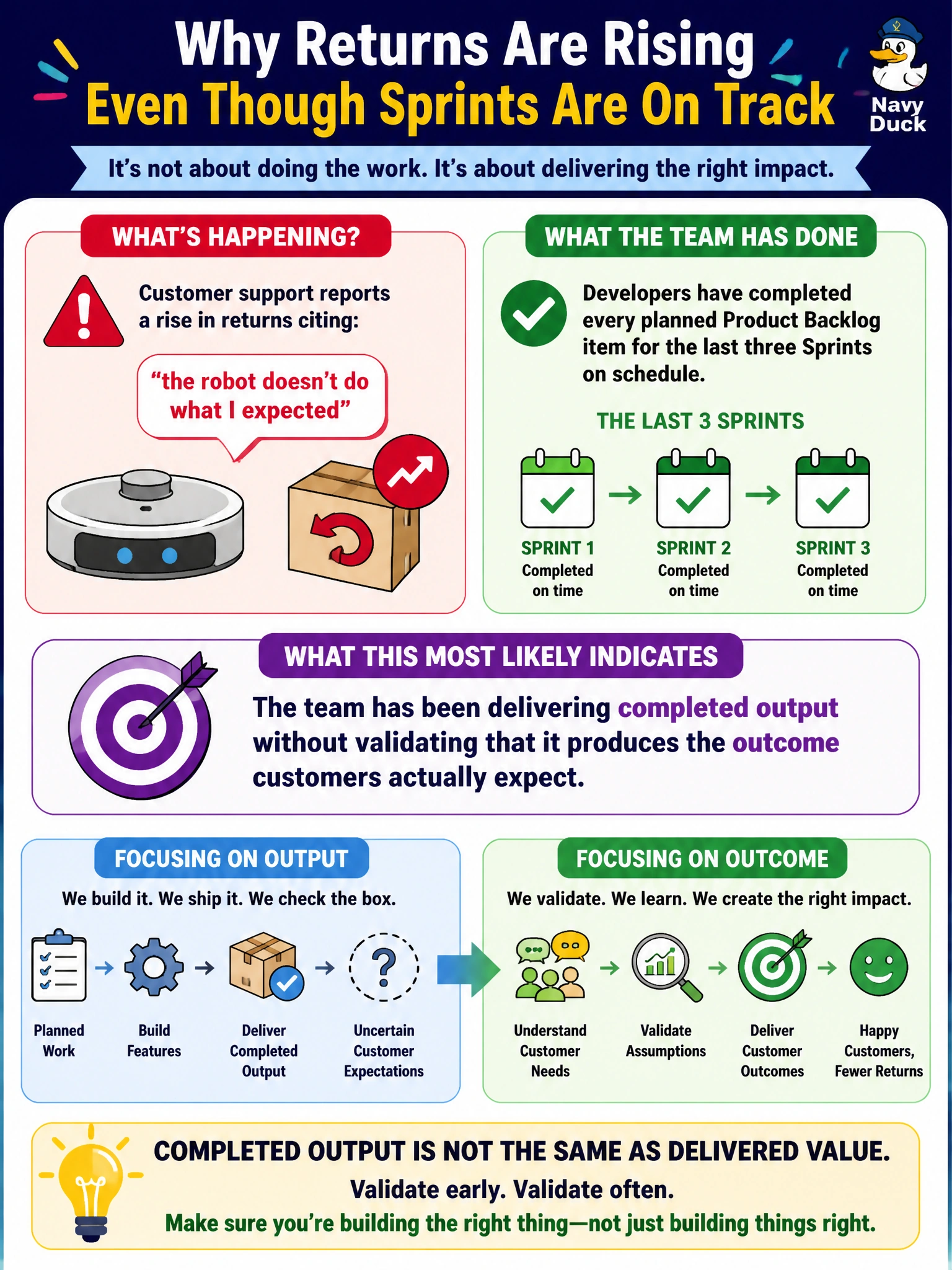
Customer support at the home-robot company reports a rise in returns citing "the robot doesn't do what I expected," even though the Developers have completed every planned Product Backlog item for the last three Sprints on schedule. What does this situation most likely indicate?
Select an answer to reveal the explanation.
Short Explanation
Hitting every item on the plan on schedule looks great on paper, but returns citing unmet expectations are a customer signal, not a delivery-speed problem. That gap between finishing what was planned and customers getting what they needed is the outcome-versus-output problem showing up in the real world.
Full Explanation
The mechanism is that on-time, on-plan delivery measures execution against a backlog, not whether that backlog reflected the right value in the first place; a spike in expectation-mismatch returns is customer-outcome data showing the two have diverged. The Daily Scrum distractor targets meeting length, which has nothing to do with whether the right things were built. Estimation and Sprint sizing, addressed by another distractor, are about throughput and predictability, not about whether delivered items met customer expectations, since a team can plan perfectly and still build the wrong thing well. A weak Definition of Done is plausible in general but doesn't explain an expectation gap specifically; Done governs whether an Increment meets a quality bar, not whether it matches what customers thought they were buying. Caveat: this isn't proof the Product Owner did anything wrong on purpose, since expectations can shift or be set poorly by marketing, not just by backlog choices. Operational check: bring recent return reasons into the next Sprint Review as real customer feedback and let it inform how upcoming Product Backlog items are described and ordered.