
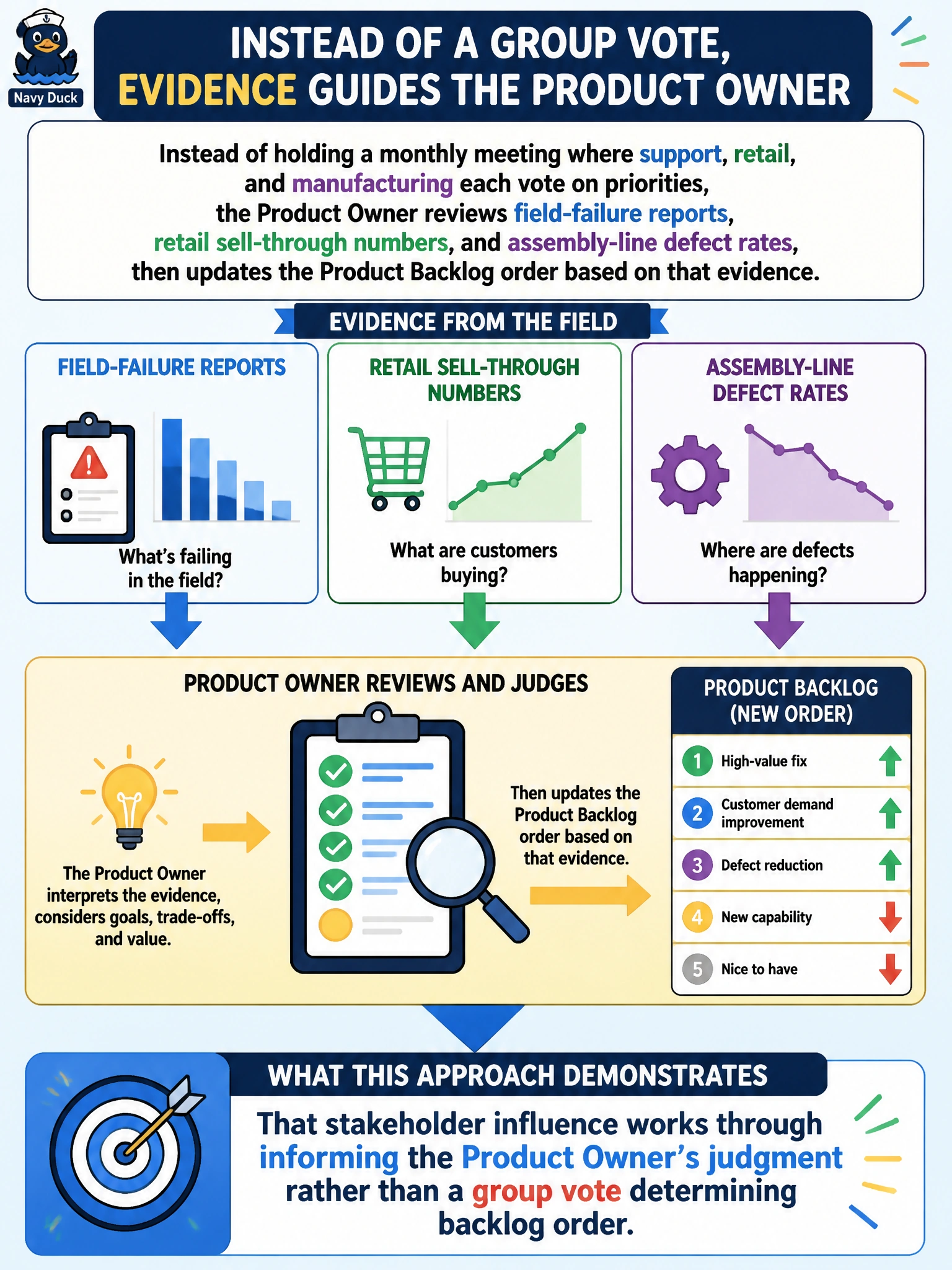
Instead of holding a monthly meeting where support, retail, and manufacturing each vote on priorities, the Product Owner reviews field-failure reports, retail sell-through numbers, and assembly-line defect rates, then updates the Product Backlog order based on that evidence. What does this approach demonstrate?
Select an answer to reveal the explanation.
Short Explanation
No ballots, no show of hands — just the Product Owner weighing real signals from the field, the shelf, and the line, and turning that into a judgment call about order. That's stakeholder engagement working as intended: information in, one accountable decision out.
Full Explanation
Engaging stakeholders well doesn't require a formal vote; it requires the Product Owner gathering the information stakeholders bring, whether field-failure reports from support, sell-through data from retail, or defect rates from manufacturing, and exercising judgment about what it means for the Product Backlog's order. This actually represents more, not less, stakeholder engagement than a monthly voting meeting would, because it treats each source as evidence to weigh rather than a ballot to tally, and it keeps the accountable decision with the person the Guide places it with. Reducing this to 'order by whichever number is largest' misreads the scenario: a small defect rate on a safety-relevant part might outweigh a much larger but low-severity support complaint volume, and only a human judgment call, not a mechanical rule, can weigh that correctly. Handing the raw data to the Developers to reorder the Sprint Backlog also misplaces the decision — the Sprint Backlog belongs to the Developers, but the Product Backlog's order is the Product Owner's accountability, and reordering the Sprint Backlog mid-Sprint based on outside data would undercut the Sprint Goal the Developers already committed to. A concrete check: can the Product Owner explain, item by item, which piece of evidence moved which item and why?