
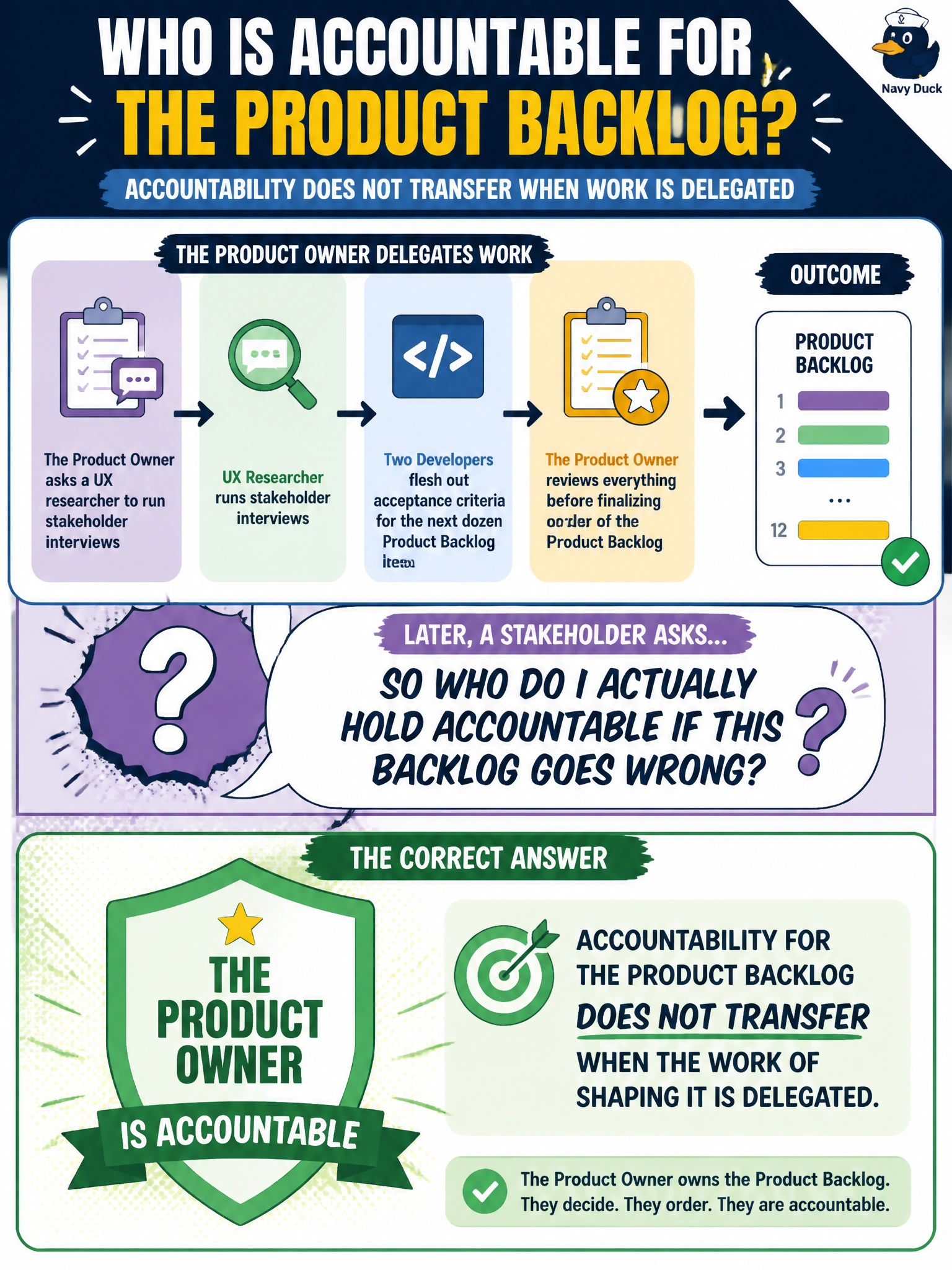
The Product Owner asks a UX researcher to run stakeholder interviews and asks two Developers to flesh out acceptance criteria for the next dozen Product Backlog items, then reviews everything before finalizing order. A stakeholder later asks, 'so who do I actually hold accountable if this backlog goes wrong?' What's the correct answer?
Select an answer to reveal the explanation.
Short Explanation
Lots of hands touched this backlog — a researcher, two Developers — but there's exactly one name on the accountability line, and it's the Product Owner. Delegating tasks is normal; delegating the accountability itself isn't something Scrum allows.
Full Explanation
The Scrum Guide allows the Product Owner to delegate refinement-related work — gathering stakeholder input, drafting acceptance criteria, even running research — to others, while stating plainly that the Product Owner remains accountable for Product Backlog management. That distinction between doing the work and owning the outcome is the whole point of the question: a UX researcher's interviews and two Developers' acceptance criteria are inputs the Product Owner reviewed and folded into a final backlog, so responsibility for how those inputs got weighted and ordered still traces back to one person. Naming the researcher or the Developers as accountable would suggest that whoever last touched a piece of the work owns the whole decision, which isn't how the accountability structure works — it also creates a diffusion of responsibility that makes it harder for stakeholders to know who to actually raise concerns with. The 'last edit in the tool' answer is a red herring too; tooling activity doesn't confer accountability under the Guide. A concrete check: when something in the backlog turns out to be wrong, is there one person who can explain the reasoning behind it and adjust course?