
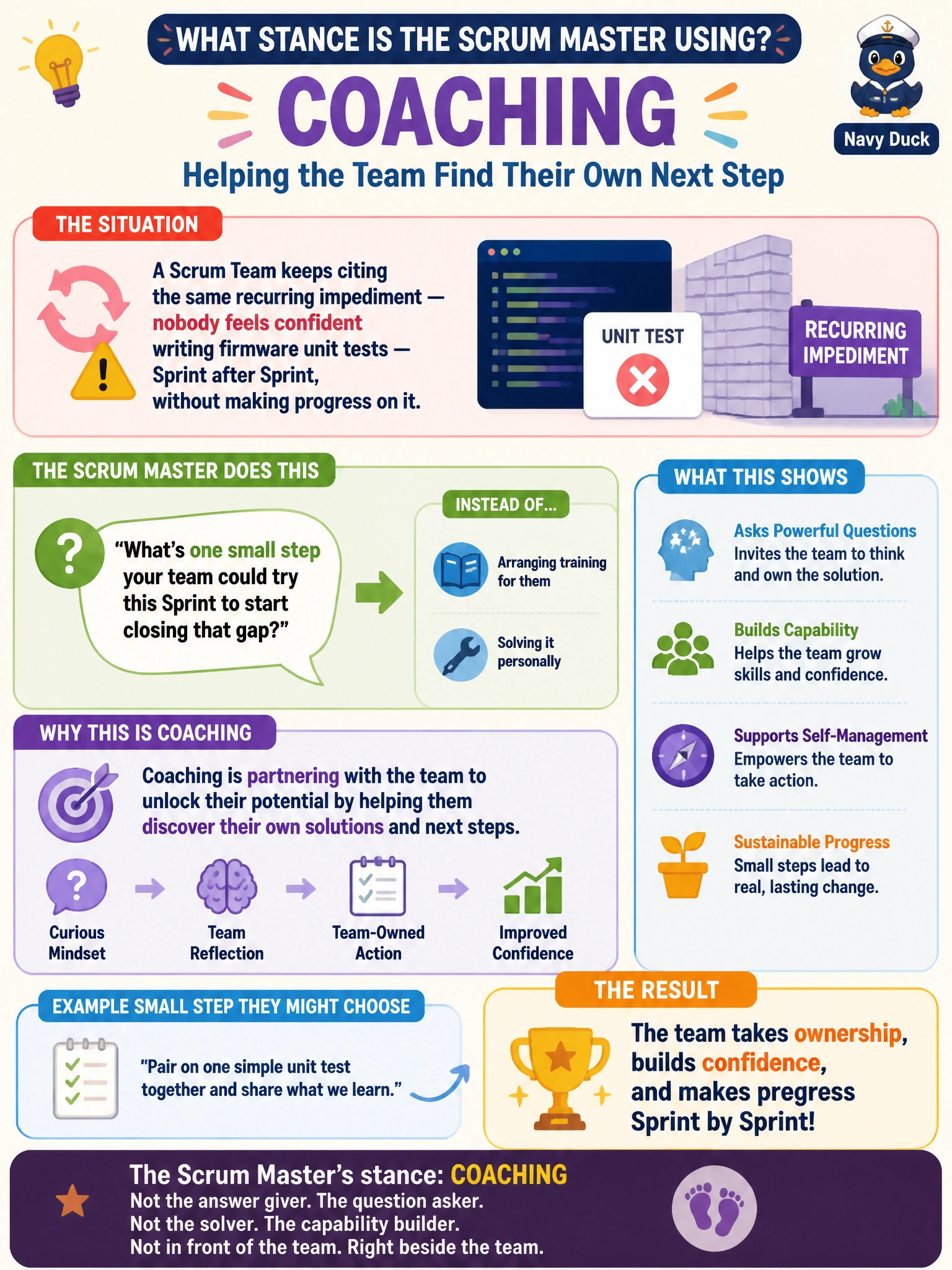
A Scrum Team keeps citing the same recurring impediment — nobody feels confident writing firmware unit tests — Sprint after Sprint, without making progress on it. Rather than arranging training for them or solving it personally, the Scrum Master asks the team, "What's one small step your team could try this Sprint to start closing that gap?" Which stance is the Scrum Master primarily using?
Select an answer to reveal the explanation.
Short Explanation
Instead of handing the team a training plan or fixing the gap directly, the Scrum Master tosses the question back to them — that's coaching, and it's a bet that the team is more likely to actually close the gap if the plan is theirs. A borrowed answer rarely sticks the way a team's own does.
Full Explanation
Coaching helps a team surface its own answer through open questions rather than being handed a solution, and that's exactly what's happening when the Scrum Master asks what small step the team itself could try, instead of prescribing training or intervening directly. This approach respects that the team, not the Scrum Master, is accountable for closing its own skill gaps and tends to produce a plan the team actually owns. Teaching would look different — it would involve the Scrum Master directly explaining unit-testing concepts or techniques, which isn't what's described; the intervention here is a question, not an explanation. Mentoring would involve the Scrum Master sharing their own past experience overcoming a similar gap ("here's what worked for me"), which also isn't present in the scenario as written — there's no experience being shared, just a question posed. Managing isn't an available Scrum Master behavior at all in this framing; arranging training unilaterally or directing the fix would edge toward managing the team's work, which is exactly what the Scrum Master avoided doing. An operational check: when the same impediment resurfaces Sprint after Sprint without movement, an open question that invites the team's own next step is often more effective than a solution imposed from outside, since it builds the team's own capability to solve similar gaps later.