
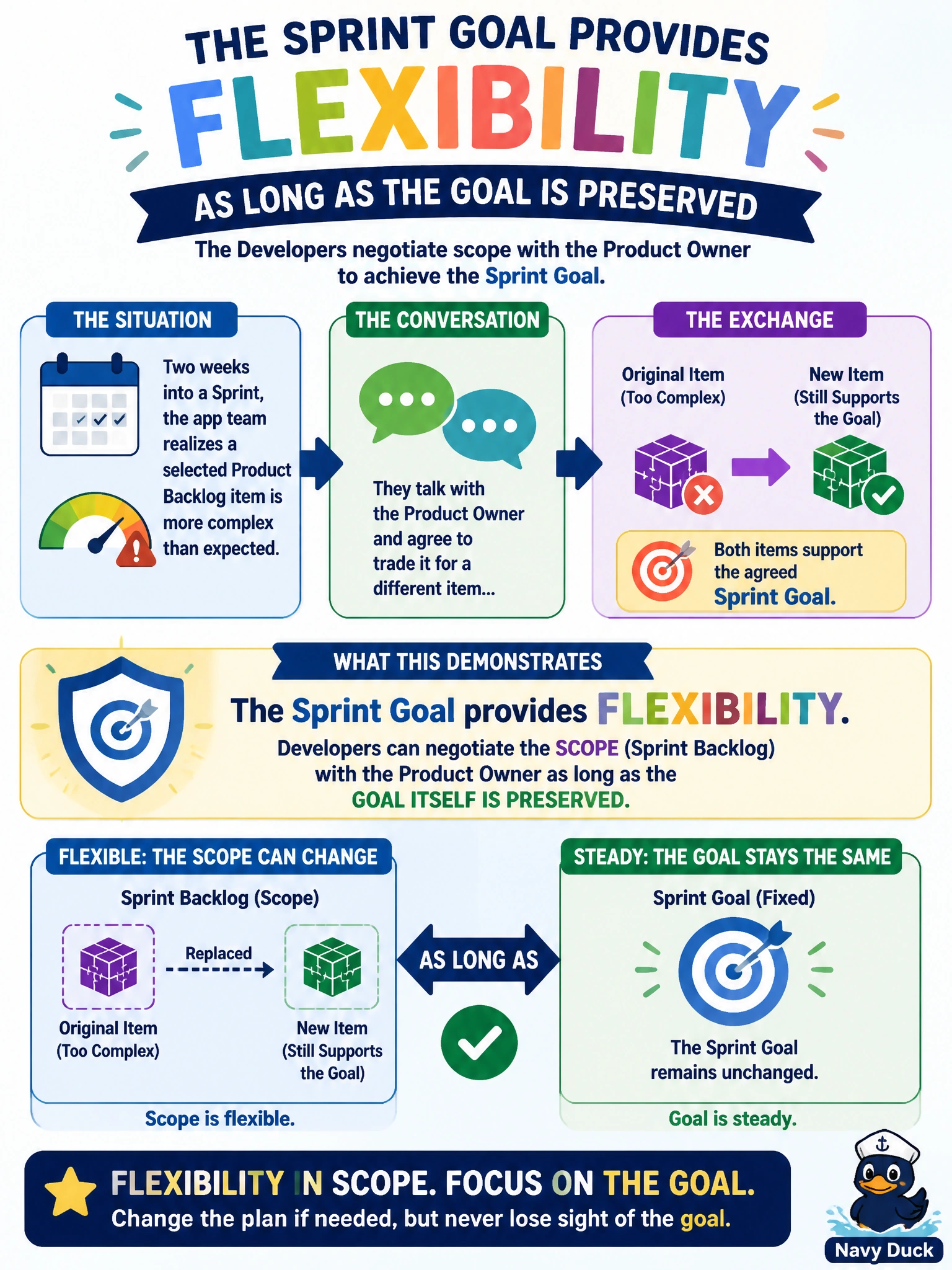
Two weeks into a Sprint, the app team realizes a selected Product Backlog item is more complex than expected. They talk with the Product Owner and agree to trade it for a different item that still supports the agreed Sprint Goal. What does this exchange demonstrate about the relationship between the Sprint Goal and Sprint Backlog scope?
Select an answer to reveal the explanation.
Short Explanation
The Sprint Goal is the fixed point; the specific items underneath it are allowed to move. Trading one item for another that still serves the same goal is the system working exactly as designed, not a workaround. It's what lets a team adapt to new information without abandoning what they promised to deliver.
Full Explanation
This is a textbook example of the flexibility the Sprint Goal is meant to provide: as the Developers learn more during the Sprint, they may clarify and renegotiate the scope of the Sprint Backlog with the Product Owner, provided the Sprint Goal remains the same. Swapping the overly complex item for one that still serves the agreed goal preserves the commitment that matters while adapting the plan to reality. Saying the Sprint Goal becomes meaningless after planning gets the logic backwards; it's precisely because the goal stays meaningful and stable that specific items can be traded without the team losing direction. Claiming the Sprint Goal must change with every item swap conflates the goal with the tactics used to reach it, when the whole point is that tactics can flex while the goal doesn't. Declaring that scope can never change mid-Sprint misdescribes the Sprint Backlog as fixed the moment Sprint Planning ends, when in fact it's expected to evolve throughout the Sprint. A useful check for Nestbot: whenever a swap like this happens, confirm out loud that the Sprint Goal still holds; if it doesn't, that's a signal the Sprint itself, not just an item, needs to be reconsidered.