
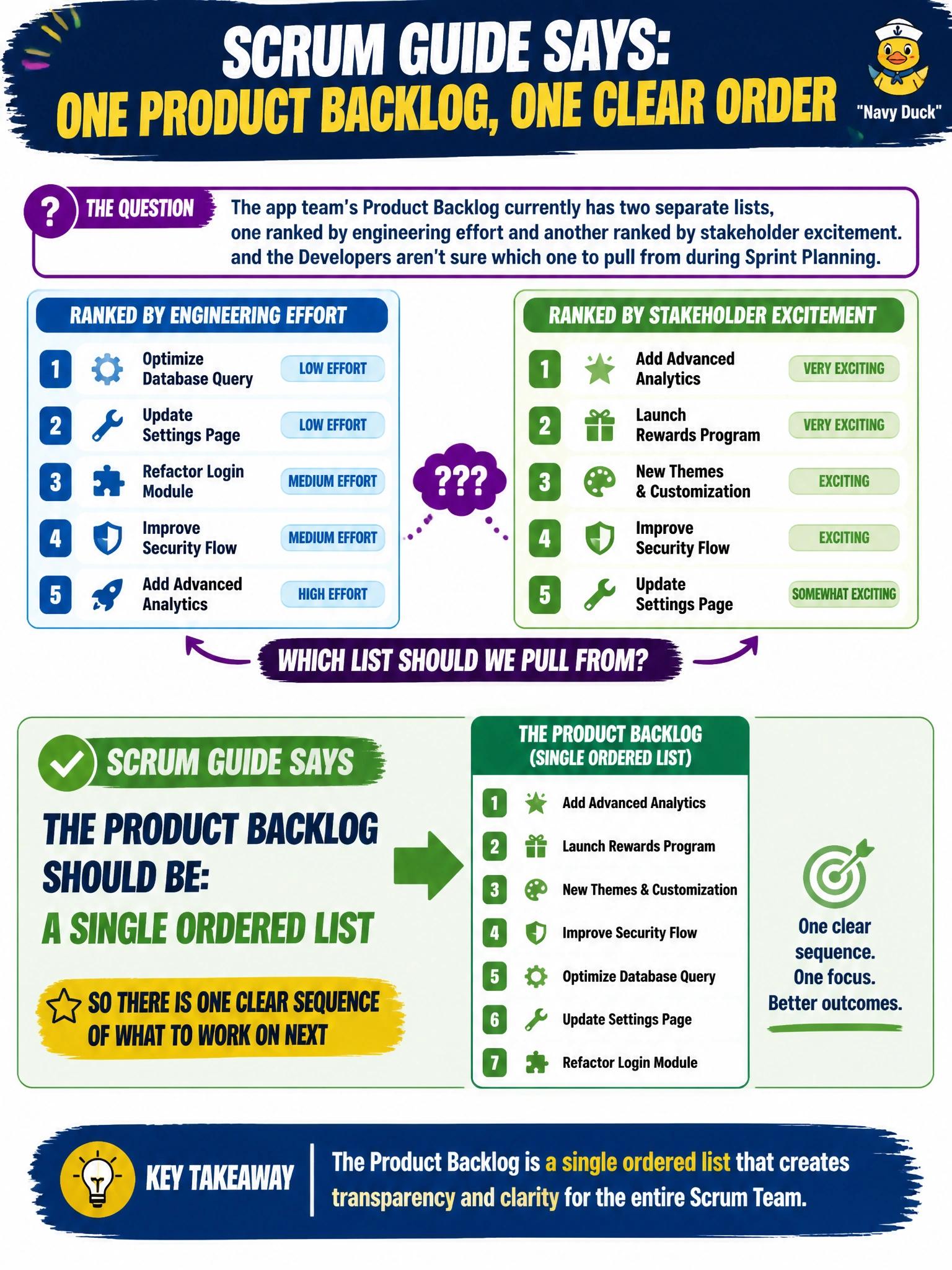
The app team's Product Backlog currently has two separate lists, one ranked by engineering effort and another ranked by stakeholder excitement, and the Developers aren't sure which one to pull from during Sprint Planning. What does the Scrum Guide say the Product Backlog should be?
Select an answer to reveal the explanation.
Short Explanation
Two competing rankings just means two competing opinions about what matters, and neither one is really "the" Product Backlog. Scrum wants one ordered list, full stop, so there's a single clear answer to "what's next." Splitting it by effort versus excitement recreates the confusion Scrum is trying to remove.
Full Explanation
The Product Backlog is defined as a single, ordered list, and that singularity is what makes "what's next" an answerable question rather than a matter of which ranking you consult. Nestbot's app team having two parallel lists, one by effort and one by excitement, has effectively created two competing sources of truth, which defeats the purpose of ordering in the first place. Allowing two lists as long as each is internally consistent misses that consistency within a list doesn't resolve the conflict between the lists; Developers still don't know which one governs Sprint Planning. Multiplying lists to represent every stakeholder group makes the problem worse, not better, turning ordering into a popularity contest across groups rather than a single, Product Owner-accountable decision. Letting each team member re-sort their own copy misunderstands ordering as a personal preference rather than a shared, agreed sequence the whole team plans against. The fix at Nestbot is to consolidate back to one list, with the Product Owner weighing both effort and stakeholder value when deciding the order, rather than maintaining two lists that quietly disagree with each other. A concrete check: at the next Sprint Planning, confirm the Developers can point to exactly one ordered list, not a choice between two.