
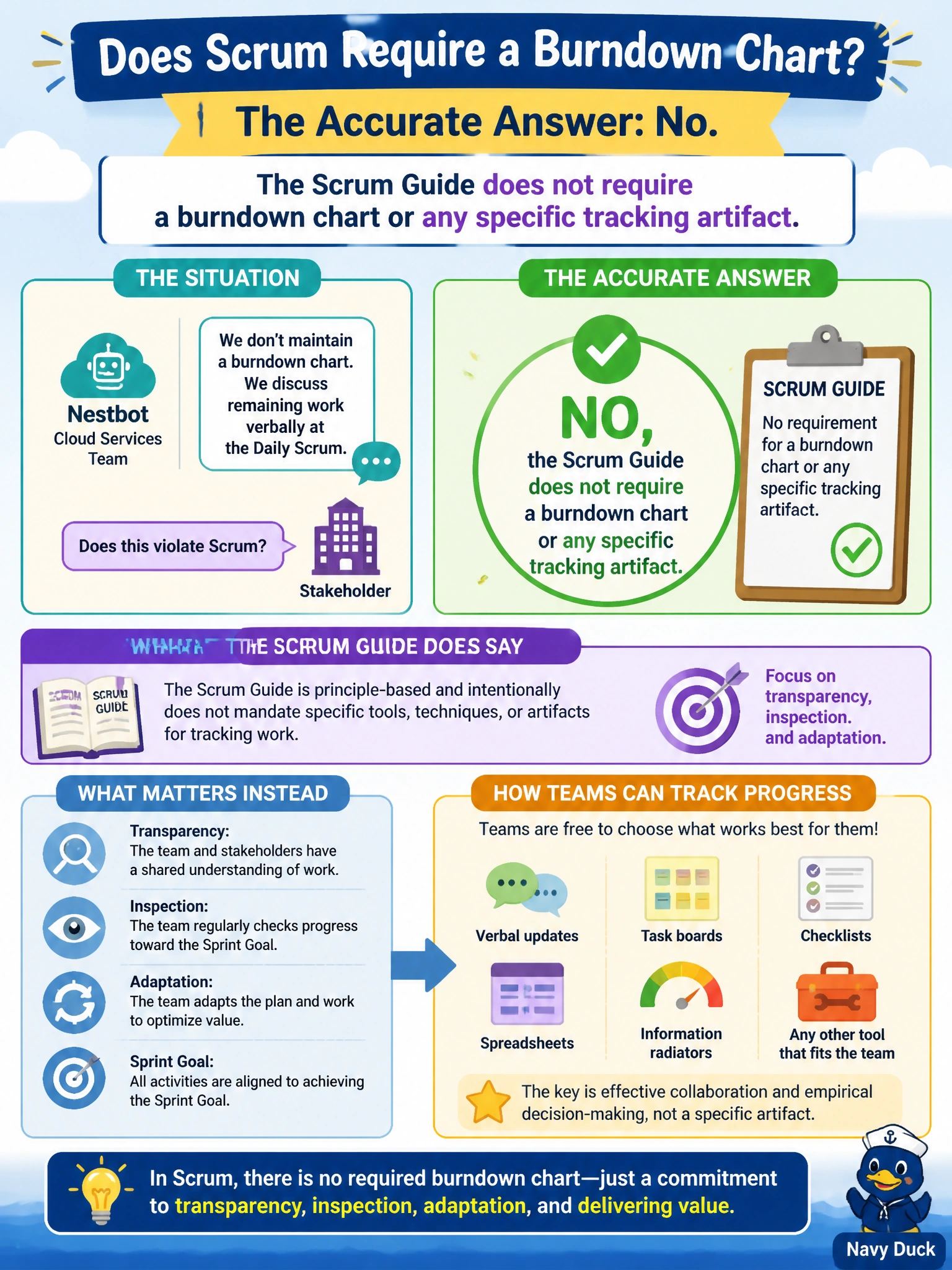
The Scrum Master joining Nestbot's cloud services team notices they don't maintain a burndown chart and instead just discuss remaining work verbally at the Daily Scrum. A stakeholder asks whether this violates Scrum. What is the accurate answer?
Select an answer to reveal the explanation.
Short Explanation
A burndown chart is a popular habit, not a Scrum rule. The Guide asks for the Sprint Backlog to give a real-time picture of remaining work and asks Developers to track progress toward the Sprint Goal, but it never names a chart to do that with. Talking it through at the Daily Scrum can satisfy the same need just fine.
Full Explanation
Nowhere does the Scrum Guide require a burndown chart, or any other specific chart, as the mechanism for tracking progress; it requires that the Sprint Backlog remain visible and current and that the Developers track their progress toward the Sprint Goal by some means that works for them. Verbally reviewing remaining work at the Daily Scrum can satisfy that intent just as legitimately as a chart would, so the cloud team isn't violating anything. Calling a burndown chart mandatory misattributes a widely taught practice, common in training material and tooling, to the Guide itself. Limiting the supposed requirement to a new team's first three Sprints invents a transition rule that appears nowhere in the framework. Substituting a burnup chart as the "real" required alternative repeats the same error with a different artifact; the Guide endorses neither by name. What actually matters is the outcome: can the team and stakeholders tell, at a glance or after a short conversation, how the Sprint is trending toward its goal. A practical check for Nestbot: sit in on a Daily Scrum and see whether the team can articulate remaining work and risk to the Sprint Goal without a chart; if they can, the intent is already met.