
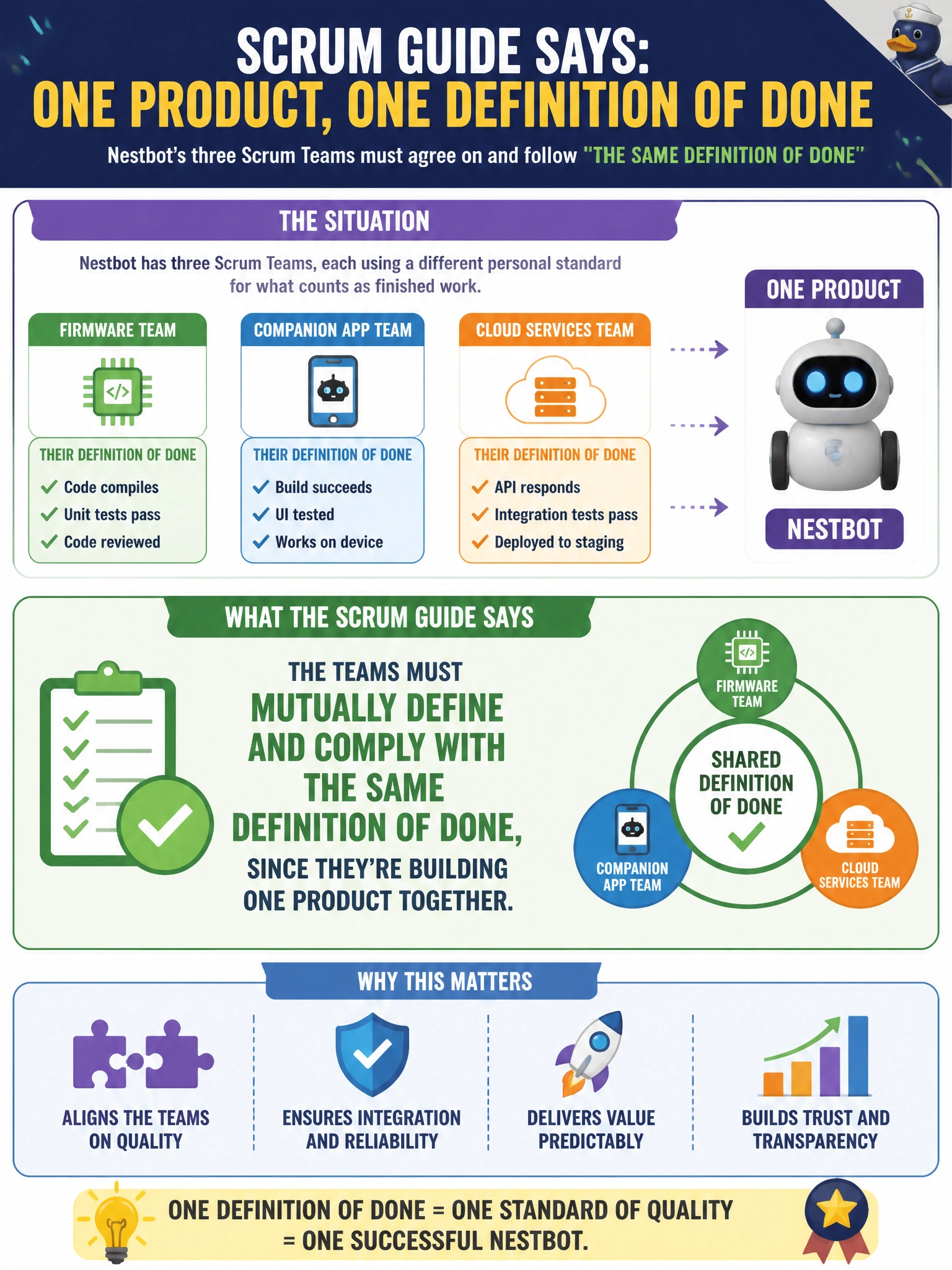
Nestbot now has three Scrum Teams, one each for firmware, the companion app, and cloud services, all contributing to the same robot product. Each team currently uses a different personal standard for what counts as finished work. What does the Scrum Guide say should happen to their Definitions of Done?
Select an answer to reveal the explanation.
Short Explanation
Three teams building one robot can't each be running their own private definition of "finished." When multiple Scrum Teams work on one product, they need to mutually agree on and follow a single Definition of Done together. Otherwise a firmware Increment and an app Increment might both be called Done while meaning completely different things.
Full Explanation
When multiple Scrum Teams are working together on one product, the Guide requires that they mutually define and comply with the same Definition of Done, since a shared Increment must mean the same thing regardless of which team touched it. Letting each of Nestbot's three teams keep its own private standard would produce Increments that all claim to be Done while representing wildly different levels of quality and verification, undermining the very transparency the artifact is supposed to provide. Allowing technical differences to justify separate standards ignores that a shared Definition of Done can still include discipline-specific criteria within one agreed document; it doesn't need to be identical in every clause, just mutually held. Handing arbitration to the Scrum Master misassigns ownership of a quality standard to a facilitation role rather than to the Developers across the teams who actually do the work. Exempting teams further from the customer ignores that an Increment from any team must be usable, and "usable" is meaningless without a shared bar. A practical check at Nestbot: put all three teams' criteria side by side and confirm they've actually agreed on one combined standard, not just tolerated each other's differences.