
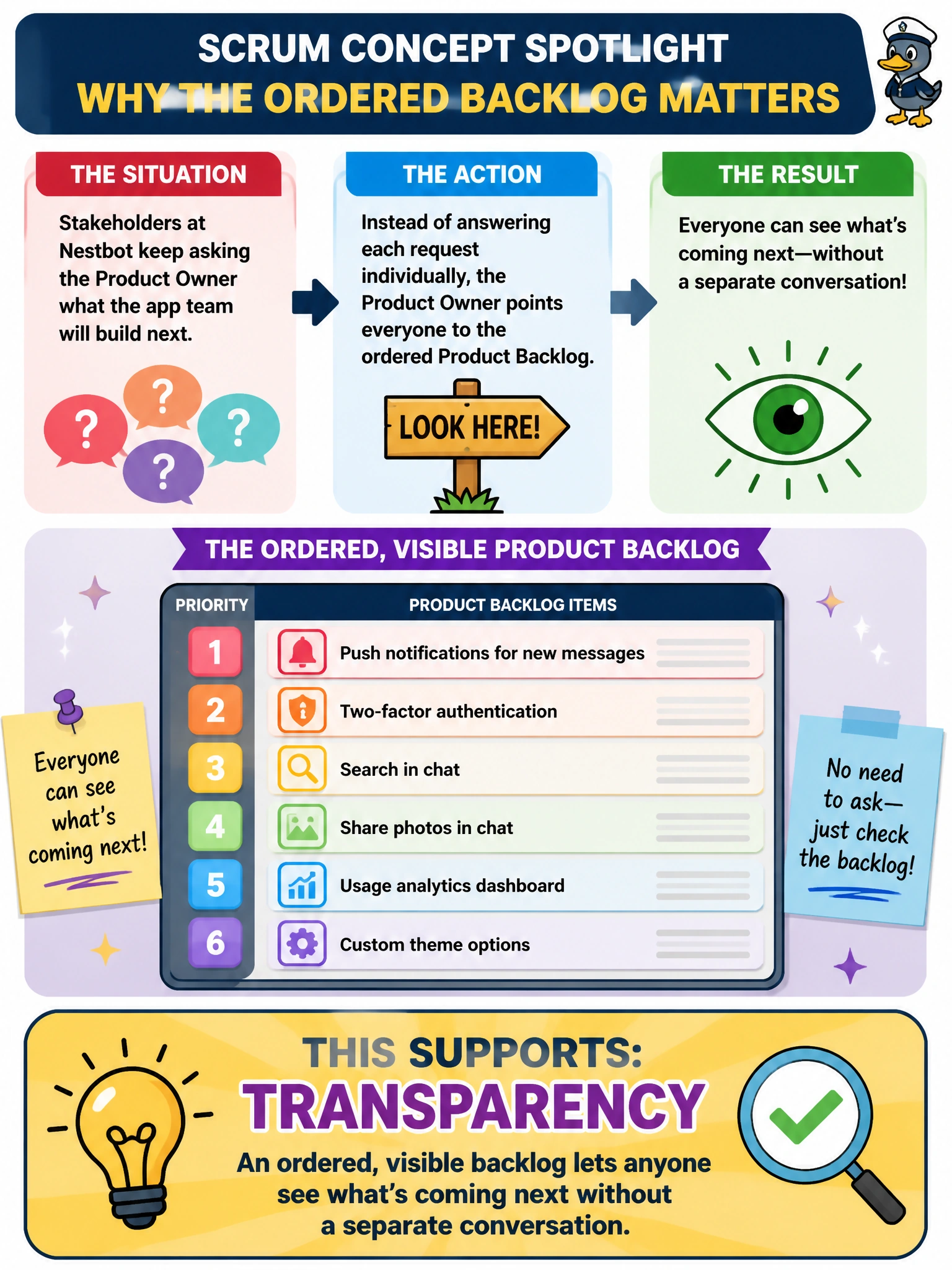
Stakeholders at Nestbot keep asking the Product Owner what the app team will build next. Instead of answering each request individually, the Product Owner points everyone to the ordered Product Backlog. Which Scrum concept does keeping the backlog visible and ordered primarily support?
Select an answer to reveal the explanation.
Short Explanation
An ordered, visible Product Backlog does the talking so the Product Owner doesn't have to answer the same question over and over. That's transparency at work: the significant aspects of the process are visible to everyone who needs to know. Anyone can look at the list and see roughly what's coming, in what order, without a side conversation.
Full Explanation
Transparency is one of the three pillars of empiricism, and it depends on significant information being visible and shared in a common, understood standard. An ordered Product Backlog that stakeholders can see for themselves is a direct expression of that pillar: it turns "what's next" from a question that requires a person to answer into information anyone can inspect on their own. Self-management describes how the Developers organize their own work internally, which is a different concept from stakeholders being able to see the backlog. The Sprint Goal is a single objective for the current Sprint, narrower than and distinct from the whole ordered Product Backlog, so it doesn't describe what visibility into the full list provides. Maintaining a backlog tool is a mechanical facilitation detail, not the underlying reason visibility matters, and conflating the two mistakes the vehicle for the concept it enables. A practical check for Nestbot: if a stakeholder still can't answer "what's coming next" after looking at the backlog themselves, the ordering or the information on each item isn't transparent enough yet.