
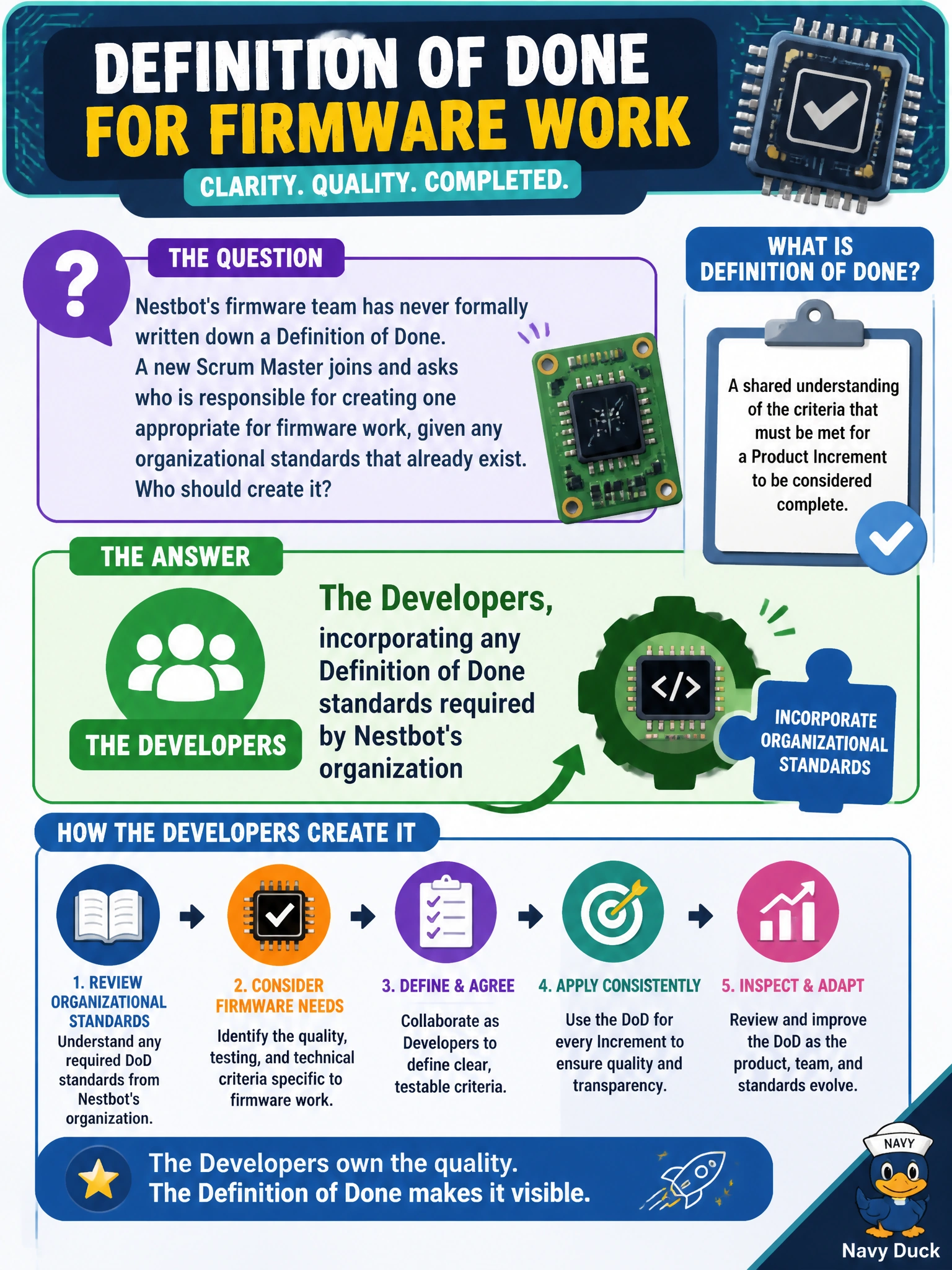
Nestbot's firmware team has never formally written down a Definition of Done. A new Scrum Master joins and asks who is responsible for creating one appropriate for firmware work, given any organizational standards that already exist. Who should create it?
Select an answer to reveal the explanation.
Short Explanation
If there's no Definition of Done yet, it's not a gap for outsiders to fill; it's the Developers' job to write one. They fold in whatever organizational standards Nestbot already requires, then own the result. It becomes their own working agreement for when firmware work is genuinely finished.
Full Explanation
When no Definition of Done exists for the kind of work being done, the Guide places the responsibility for creating one squarely on the Developers, who must fold in any Definition of Done standards their organization already mandates. This keeps the standard grounded in the people who actually build and verify the work, while still respecting company-wide quality requirements that predate the team. A newly arrived Scrum Master bringing outside perspective is welcome as a facilitator surfacing the gap, but authoring the standard themselves would substitute their judgment for the Developers' technical ownership of quality. The Product Owner's accountability for product value doesn't extend to defining what "done" means technically; that would blur two distinct accountabilities the Guide keeps separate. Handing it to a QA department independent of the Scrum Team recreates a hand-off between building and verifying that Scrum is structured to eliminate. A useful check: once a Definition of Done is drafted, confirm it was written or at least ratified by the Developers themselves, with any mandatory organizational criteria clearly folded in rather than bolted on afterward.