
A home-robot company's Product Owner wants to invite the retail partner's merchandising lead and the customer-support director to the next Sprint Review, alongside the app and firmware Developers. Is this consistent with the Scrum Guide's description of the Sprint Review?
Select an answer to reveal the explanation.
Short Explanation
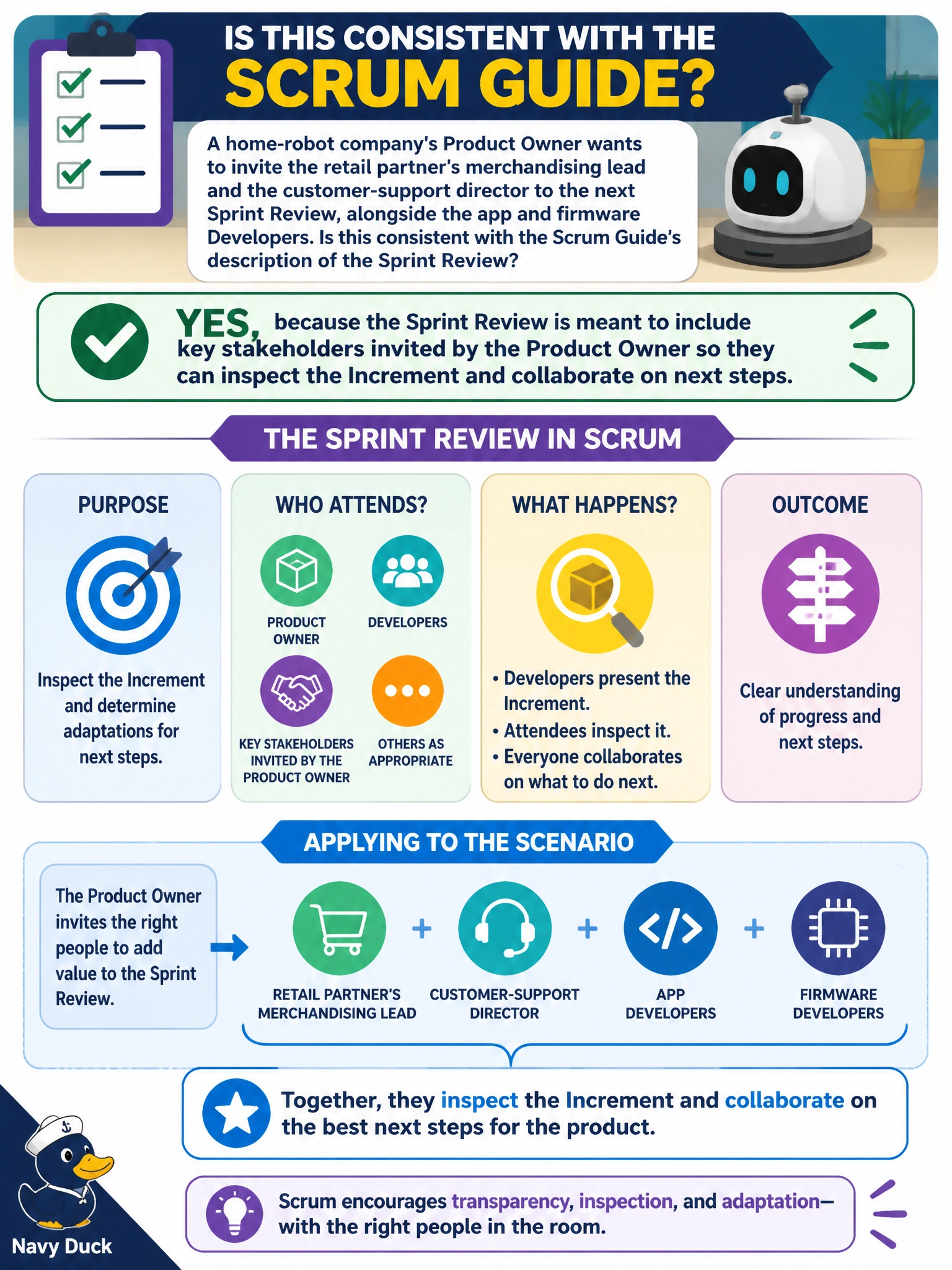
Bringing in the merchandising lead and the support director is exactly the kind of thing a Sprint Review is for — real stakeholders looking at real progress and weighing in. They don't need to join the Scrum Team to have a seat at that table; they're stakeholders, and the event is built around having them there.
Full Explanation
The Scrum Guide describes the Sprint Review as a working session where the Scrum Team presents its work to key stakeholders, and the whole group collaborates on what to do next — stakeholders are external to the Scrum Team by definition and are invited because their perspective matters to the product's direction. A retail merchandising lead and a customer-support director are natural stakeholders for a consumer hardware product: one represents the channel the product ships through, the other represents the field feedback loop. Restricting attendance to internal employees only, or to just the Product Owner and Developers, contradicts the Guide's own description of the event's purpose, which explicitly anticipates outside participation. Requiring the retail partner to formally join the Scrum Team misunderstands both the Scrum Team's composition — which stays at Product Owner, Scrum Master, and Developers, with no fourth accountability — and the nature of stakeholder involvement, which does not require membership; stakeholders participate in the Review without becoming part of the Scrum Team itself. A concrete check: when planning a Sprint Review's guest list, ask whether each invitee can give input that would change what's next on the Product Backlog — if yes, they belong in the room as a stakeholder, not as a team member.