
A Product Owner at a home-robot company wants to sit in on the app team's Daily Scrum to stay informed but is not actively working on Sprint Backlog items. According to the Scrum Guide, is this allowed, and under what condition?
Select an answer to reveal the explanation.
Short Explanation
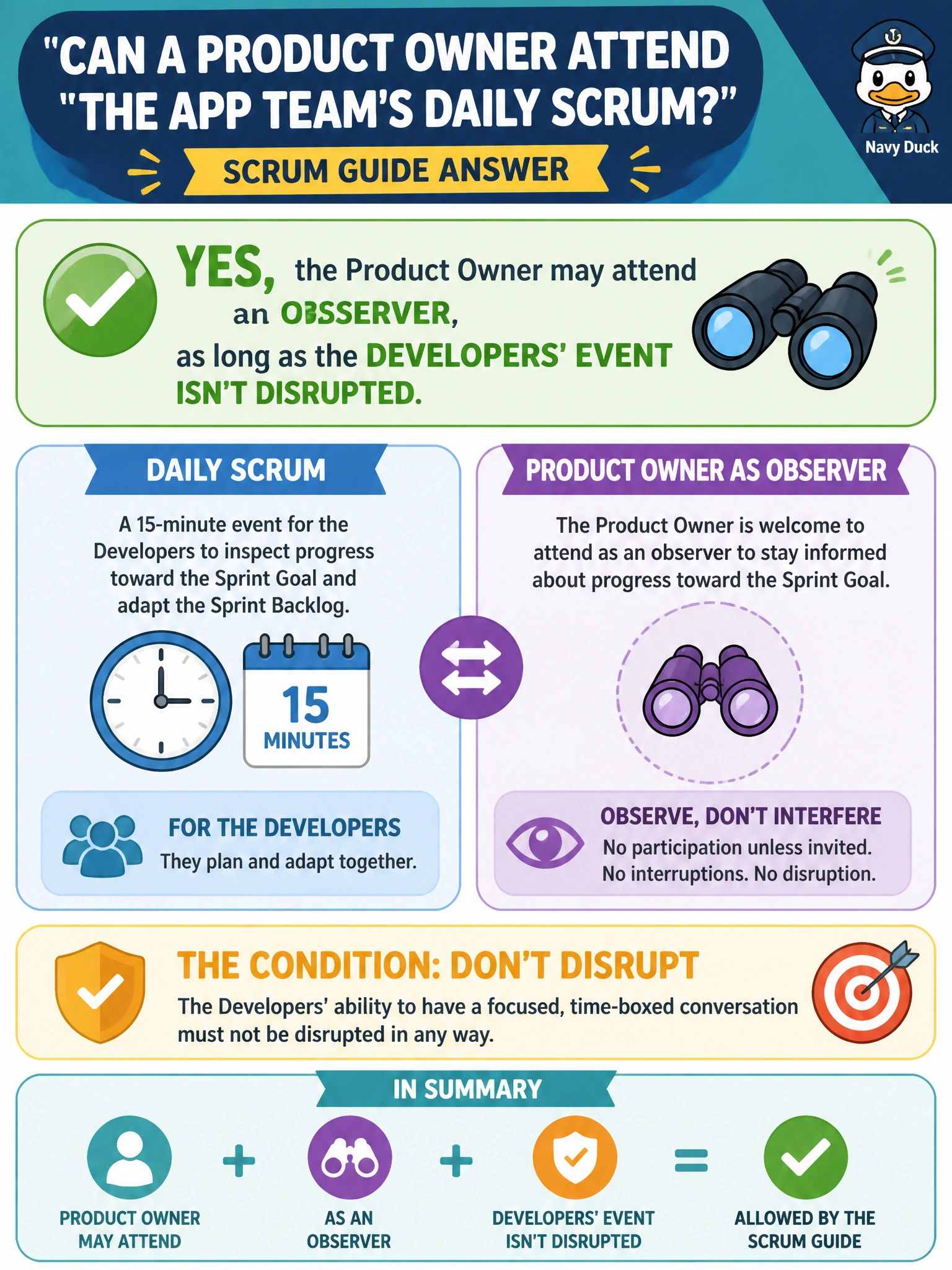
Sitting in quietly is fine — the Daily Scrum just isn't a stage for anyone who isn't a Developer to take over. A Product Owner can be present as an observer as long as the event stays focused and undisturbed. Actively contributing to the Sprint Backlog work is a different matter, which is what turns someone into a Developer for that purpose.
Full Explanation
The Scrum Guide allows other people, including the Product Owner and the Scrum Master, to be present at the Daily Scrum, and specifically says that if they are actively working on items in the Sprint Backlog, they participate as Developers - otherwise, they're present as observers who must not be allowed to disrupt the event. A Product Owner who just wants to stay informed, without steering the conversation or asking the Developers to justify their plan mid-event, fits comfortably inside that allowance. Banning anyone but Developers and the Scrum Master outright is stricter than what the Guide actually says; observers are explicitly permitted. Requiring a title change to "Developer" for the Product Owner to attend invents a formality the Guide doesn't require - attending as an observer doesn't require reclassifying anyone's accountability. Restricting the Product Owner to written status reports only removes an option the Guide leaves open, and isn't necessary as long as the Product Owner's presence doesn't disrupt the event. Caveat: "not disrupting" is doing real work here - an observer who starts asking questions, requesting justifications, or redirecting the conversation has crossed from observing into disrupting, which the Guide doesn't sanction. Operational check: if a Daily Scrum regularly runs long or the Developers start talking to the Product Owner instead of each other, a Scrum Master should treat that as the disruption condition being crossed, not as normal attendance.