
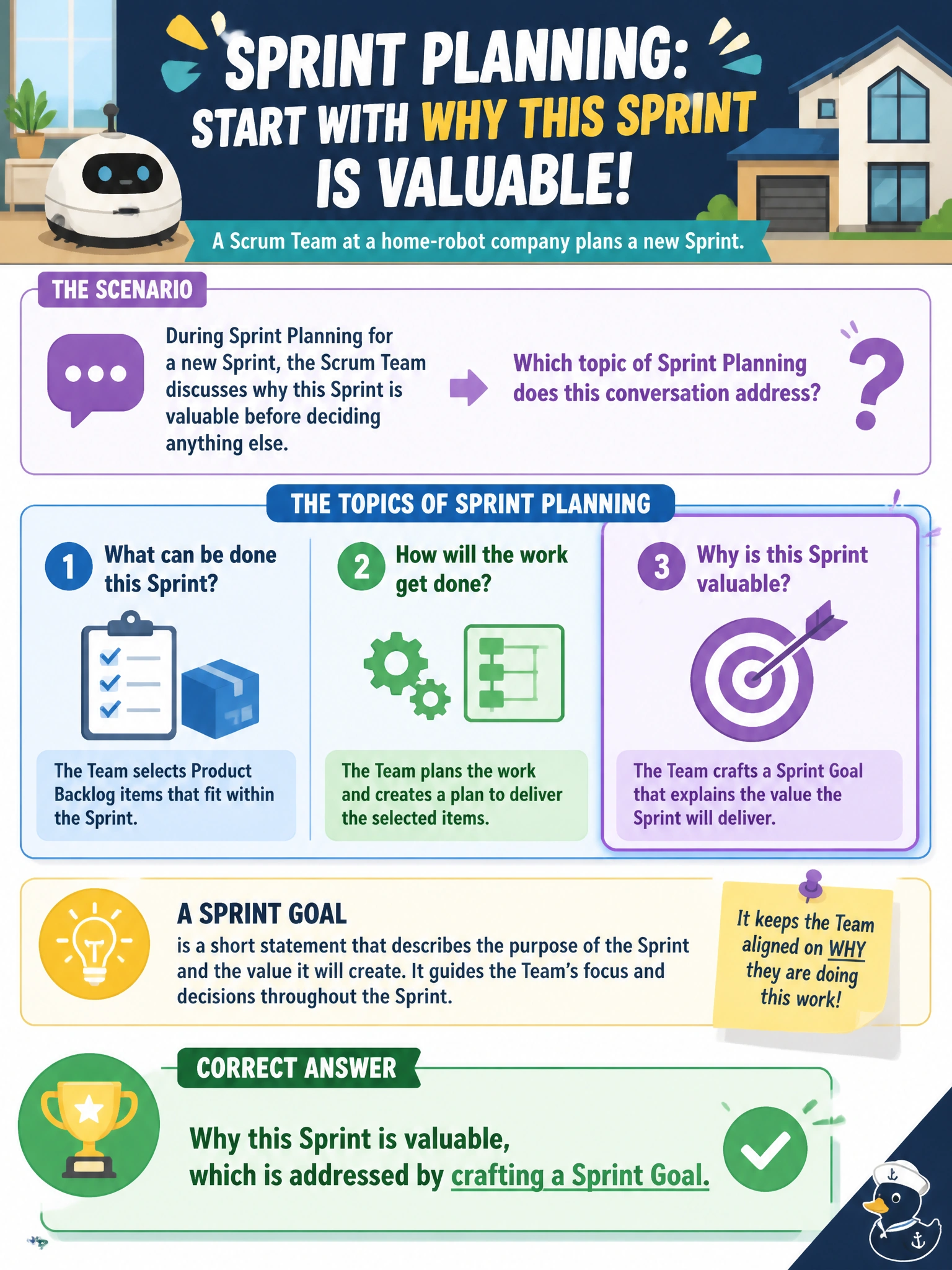
During Sprint Planning for a new Sprint, the Scrum Team at a home-robot company discusses why this Sprint is valuable before deciding anything else. Which topic of Sprint Planning does this conversation address?
Select an answer to reveal the explanation.
Short Explanation
Sprint Planning opens with the biggest-picture question first: why does this Sprint matter at all? That conversation is where the Scrum Team shapes a Sprint Goal — the single objective that gives the whole Sprint its purpose. Everything else planned in the Sprint gets checked against that "why" before anyone talks about specific items or tasks.
Full Explanation
Sprint Planning addresses three topics in sequence: why the Sprint is valuable, what can be done, and how the chosen work will get done. The "why" topic is where the Product Owner proposes how the product could increase its value and utility in the current Sprint, and the whole Scrum Team collaborates to craft a Sprint Goal that everyone attending can articulate - that Goal is what later gives the Sprint Backlog coherence and lets the Developers make trade-offs during the Sprint without losing sight of the objective. Describing the "how" topic - the delivery approach and breaking work into a plan - answers a later question in Sprint Planning, not this first one. Describing the "what" topic - which Product Backlog items become the forecast - is the second topic, decided after the Sprint Goal is set, not before it. Sprint extension for hardware testing isn't a Sprint Planning topic at all; a Sprint's length doesn't change once it starts, regardless of what Sprint Planning covers. Caveat: a Sprint Goal is a commitment made by the Developers, but the specific items or tasks used to achieve it can still be renegotiated with the Product Owner as the Sprint unfolds. Operational check: at the end of the "why" conversation, every Developer should be able to state the Sprint Goal in one sentence without checking a backlog tool.