
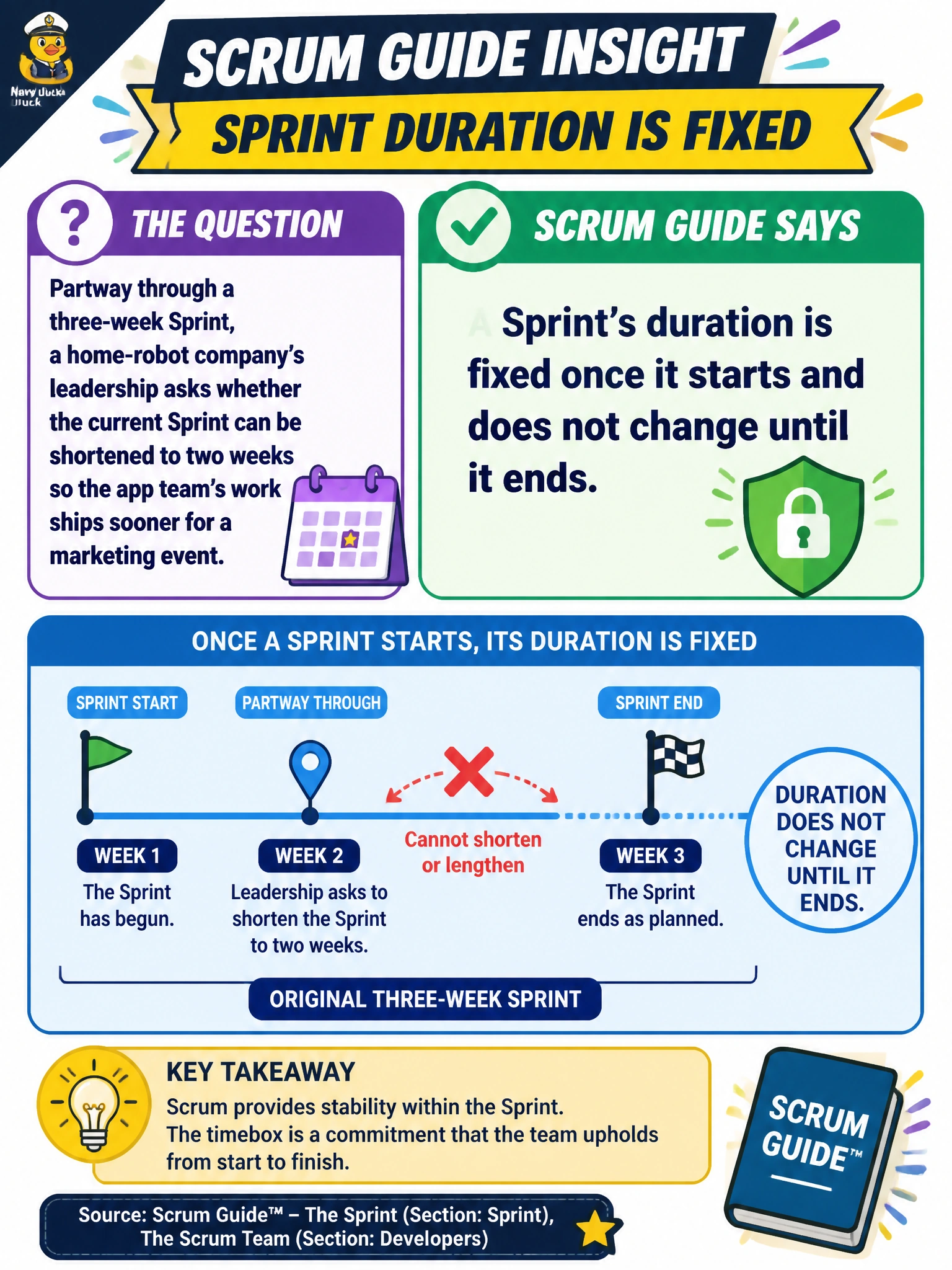
Partway through a three-week Sprint, a home-robot company's leadership asks whether the current Sprint can be shortened to two weeks so the app team's work ships sooner for a marketing event. What does the Scrum Guide say about changing a Sprint's duration once it has started?
Select an answer to reveal the explanation.
Short Explanation
A Sprint's length locks in the moment it starts, the same way a race distance doesn't shrink halfway through because a runner is ahead of pace. Wanting to ship sooner for a marketing event is a real business need, but it gets handled by what goes into the next Sprint, not by rewriting the current one's clock. Consistency in length is what makes the whole cadence trustworthy.
Full Explanation
Once Sprint Planning ends and a Sprint begins, its duration is fixed for the rest of that Sprint - the Scrum Guide describes Sprint length as set and unchanging within the Sprint, whether the pressure is to lengthen it for a delay or shorten it for good news. A marketing deadline is legitimate input, but it belongs in decisions about what the next Sprint contains or how the Product Backlog gets ordered, not in editing the current Sprint's boundary. Letting the Product Owner shorten it because remaining items are Done misreads what finishing early means: a Sprint that finishes its planned work early doesn't need a shorter clock, it just has room for the Developers to pull in more backlog work or invest in improvements. Requiring unanimous Daily Scrum agreement invents a governance mechanism for changing Sprint length that the Guide never describes - the Daily Scrum inspects progress toward the Sprint Goal, it doesn't renegotiate the calendar. Giving the Scrum Master authority to shorten a Sprint assigns a unilateral power no accountability holds; the only structural way a Sprint ends early is cancellation by the Product Owner, and that's a distinct, narrowly defined event. Caveat: cancellation exists for when a Sprint Goal becomes obsolete, not for hitting a marketing window early. Operational check: if a Sprint finishes its forecast ahead of schedule, look at the Product Backlog for more value to pull in rather than touching the end date.