
At a home-robot company, a newer Scrum Master is drawing a calendar for the team and wonders where the Daily Scrum, Sprint Review, and Sprint Retrospective fit relative to the Sprint boundaries. According to the Scrum Guide, how do these other events relate to the Sprint?
Select an answer to reveal the explanation.
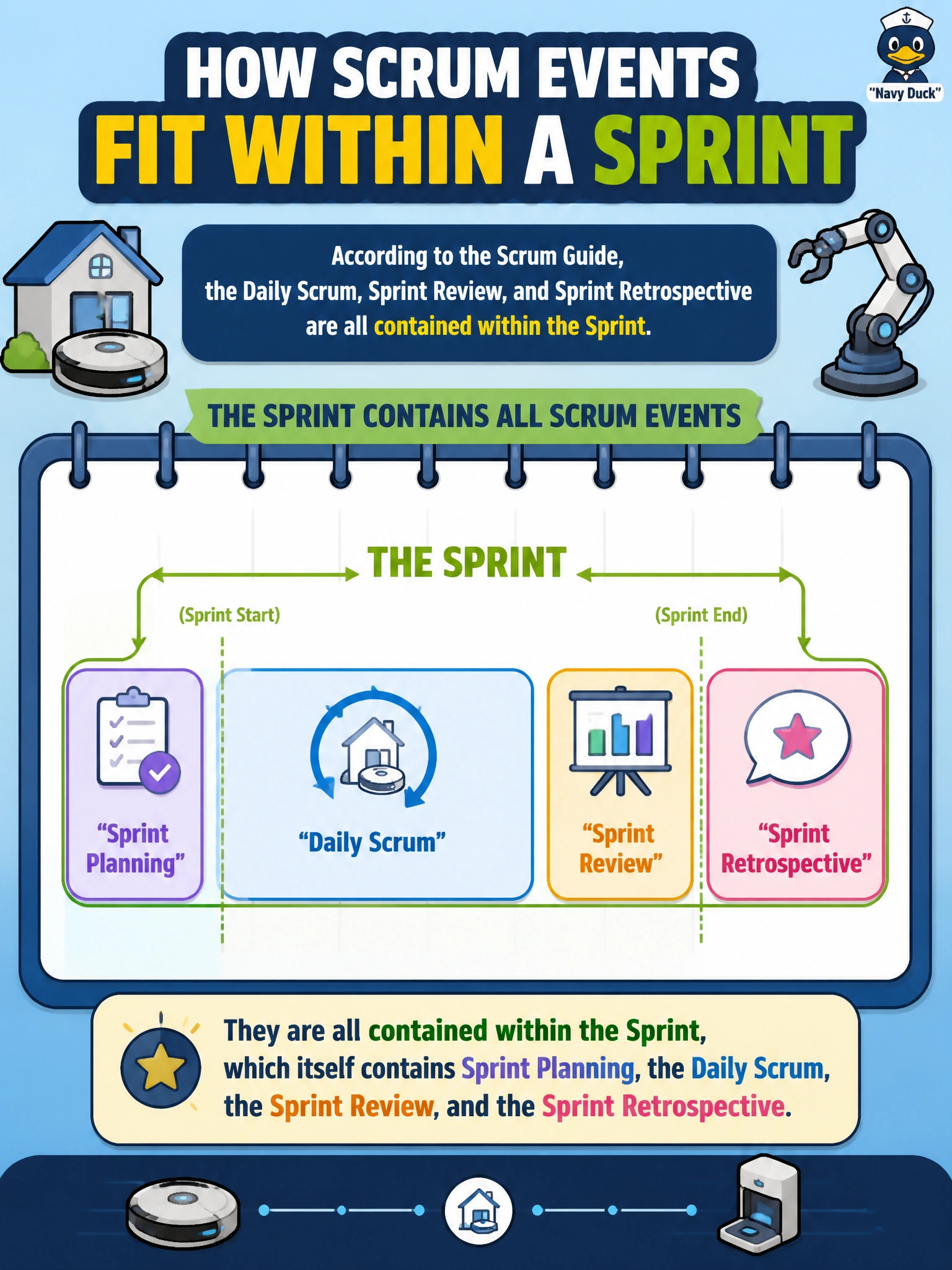
Short Explanation
Picture the Sprint as a box, and every other Scrum event lives inside that box — nothing spills over the edges. Sprint Planning kicks the box off, Daily Scrums happen every working day inside it, and the Sprint Review and Sprint Retrospective close it out before the next box starts right after. There's no gap between Sprints where these events float free.
Full Explanation
A Sprint is a fixed-length container of work, and the Scrum Guide is explicit that Sprint Planning, the Daily Scrum, the Sprint Review, and the Sprint Retrospective all happen inside that container - a new Sprint starts immediately after the previous one ends, leaving no idle interval for events to occur between Sprints. This matters for a scaling robotics company because it keeps cadence predictable across an app team, a firmware team, and a cloud team even as headcount grows: everyone knows the rhythm repeats without gaps. Placing the Sprint Review and Retrospective after the Sprint ends invents a between-Sprints gap the Guide does not describe. Putting the Daily Scrum between Sprints confuses it with a retrospective-style look-back; the Daily Scrum inspects progress toward the current Sprint's goal, which only exists while a Sprint is active. Treating Sprint Planning as pre-Sprint prep misplaces the event that actually opens the Sprint. Caveat: the only thing that can shorten a Sprint from the outside is cancellation by the Product Owner, and even that is still an event happening within the Sprint, not before it. Operational check: on a team calendar, the Sprint Retrospective for Sprint 12 should close on the same day Sprint 13's Planning opens, with zero days between.