
A robotics company is debating whether its Scrum Master should also serve as the Product Owner for the same Scrum Team to 'save headcount.' What does the 2020 Scrum Guide indicate about combining these two accountabilities in one person?
Select an answer to reveal the explanation.
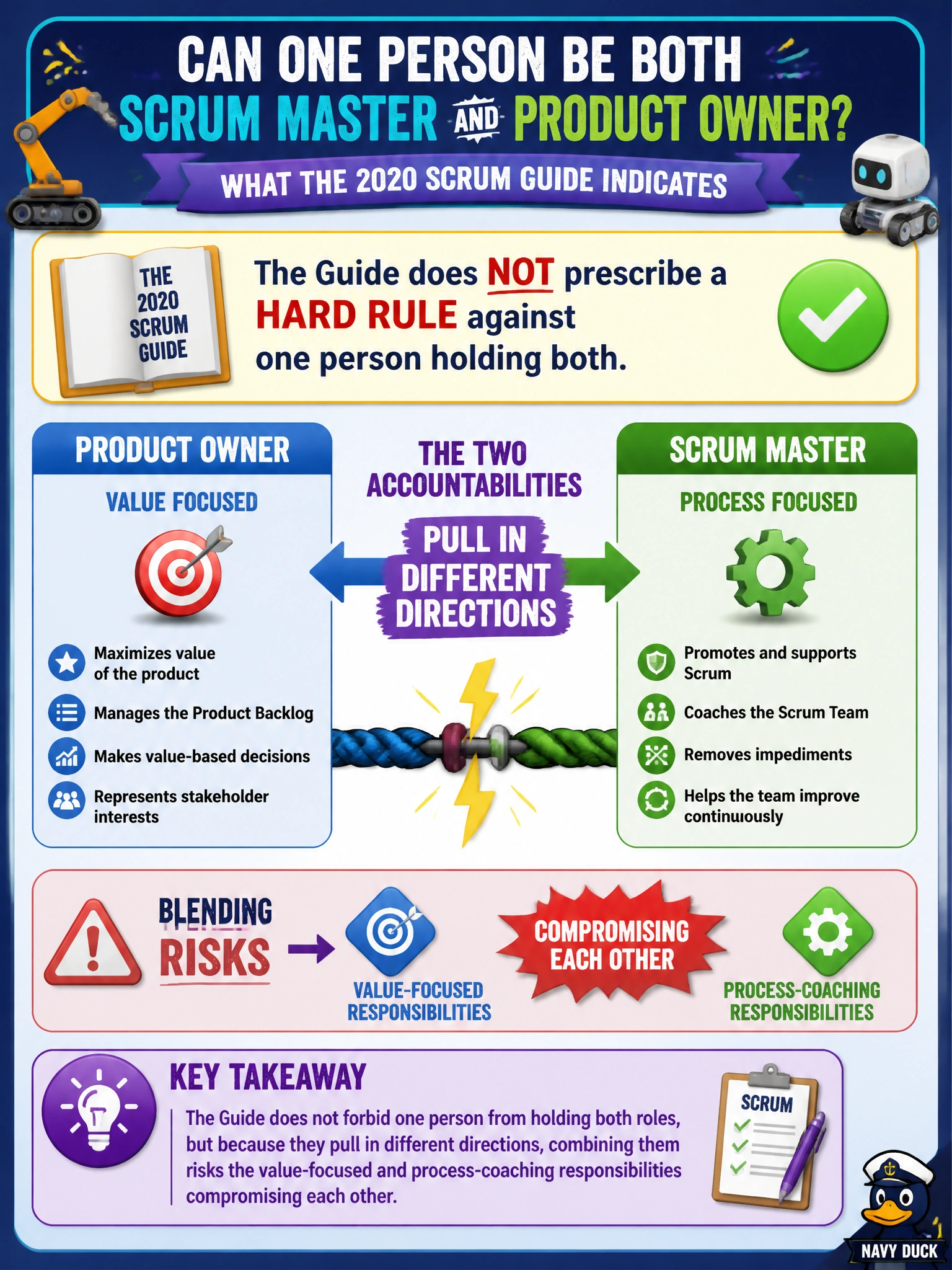
Short Explanation
Nothing in the Guide slaps a flat ban on one person wearing both hats, but that doesn't make it a good idea. The Product Owner is chasing value trade-offs while the Scrum Master is coaching the process and protecting the team's health — stack both jobs on one person, and one of those focuses usually starts losing to the other.
Full Explanation
The 2020 Scrum Guide does not state an absolute prohibition on one individual holding both the Product Owner and Scrum Master accountabilities, but it does describe them as distinct, with different responsibilities — the Product Owner focused on maximizing value and Product Backlog management, the Scrum Master focused on coaching the team and organization toward effective Scrum. Combining them creates real tension: a Product Owner instinct to push for more scope can conflict with a Scrum Master instinct to protect the team's sustainable pace and self-management, and one person under pressure is likely to favor one accountability's priorities over the other's rather than serve both fully. Calling it 'required for small companies' overstates what the Guide says — headcount pressure is a real-world business constraint, not a Scrum Guide mandate to merge the roles. Calling it 'forbidden in every circumstance' also overstates the Guide's actual silence on the specific staffing question. Framing it as 'ideal' because it reduces coordination points ignores the accountability conflict entirely and treats fewer people as automatically better regardless of the tension it introduces. The practical caution: if a company does combine the accountabilities, it should watch closely for whichever accountability quietly starts losing out to the other.