
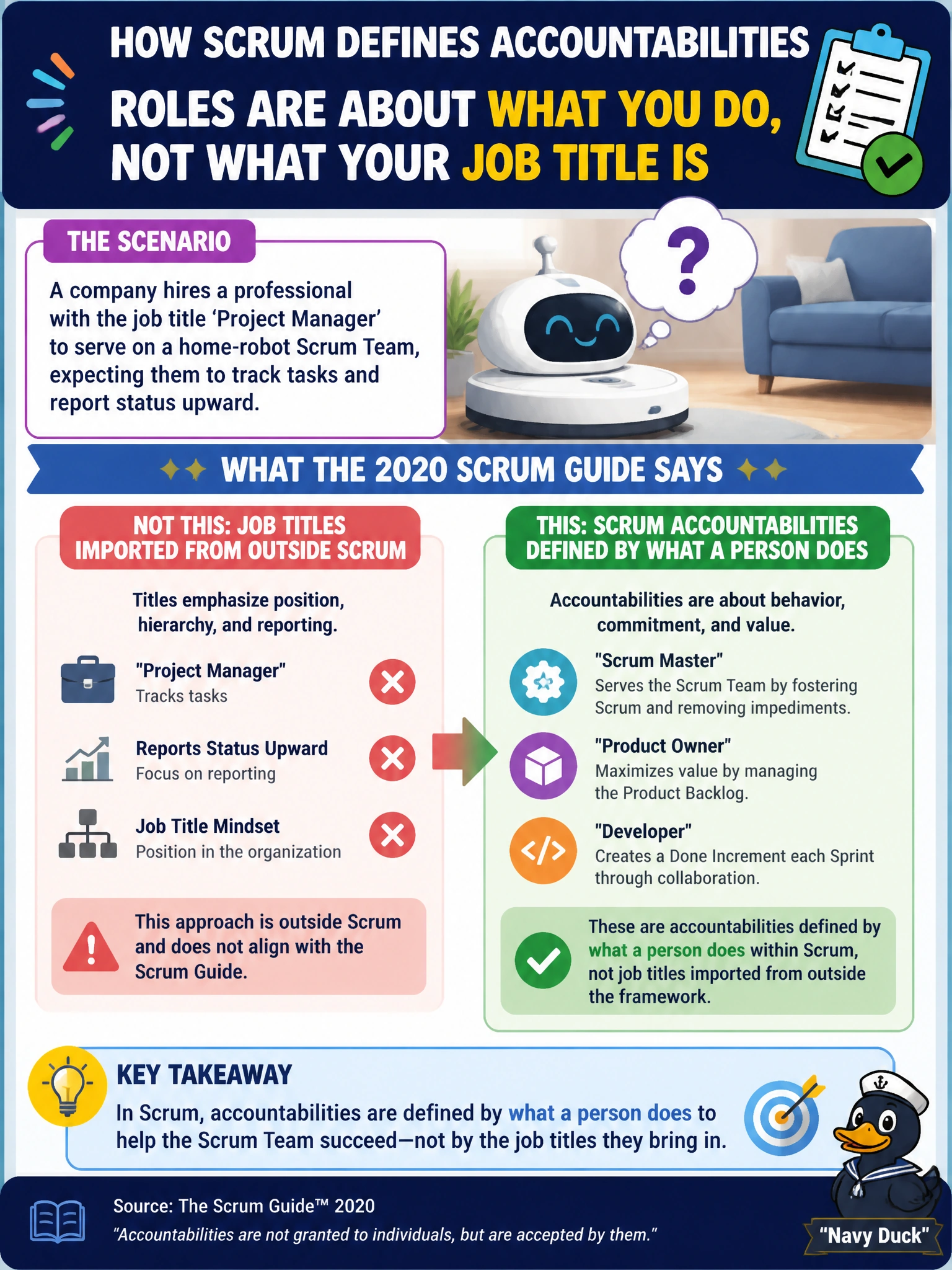
A company hires a professional with the job title 'Project Manager' to serve on a home-robot Scrum Team, expecting them to track tasks and report status upward. Which statement best reflects how the 2020 Scrum Guide treats accountabilities like Scrum Master, Product Owner, and Developer?
Select an answer to reveal the explanation.
Short Explanation
Scrum doesn't hand out job titles — it hands out accountabilities. Whatever someone's badge says on the org chart, inside the Scrum Team what matters is which of the three jobs they're actually doing: shaping the product, coaching the process, or building the thing. A 'Project Manager' title doesn't map onto any of them automatically.
Full Explanation
The 2020 Scrum Guide describes Product Owner, Scrum Master, and Developers as accountabilities — defined by the specific responsibilities each carries within the Scrum Team — rather than as job titles carried over from other management traditions. A person with an external title like 'Project Manager' can join a Scrum Team, but they must take on one of the three actual accountabilities and do that work, not import a status-reporting or task-tracking function that doesn't correspond to any of them. Framing the accountabilities as skill certifications misses that they describe responsibility, not credentialing. Treating them as interchangeable labels for one generic role erases the real boundaries the Guide draws around each accountability's decisions and scope. Describing them as management positions with authority over teammates is also wrong: none of the three accountabilities is a boss role, since the Developers self-manage internally. The useful test for a new hire's title: ask which of the three accountabilities they will actually hold and what decisions that accountability gives them — if the answer is 'reporting status upward with authority over the team,' that isn't one of the three.