
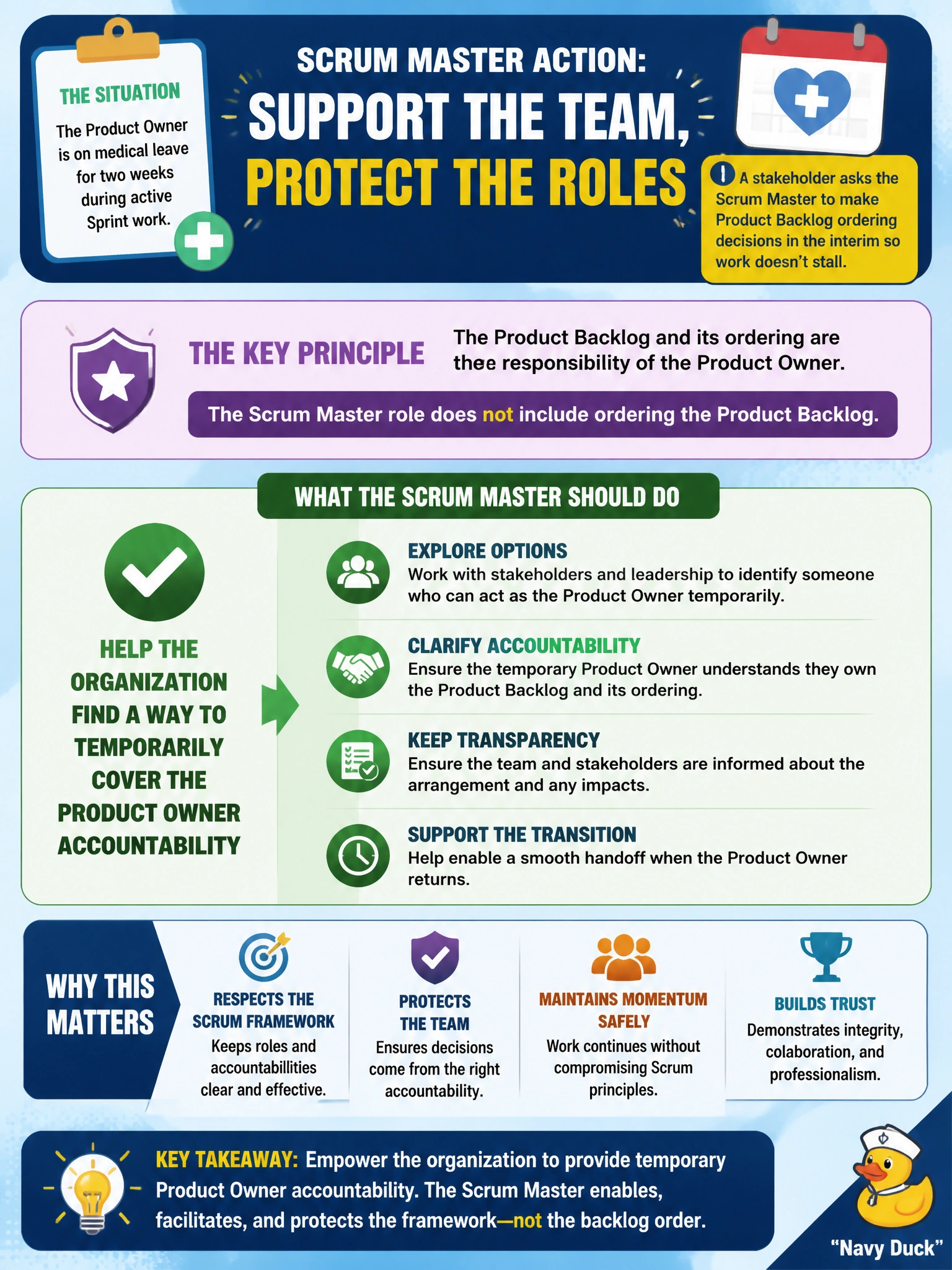
A robotics company's Product Owner is on medical leave for two weeks during active Sprint work. A stakeholder asks the Scrum Master to make Product Backlog ordering decisions in the interim so work doesn't stall. What should the Scrum Master do?
Select an answer to reveal the explanation.
Short Explanation
A vacancy in one accountability doesn't get quietly absorbed into a different one. The Scrum Master's job here is to help the organization figure out coverage — maybe a delegate, maybe a stand-in with real authority — not to start wearing the Product Owner's hat because it's convenient and they happen to sit nearby.
Full Explanation
The Scrum Master's accountability is serving the Scrum Team, the Product Owner, and the organization — including helping the organization understand and enact Scrum, which covers finding a way to cover a temporarily absent accountability. It does not include personally absorbing the Product Owner's ordering authority, since the accountabilities in Scrum are deliberately distinct and not interchangeable just because someone is unavailable. Taking over the Product Backlog directly blurs that line and risks the Scrum Master making value-tradeoff decisions they aren't positioned to own, even with a good working relationship with the absent Product Owner. Letting the Developers vote on ordering conflates their accountability — how to build the Increment — with a decision that belongs to Product Backlog management. Freezing all refinement is also the wrong instinct: work and learning don't need to stop just because one accountability is temporarily uncovered; the organization can name a delegate with real Product Owner authority. A practical check: whoever is filling in should have the same authority a Product Owner has — if the fill-in still needs sign-off, the gap hasn't actually been covered.