
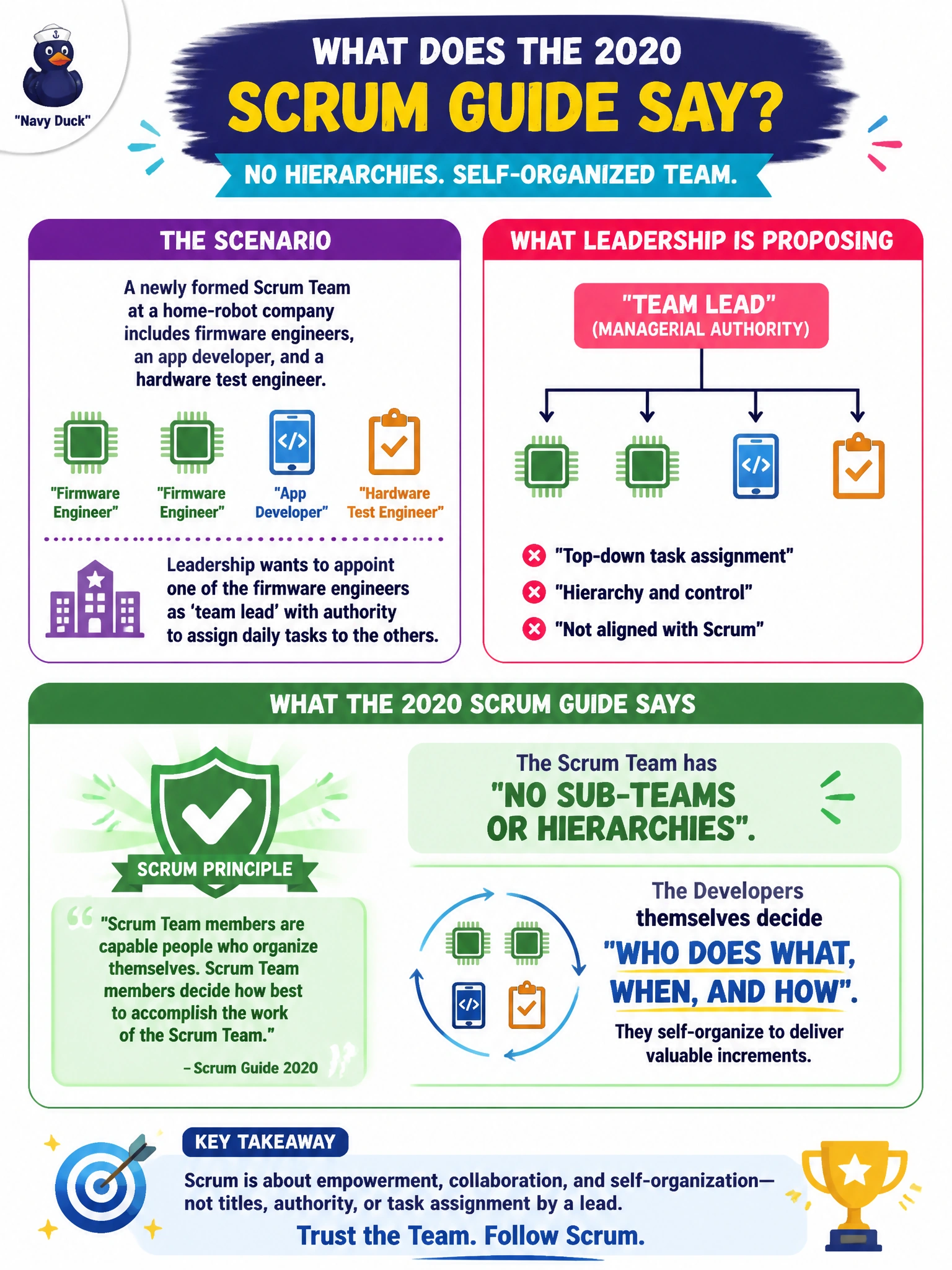
A newly formed Scrum Team at a home-robot company includes firmware engineers, an app developer, and a hardware test engineer. Leadership wants to appoint one of the firmware engineers as 'team lead' with authority to assign daily tasks to the others. What does the 2020 Scrum Guide say about this?
Select an answer to reveal the explanation.
Short Explanation
A Scrum Team isn't a mini org chart hiding inside a bigger one. The Guide is blunt about it: no sub-teams, no hierarchy — just Developers who self-manage and sort out who does what. Slapping a 'lead' title with task-assignment power on someone quietly reintroduces the boss role Scrum deliberately left out.
Full Explanation
The 2020 Scrum Guide states plainly that the Scrum Team is a cohesive unit of professionals with no sub-teams or hierarchies, and that the Developers are self-managing — they decide internally who does what, when, and how, rather than being assigned work by anyone. Appointing a task-assigning lead recreates a command structure the framework intentionally omits, regardless of who that lead reports to. Routing the arrangement through the Scrum Master doesn't fix it, since the Scrum Master also has no authority to direct the Developers' work — their accountability is coaching and removing impediments, not chain-of-command. Requiring a lead 'once a team is cross-functional' misreads why cross-functional teams exist: the mix of disciplines is precisely what self-management is meant to coordinate without a boss. Product Owner sign-off is irrelevant here too, since the Product Owner's accountability is the Product Backlog and value, not internal team structure. A useful check: watch who actually decides the day's task order — if it's one person by title, self-management isn't really happening yet.