
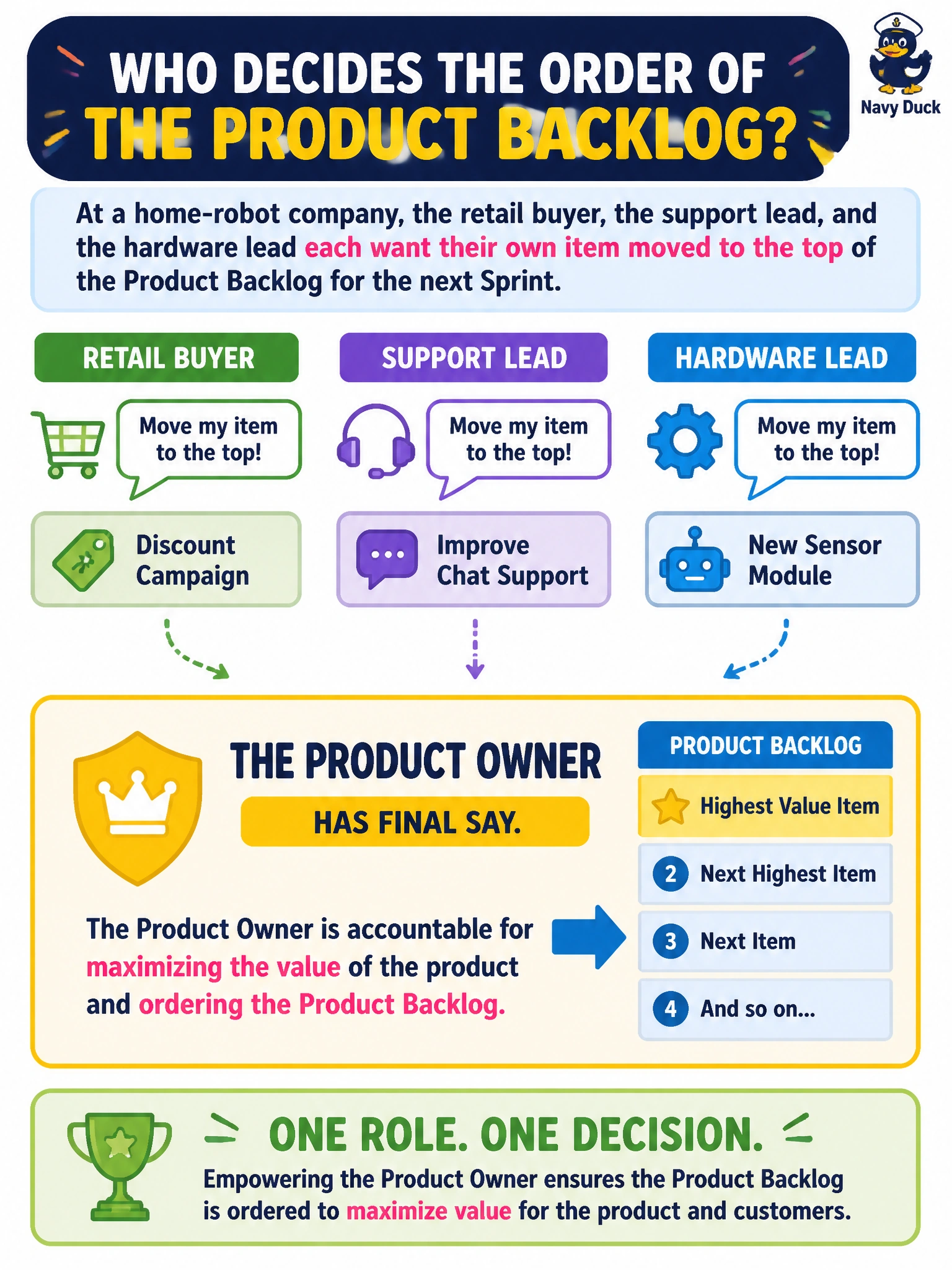
At a home-robot company, the retail buyer, the support lead, and the hardware lead each want their own item moved to the top of the Product Backlog for the next Sprint. Who has final say over the order of the Product Backlog?
Select an answer to reveal the explanation.
Short Explanation
Think of the Product Backlog as a single ranked to-do list with exactly one owner's pen on it. Stakeholders can lobby all they want, but the Product Owner is the one who actually moves lines up or down. Everyone else can influence the order; only they decide it.
Full Explanation
The 2020 Scrum Guide names the Product Owner as accountable for maximizing the value of the work the Scrum Team does, and Product Backlog ordering is the primary lever for that. Stakeholder requests, retail dates, and hardware constraints are all real inputs, but they are inputs to one decision-maker, not a vote. The Scrum Master option fails because facilitation is a process role, not a value-maximization accountability — a Scrum Master can coach the Product Owner on techniques for ordering, but does not own the order. The Developers option fails because their accountability is how work gets built and whether the Sprint Backlog plan is sound, not what business value ranks highest. The 'most urgent stakeholder' option describes exactly the chaos the Product Backlog exists to prevent: without a single accountable owner, the backlog becomes whoever shouted last. Operationally, check who can actually re-rank the Product Backlog and have it stick across teams — if it takes a committee vote, the accountability has drifted from where the Guide places it.