What is the primary objective of implementing a continuous monitoring process within a corporate compliance framework?
Select an answer to reveal the explanation.
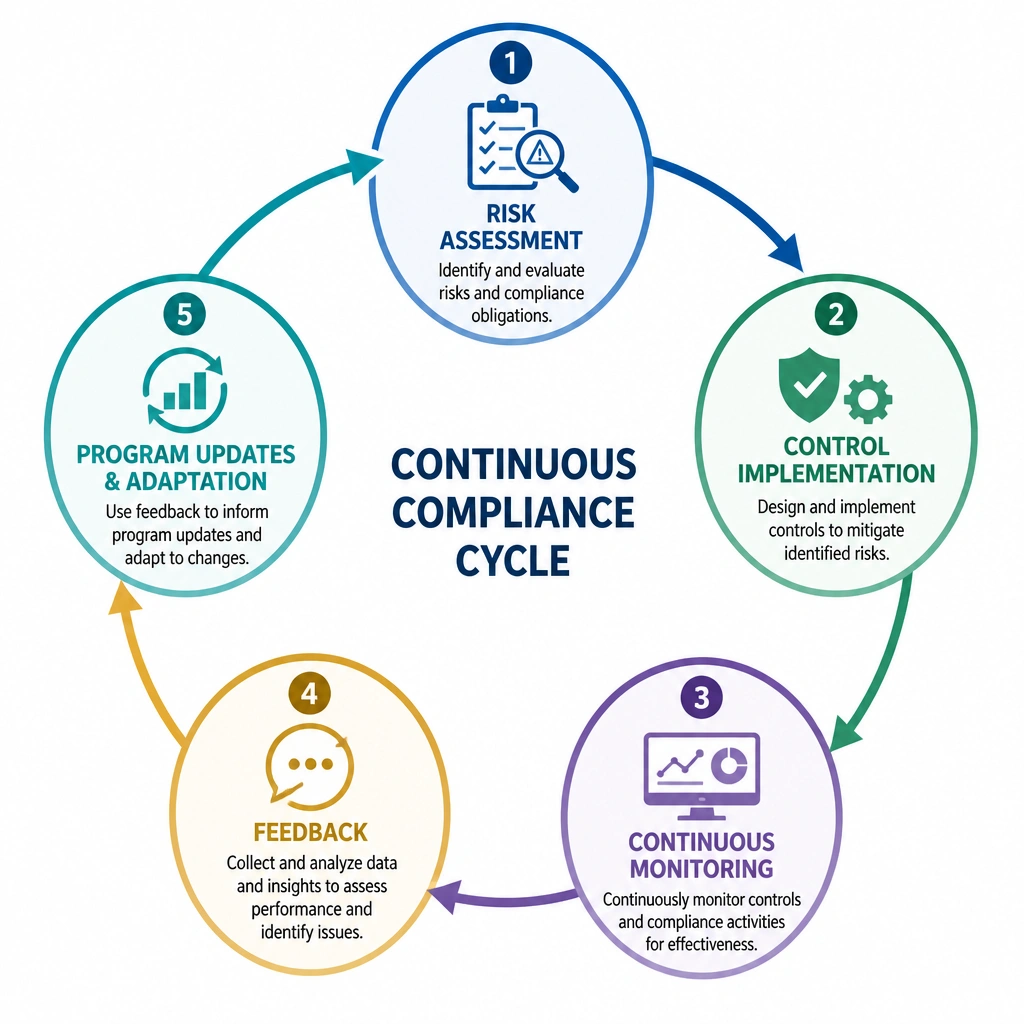
Short Explanation and Infographic
Let's dive into this one: think of continuous monitoring like the dashboard in your car. It’s constantly checking the engine temp, tire pressure, and oil levels while you drive. Why? Because you want to catch a leak before your engine blows up on the highway! That's exactly what continuous monitoring does for compliance. It gives you a real-time feedback loop so you can see if your controls are actually working and tweak things as new risks pop up. Now, some people confuse monitoring with auditing, but monitoring does not replace internal audits. Audits are independent, periodic spot-checks. And we definitely aren't doing this just to punish employees for minor slips—that would kill your company culture. Finally, no program can guarantee 100% compliance at all times; that's just not realistic. Continuous monitoring is all about staying proactive and agile.
Full explanation below image
Full Explanation
Continuous monitoring is an ongoing management control process designed to evaluate the operational effectiveness of compliance controls, identify transaction anomalies, and spot process deviations in real time. It is a critical component of a mature compliance program, as recognized by COSO and regulatory authorities. The primary goal of continuous monitoring is to provide a constant feedback loop. By analyzing operational data continuously, management can quickly identify when controls are failing or when changes in the internal or external environment have created new risks. This allows the organization to dynamically adjust policies, update training, and patch control gaps before significant compliance breaches occur. Let's analyze the incorrect choices: - Option A is incorrect because continuous monitoring is a management function and does not replace internal auditing. Internal audit is an independent, third-line defense function that objectively evaluates the effectiveness of management’s first- and second-line controls, including monitoring systems. - Option B is incorrect because using monitoring primarily as a punitive tool for minor mistakes creates a toxic culture, discourages transparency, and prevents employees from reporting serious risks. - Option C is incorrect because no compliance program can provide absolute, 100% assurance of compliance. Compliance frameworks aim to provide reasonable assurance, acknowledging that human error, collusion, and unforeseen risks cannot be completely eradicated. Therefore, continuous monitoring serves as a proactive steering mechanism that keeps the compliance program aligned with the company's risk landscape.