
If senior leadership and middle management fail to actively and visibly advocate for the company's compliance program, what is the most significant risk to the organization?
Select an answer to reveal the explanation.
Short Explanation
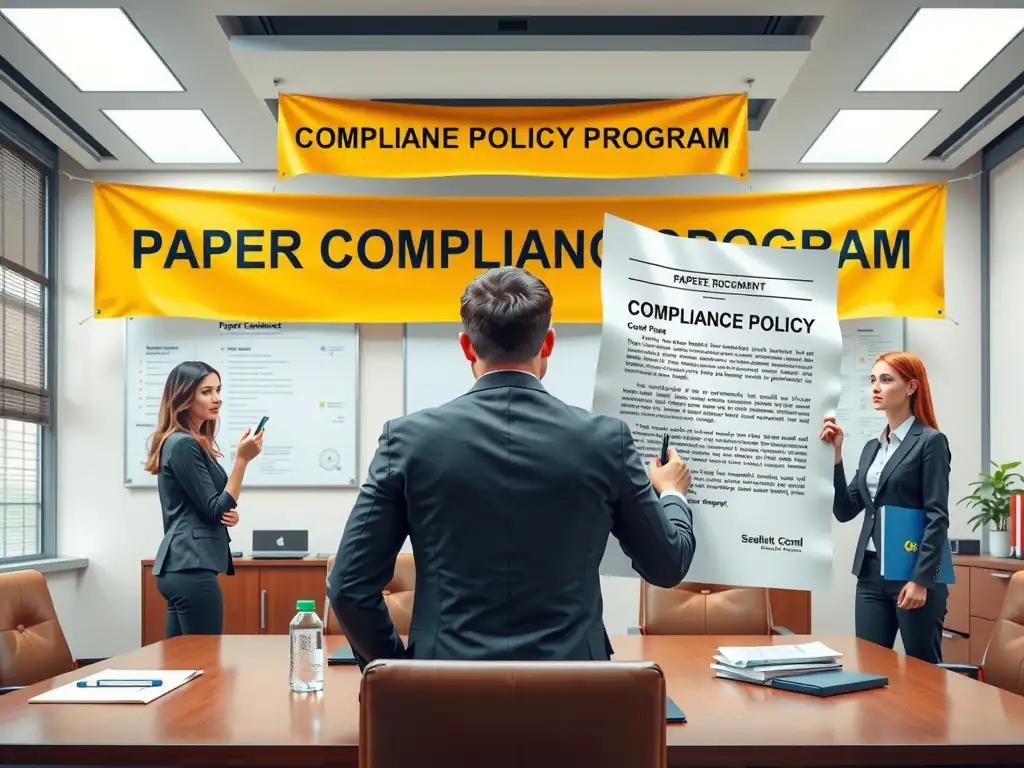
If leadership doesn't walk the walk, employees see compliance as a paper-shuffling bureaucratic exercise, not a real priority. They'll click through training, keep cutting corners, and the program dies. You need visible tone at the top and middle, or nobody else will care.
Full Explanation
The 'tone at the top' and the 'tone in the middle' are fundamental to establishing an ethical corporate culture. Regulatory agencies, such as the United States Department of Justice, evaluate whether senior management and middle managers inspire compliance and lead by example. If leadership fails to visibly support and prioritize compliance, the program is highly likely to be viewed by the workforce as a 'paper program'—a bureaucratic exercise designed solely to limit organizational liability rather than a core business value. This lack of management buy-in undermines the legitimacy of policies, decreases employee engagement with compliance training, and increases the likelihood that staff will bypass controls to meet performance targets. The idea that written policies will fail to meet standard legal formatting and structural rules is incorrect because legal formatting is an administrative detail that is unaffected by management's public support. The correct risk is that the program will be perceived by employees as a mere paper-shuffling bureaucratic exercise rather than an operational priority. The claim that the cost of purchasing compliance training software will automatically double due to vendor penalties is incorrect because vendor pricing structures for training software are independent of corporate management's internal advocacy. The assertion that the compliance department will be legally restricted from conducting any further internal audits is incorrect because the legal authority of the compliance department to conduct audits is established by the board-approved charter, not the daily visibility of management's support.