When establishing a third-party compliance program, which of the following represents a critical due diligence pitfall that compliance professionals must avoid?
Select an answer to reveal the explanation.
Short Explanation and Infographic
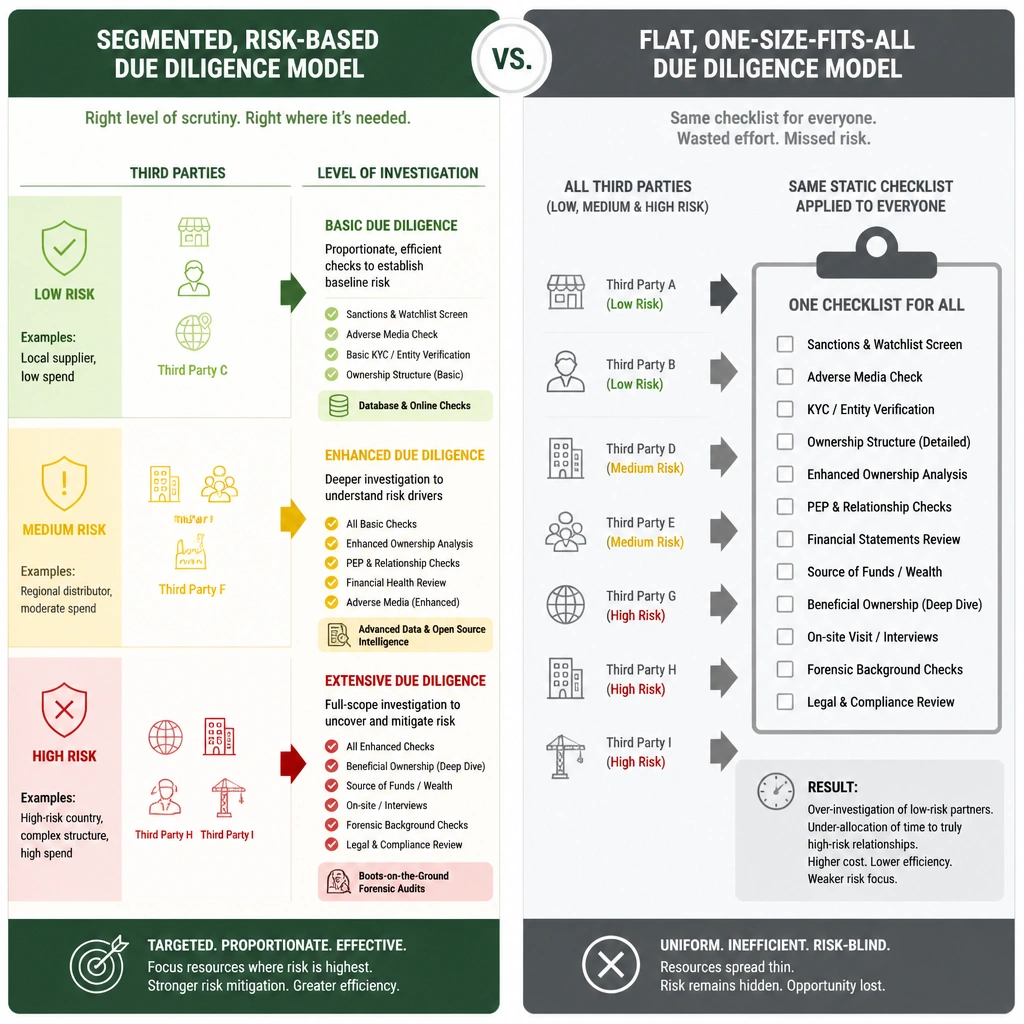
Here's the deal: imagine your boss walks in and tells you to run the exact same security audit on a local mom-and-pop office supply vendor that you would run on a multi-million dollar software vendor handling all your customers' private data. That would be a massive waste of time and money, right? In the compliance world, we call this the "one-size-fits-all" trap, and it bites companies hard. If you treat a low-risk local vendor the same as a high-risk offshore partner, you're going to burn through your budget and miss the actual red flags where they matter most. You've got to tailor your due diligence. Assess the risk first, then apply the right level of scrutiny. Don't check every single box for everyone just to say you did it—be smart and focus your resources where the real danger lies.
Full explanation below image
Full Explanation
Effective third-party risk management is built on the principle of proportionality. A common and significant pitfall in due diligence processes is adopting a static, standardized approach—often referred to as a "one-size-fits-all" methodology—that applies the same level of scrutiny to every vendor, partner, or agent. This approach is highly inefficient and dangerous. It fails to distinguish between low-risk suppliers (such as a local office supply company) and high-risk intermediaries (such as a customs clearance agent operating in a high-corruption jurisdiction). Without risk-based tiering, compliance resources are misallocated, and critical red flags associated with high-risk relationships can easily be overlooked.
Let's review the other options: - Option A is incorrect because adapting the due diligence process to the risk profile of the third party is a recognized best practice, not a pitfall. It ensures that higher-risk entities receive deeper screening (e.g., beneficial ownership verification, political exposure checks) while lower-risk entities undergo simplified vetting. - Option C is incorrect because performing due diligence at the inception of the relationship—before any contracts are executed—is the proper sequencing. Initiating relationships before performing due diligence exposes the company to immediate legal and reputational liability. - Option D is incorrect because involving a cross-functional team of experts (such as legal counsel, forensic accountants, and compliance officers) is a strength. It ensures that different dimensions of risk (e.g., bribery, financial insolvency, sanctions) are thoroughly evaluated.
Regulators, including the U.S. Department of Justice (DOJ), explicitly state that effective compliance programs must apply risk-based due diligence. A program that treats all third parties identically is likely to be deemed ineffective during a regulatory review.